Ninety Climbers Scale Kurdistan's Highest Peak in Festival Blending Sport and Environmental Stewardship
Kurdistan mountaineering & Climbing Federation held an intensive winter training camp and sports festival on the region's highest peak, weaving avalanche safety skills together with a philosophy of environmental stewardship
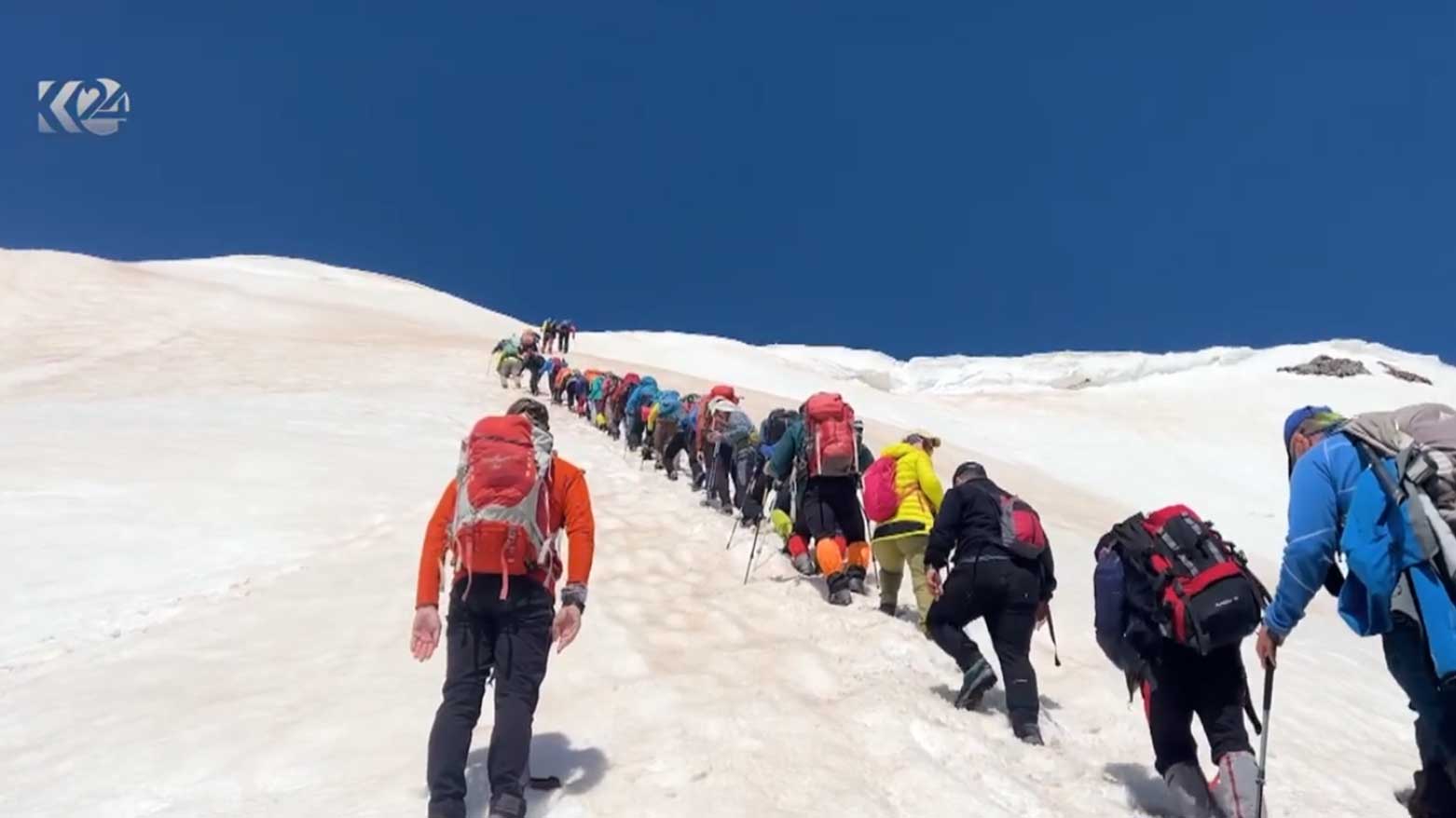
ERBIL (Kurdistan24) - At 3,607 meters above sea level, Mount Halgurd stands as the highest point in the Kurdistan Region, a wall of rock and snow that demands respect from anyone who approaches it.
It was on those slopes that the Kurdistan mountaineering & Climbing Federation recently gathered 90 climbers from across Eastern Kurdistan (Western Iran) and Kurdistan Region for an intensive training camp and sports festival, turning the mountain into both a classroom and a stage for a broader message: that the natural world is not simply a backdrop for adventure, but a responsibility to be carried back down into daily life.
The event combined rigorous practical training in winter mountaineering with an explicit focus on environmental awareness and conservation, framed in the language of international standards for nature protection.
Snow avalanche and slip accidents represent one of the most serious hazards in high-altitude mountaineering, and the festival placed this challenge at the center of its training curriculum. Participants received hands-on instruction in route-finding across snowfields and icy surfaces, body control techniques, and — critically — how to arrest a fall before it becomes a catastrophe.
Siamand Jafar, a trainer with the Federation, explained the urgency behind the curriculum.
"The importance of snow training - especially in the spring season - lies in avoiding the accidents we have witnessed in previous periods," he said.
"We teach participants how to walk safely on soft snow and icy surfaces, how to control and stabilize the body in the event of a slip to avoid serious accidents, as well as providing them with the knowledge and experience endorsed by the Federation to raise their efficiency and develop their skills."
The timing of such training is not incidental. Spring, when snow softens and becomes less predictable, is among the most dangerous seasons for mountain climbers — a fact that gives the festival's emphasis on practical skill its particular weight.
The Mountain as Teacher
Beyond technique, the festival carried a philosophical dimension that its participants articulated with striking clarity.
For the organizers and climbers alike, the mountain is not merely a physical challenge but an education in values, in humility, in generosity, and in the fragility of what human beings too often take for granted.
Climber Hamed Asrari drew on that philosophy directly.
"When a green blade of grass grows and gives oxygen to a human being, it does not think about whether that person is male or female, or what religion or faith they belong to — it offers us a profound lesson in unconditional giving and love," he said.
"We try to pass on this lesson, which we have learned from nature, to its visitors, to encourage them to treat the environment with that same gentleness and love."
It is a framing that deliberately elevates environmentalism from policy into something closer to ethics, a set of obligations owed not to governments or institutions, but to the natural world itself.
Climber Abdullah Raqib pushed that argument further, casting environmental destruction in explicitly intergenerational terms.
"We are merely guests in this nature, and if we come and cannot preserve it as it is, it is better that we do not come at all," he said. "Destroying nature in Kurdistan is destroying the homes and rights of future generations — not only the destruction of our present and our current generation."
The organizers were careful to frame mountaineering not as an extreme sport pursued for its own sake, but as a discipline with interior dimensions — one that cultivates psychological calm, self-discipline, and a capacity for wonder.
Camping overnight on Halgurd's slopes in sub-zero temperatures was not incidental to the experience; it was central to it, stripping away comfort and forcing a reckoning with nature on its own terms.
As the 90 participants pushed through the white slopes toward Halgurd's summit, the organizers described the scenes at the peak as ones of stillness and beauty, a reward, in the language of mountaineering, proportionate to the effort required to reach it.
Whether that combination of physical rigor, environmental advocacy, and reflective philosophy can translate into lasting behavioral change, in how Kurdistani citizens and visitors relate to their natural landscape, remains the deeper question the festival poses. Mount Halgurd offered the stage. What its climbers carry back down with them is what will matter most.