Former Turkish PM Highlights President Barzani’s Unmatched Strategic Leadership
The former Turkish prime minister praised the Kurdistan Region's balanced policies, highlighted his longstanding relationship with President Masoud Barzani, and described Erbil as a key regional actor during an interview with Kurdistan24.
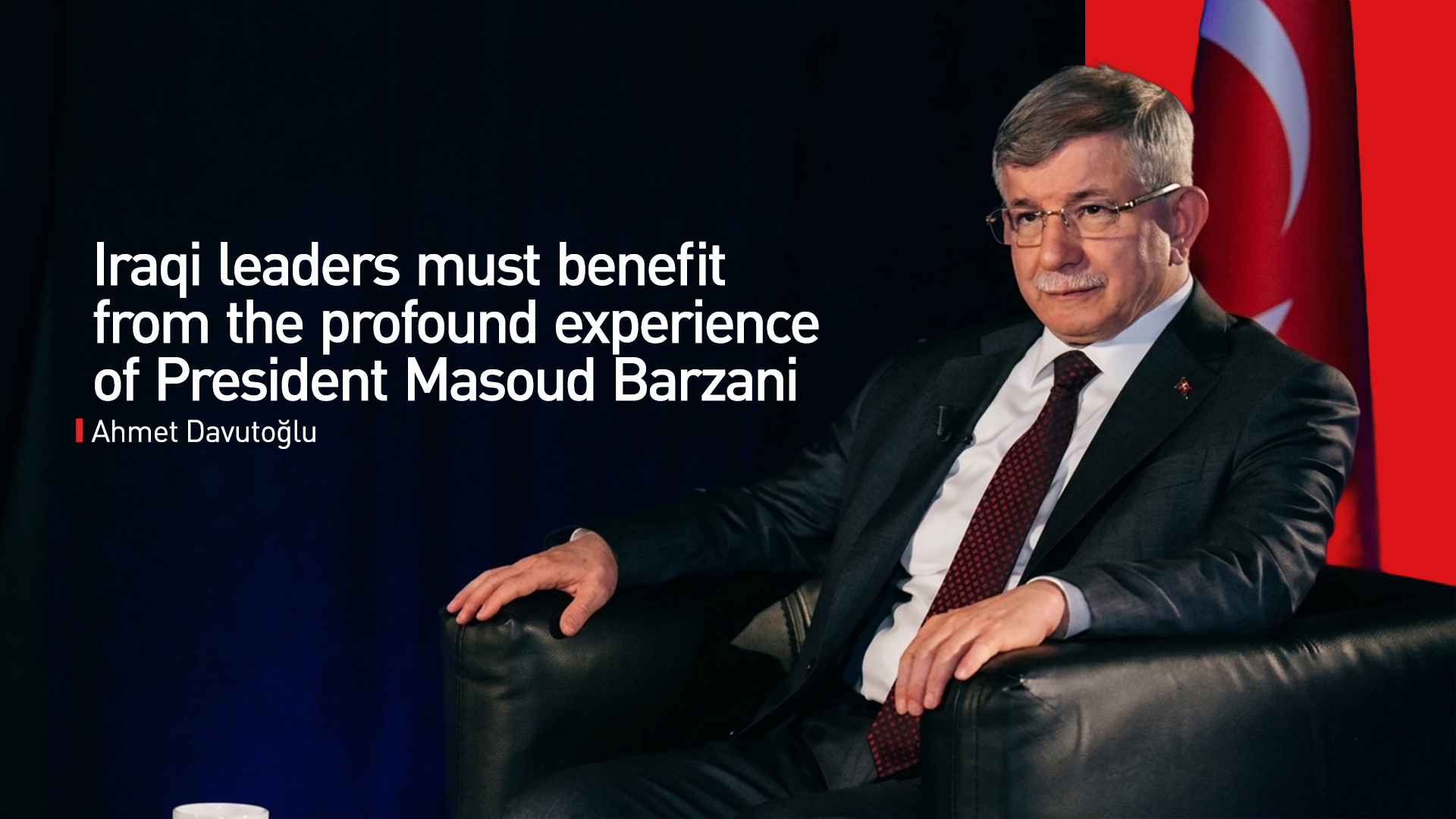
ERBIL (Kurdistan24) - Former Turkish Prime Minister and Future Party leader Ahmet Davutoğlu said he and President Masoud Barzani have stood side by side through some of the region's most challenging moments, praising the Kurdistan Region's neutral stance amid current regional conflicts and describing Barzani's decisions as a protective shield that kept the Kurdistan Region away from war.
Speaking in an exclusive interview with Kurdistan24, presented by Zhino Mohammed on Tuesday, Davutoğlu reflected on his latest visit to the Kurdistan Region, his meetings with Kurdish leaders, and his assessment of the political and security challenges facing the Middle East.
Meetings with President Barzani and Prime Minister Barzani
Davutoğlu expressed happiness about returning to Erbil, describing the visit as "coming back home." He noted that over the past two years he has visited Erbil, Sulaimani, and Duhok four times for consultations and participation in various forums.
Discussing his meetings with President Masoud Barzani and Kurdistan Region Prime Minister Masrour Barzani, Davutoğlu said he held a two-hour meeting with the prime minister and a one-and-a-half-hour meeting with President Barzani.
"We have a friendship that spans 24 years, and during difficult times we have always supported one another," he said.
According to Davutoğlu, the discussions focused on global developments, the consequences of US and Israeli strikes against Iran, the impact of regional conflicts, and relations between Türkiye, Iraq, and the Kurdistan Region.
Support for Erbil's neutral policy
Davutoğlu voiced strong support for the Kurdistan Region's neutral position regarding the current regional conflict, describing the policy as "very correct."
"The Kurds paid the highest price in previous wars, especially during the Iran-Iraq war and the Halabja tragedy," he said. "Maintaining neutrality at this stage prevents those tragedies from being repeated."
He also praised President Barzani's historical experience, describing him as one of the few active regional leaders who has witnessed every major transformation since Iraq's invasion of Kuwait in 1990.
Davutoğlu argued that President Barzani's experience has helped prevent Iraqi Kurds from becoming instruments in regional power struggles and has enabled the Kurdistan Region to remain distant from war and instability.
"President Barzani protected the Kurdistan Region through wise decisions," he said.
Erbil, Kirkuk, and coexistence
Highlighting Erbil's regional significance, Davutoğlu said the city holds an influential position in the Middle East and reiterated his personal attachment to it.
"I call myself Ahmed Erbili," he said, emphasizing his longstanding connection with the city and its people.
On ethnic and social diversity, he stressed that different communities in Türkiye and the Kurdistan Region should never be viewed as threats to security, but rather as sources of cultural and social strength.
Referring to Kirkuk, Davutoğlu described the city as "a small Iraq" because of its diverse communities. He noted that the city currently has a Turkmen governor and characterized this as an example of participation and representation among different groups.
He also spoke positively about the situation of Turkmens in the Kurdistan Region, saying they live in a favorable environment shaped by stability and coexistence.
Peace process and Türkiye-Kurdistan Region relations
Davutoğlu described Türkiye and the Kurdistan Region as strategic partners and close friends whose cooperation serves mutual political, economic, and security interests.
Addressing the peace process, he said peace remains a serious and important issue and argued that the process has already made meaningful progress that could benefit both sides.
He also called for removing restrictions on the Kurdish language and allowing its broader use across all areas of public life. In addition, he advocated ending the trustee appointment system and called for a democratic, non-discriminatory constitution.
Iraq's politics and the future of armed groups
Commenting on Iraq's political landscape, Davutoğlu said the country's new prime minister had delivered positive messages aimed at moving beyond sectarian divisions, despite being relatively new to politics.
Davutoğlu stressed the importance of maintaining strong Kurdish representation in Baghdad and said the Kurdistan Democratic Party should continue playing an influential role in Iraqi politics.
"There is no Iraqi leader with experience comparable to President Barzani's," he said, adding that Iraqi political leaders should benefit from Barzani's experience.
He also called on the Kurdistan Democratic Party and the Patriotic Union of Kurdistan to set aside differences and work together in Baghdad, while expressing hope that the Kurdistan Region's tenth cabinet would be formed soon.
Turning to security issues, Davutoğlu said the future of Iraq depends on addressing the presence of armed groups.
"Where there is an official army, there should not be armed groups," he said, arguing that disarmament or the dissolution of such groups is essential for restoring stability, encouraging economic development, and attracting investment.
Kurdish identity and a final message
Speaking about Kurds, Davutoğlu rejected portrayals of Kurds as violent.
"Anyone who describes Kurds as violent does not truly know them or understand their character," he said. "But anyone who says Kurds are courageous has understood them well, because courage and generosity are among the defining characteristics of the Kurdish people."
Concluding the interview, Davutoğlu thanked Kurdistan24 and its audience for the opportunity to discuss key regional issues and praised the questions raised during the conversation.
Addressing presenter Zhino Mohammed in his closing remarks, he said: "God willing, in our next interview I will speak with you in Kurdish."