Millions Join Ali Khamenei Funeral Procession in Tehran
According to Agence France-Presse, the funeral of Iran's slain Supreme Leader has evolved into a carefully choreographed display of national unity, succession, and strategic messaging at a pivotal moment for the Islamic Republic.
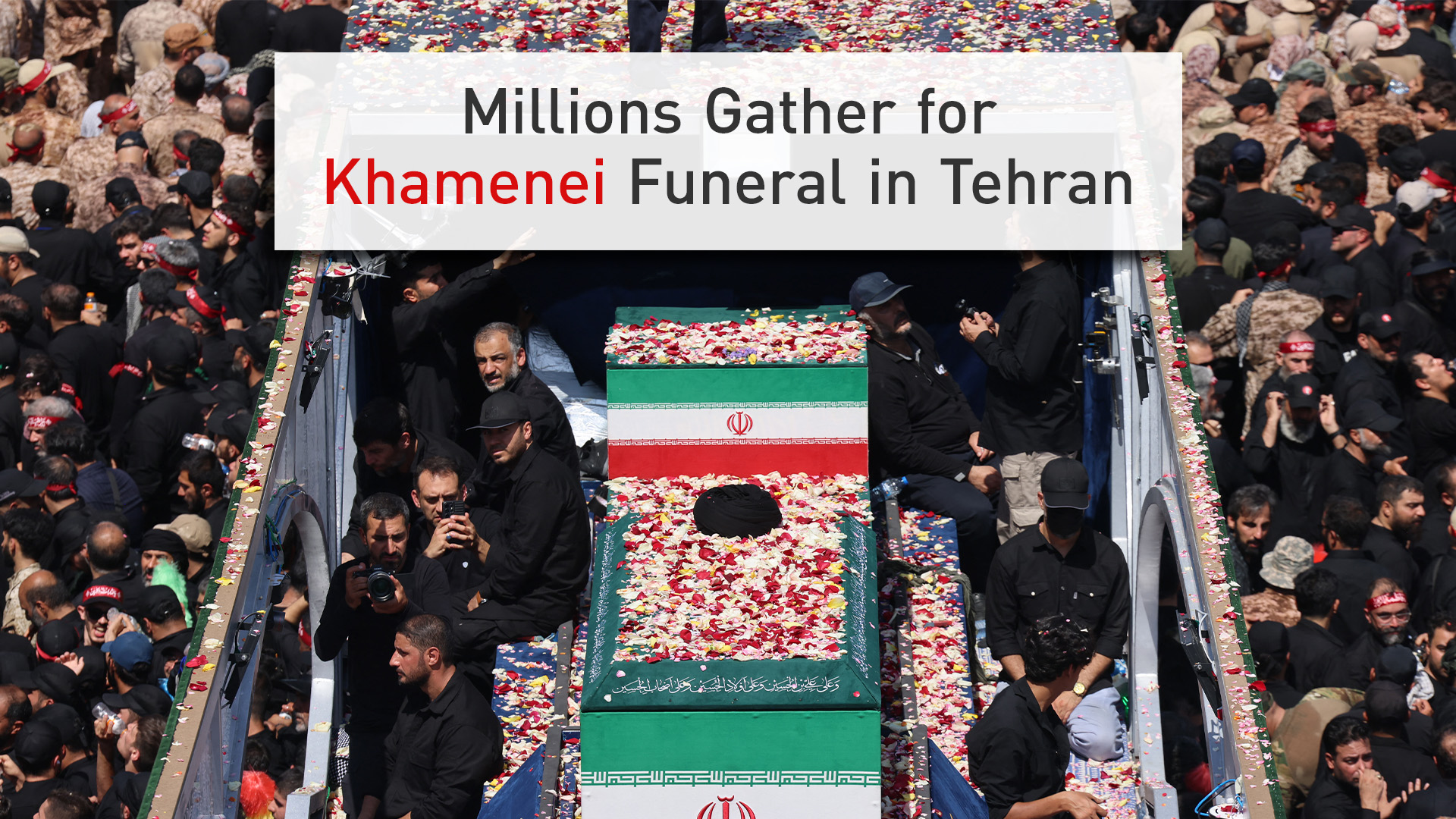
ERBIL (Kurdistan24) - Millions of mourners filled Tehran's streets on Monday for the funeral procession of Iran's slain Supreme Leader Ali Khamenei, transforming a state funeral into one of the Islamic Republic's most consequential political moments in decades.
According to Agence France-Presse (AFP) and correspondent Payam Doost Mohamadi, Iranian authorities view the ceremonies not only as a tribute to the country's longtime leader but also as an opportunity to demonstrate institutional resilience following weeks of war with Israel and the United States.
The scale of the turnout underscored the event's significance beyond its ceremonial role.

While Iranian officials had not released an official attendance figure, AFP reported that crowds stretched across major boulevards in the capital, with authorities hoping participation would rival the funeral of Ruhollah Khomeini in 1989.
That funeral, remembered as one of the largest public gatherings in modern history, remains a defining symbol of the Islamic Republic's revolutionary legitimacy.
This year's procession unfolded under markedly different circumstances.

It followed a five-week conflict involving Iran, Israel, and the United States that culminated in Khamenei's death and left the country's leadership confronting questions over succession, regional deterrence, and domestic stability.
Against that backdrop, the funeral has become a closely watched indicator of how Tehran intends to project continuity during one of the most sensitive political transitions since the Islamic Republic was founded.
According to AFP, Khamenei's coffin departed Tehran's Grand Mosalla religious complex after lying in state for two days, with mourners lining a route of roughly 20 kilometers through the capital.

Authorities implemented extensive crowd-control measures, including barriers around the coffin, reflecting lessons learned from the chaotic funeral of Khomeini nearly four decades ago, when overcrowding caused fatalities and injuries before security forces ultimately resorted to transporting the body by helicopter for burial.


Security precautions extended beyond the procession itself.
AFP reported that Tehran's airspace was closed as ceremonies took place, while organizers distributed flags and portraits of Khamenei and his successor, Mojtaba Khamenei.
Water trucks were deployed to cool mourners during intense summer temperatures as state institutions sought to manage what had become one of the largest public events in recent Iranian history.
The funeral has also highlighted the unusual dynamics surrounding Iran's leadership transition.
Although three of Ali Khamenei's sons appeared publicly during earlier ceremonies, AFP reported that Mojtaba Khamenei has not appeared in public since assuming the position of supreme leader following his father's death.

Iranian officials have said he was injured during the strikes that killed his father, though the extent of those injuries remains unclear.
The absence has intensified international interest in how Iran's new leadership intends to establish public authority while maintaining continuity across the country's political and security institutions.
At the same time, the appearance of senior military figures, including Ahmad Vahidi and Esmail Qaani, according to AFP, served as a visible reminder that the country's military leadership continues to project cohesion following heavy wartime losses.

Beyond domestic politics, the funeral has carried a clear regional dimension. AFP reported that mourners displayed Iranian flags alongside those of the Lebanese group Hezbollah and carried red banners associated with calls for revenge.
Delegations representing both Hezbollah and Hamas attended the ceremonies, reflecting Tehran's longstanding relationships with regional armed groups that remain central to Iran's strategic posture across the Middle East.
Those images are likely to be scrutinized well beyond Iran's borders.
For policymakers in Washington, Jerusalem, and Gulf capitals, the funeral offers early indications of how Iran intends to balance leadership succession with deterrence following the recent conflict.

The event also unfolds while a ceasefire remains in place and preliminary understandings with the United States continue to leave open the possibility of future negotiations alongside persistent risks of renewed confrontation.
Governance symbolism has therefore become inseparable from broader geopolitical considerations.
Large public mobilizations in Iran have historically served both domestic and international purposes, reinforcing the state's narrative of continuity while signaling that institutions remain intact despite military and political shocks.

That messaging carries implications for regional security calculations, sanctions policy, proxy dynamics, and energy markets, all of which are closely linked to perceptions of Iran's internal stability.
The funeral route itself extends beyond Tehran.
According to AFP, ceremonies will continue in Qom, followed by commemorations in the Iraqi holy cities of Najaf and Karbala, before concluding with Khamenei's burial in Mashhad.

The multi-city procession reflects both the religious significance of the occasion and Iran's effort to frame the transition as one supported across the broader Shiite religious sphere.
As the ceremonies continue, attention is likely to shift from public mourning to the practical challenges facing Iran's new leadership.
The funeral has offered a powerful display of state organization and political symbolism, but its longer-term significance will depend on how the leadership transition intersects with ceasefire diplomacy, regional security, relations with the United States, and Iran's evolving role in an increasingly volatile Middle East.


|
Summary Millions gathered in Tehran for Ali Khamenei's funeral procession, AFP reported, turning the ceremony into a pivotal moment in Iran's leadership transition after war with Israel and the U.S. The event carries broad implications for regional stability and future diplomacy. |