Iraq, Iran Strengthen Economic Cooperation During Iraqi Premier's Tehran Visit
Iraq and Iran signed four agreements covering transportation, railway connectivity, municipal cooperation and public administration as Prime Minister Ali Falih Al-Zaidi and President Masoud Pezeshkian pledged deeper economic coordination and long-term partnership.
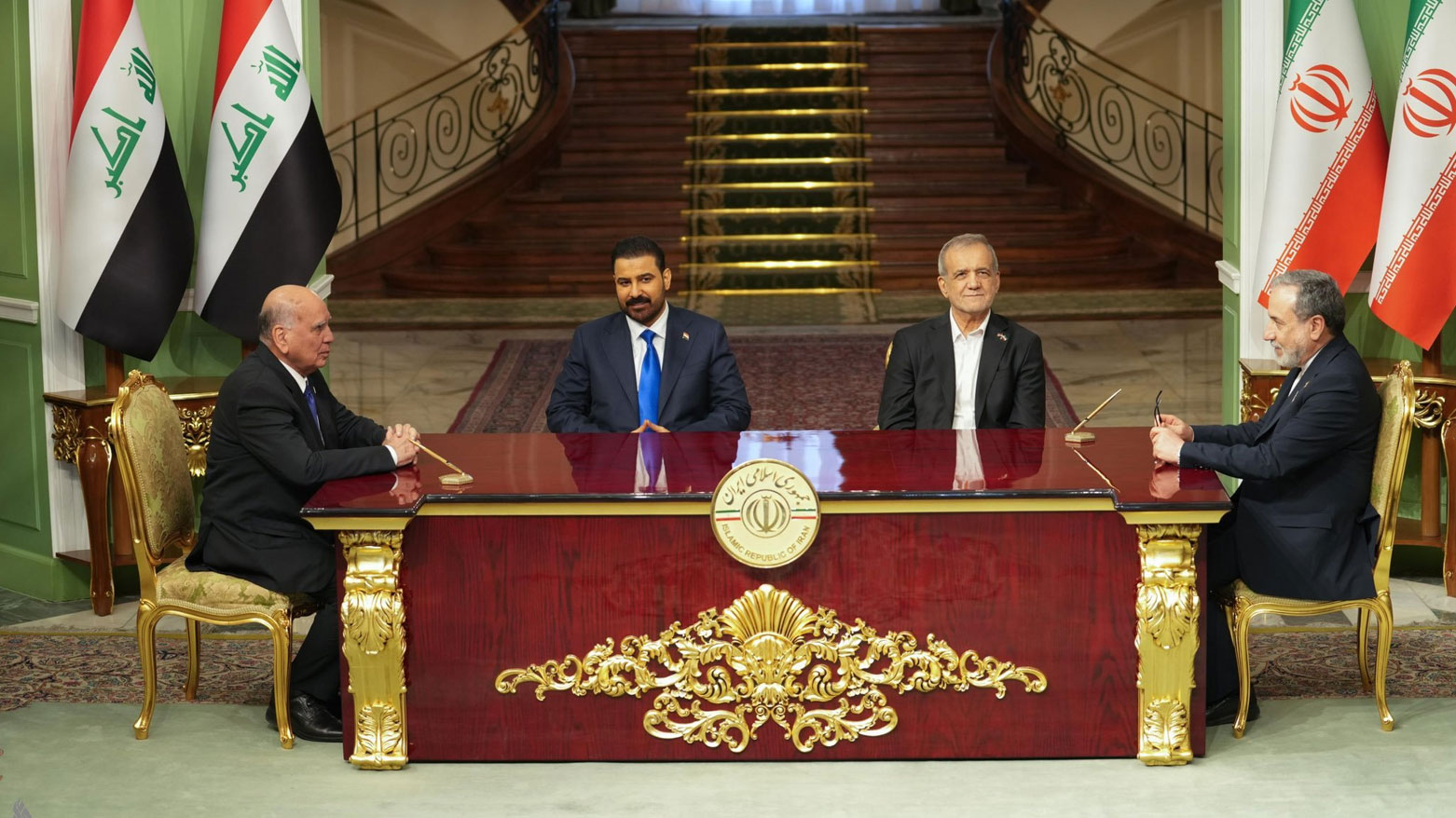
ERBIL (Kurdistan24) - Iraq and Iran have taken another step toward broadening their economic and institutional partnership, signing four agreements and memorandums of understanding during Prime Minister Ali Falih Al-Zaidi's official visit to Tehran, where both governments emphasized closer coordination on infrastructure, investment and regional development.
According to reporting by the Iraqi News Agency (INA), the agreements were signed in the presence of Prime Minister Al-Zaidi and Iranian President Masoud Pezeshkian, underscoring a shared effort to translate long-standing political ties into practical cooperation across key sectors.
Rather than focusing on a single initiative, the package spans transportation, municipal governance and public administration, reflecting a wider strategy aimed at strengthening economic links while improving institutional collaboration between the neighboring countries.

Among the most significant projects is a memorandum of understanding to develop a railway connecting Kermanshah and Khosravi in western Iran with Khanaqin and Baghdad.
The proposed corridor is expected to enhance cross-border connectivity and support the movement of passengers and goods, adding a new dimension to broader regional transportation networks.
The two governments also concluded an agreement covering international land freight and cargo transport, a move intended to facilitate commercial exchanges and improve logistics between Iraq and Iran.
Additional memorandums established cooperation between the municipalities of Baghdad and Tehran and outlined collaboration in public administration and human resources training, highlighting an effort to expand engagement beyond traditional economic sectors.

According to INA, the Iraqi side was represented during the signing ceremony by the ministers responsible for foreign affairs and electricity, along with the acting ministers of finance and planning.
The agreements followed broader bilateral talks led by Al-Zaidi and Pezeshkian, where discussions extended beyond the newly signed documents to encompass future mechanisms for economic coordination and regional cooperation.
A central topic was the activation of an operational framework for the Iraqi-Iranian Joint Economic Committee, which both sides view as an important platform for coordinating future initiatives and monitoring the implementation of bilateral projects.
During the discussions, Al-Zaidi described his visit as evidence of the enduring relationship between Baghdad and Tehran, saying it reflects both the depth of existing ties and a renewed commitment to expanding cooperation.
He characterized the relationship as one shaped by longstanding historical, cultural and geographical connections while emphasizing that the visit was intended to address issues affecting both countries and the wider region.

The Iraqi prime minister also called for broader joint investment across multiple sectors, arguing that closer economic cooperation can generate opportunities benefiting both nations while reinforcing long-term development objectives.
Security cooperation likewise featured prominently in the talks.
Al-Zaidi stressed that Iraq would not allow its territory to be used for threats against Iran, describing the security interests of the two countries as closely interconnected.
He also recalled Iran's support for Iraq during the conflict against the ISIS terrorist organization, presenting that experience as part of the broader foundation underpinning bilateral relations.
For his part, President Pezeshkian highlighted what he described as the strong social and historical links between the Iraqi and Iranian peoples. He also underscored the importance of preserving regional security, arguing that stability creates favorable conditions for economic development and expanded cooperation.

The Iranian president further pointed to what he said were significant opportunities for joint investment, echoing Al-Zaidi's emphasis on broadening economic engagement beyond existing levels.
Taken together, the agreements signed in Tehran illustrate an effort by Baghdad and Tehran to deepen cooperation through practical projects alongside continued political dialogue.
While the documents cover distinct sectors, from freight transportation and railway development to municipal partnerships and administrative training, they collectively reflect a broader agenda focused on improving connectivity, strengthening institutions and encouraging long-term economic collaboration.
As Iraq and Iran continue to pursue closer coordination through mechanisms such as the Joint Economic Committee, the latest agreements signal a shared intention to build a more structured framework for bilateral engagement, with infrastructure, investment and institutional cooperation positioned at the center of that evolving relationship.
|
Summary Iraq and Iran signed four agreements covering transport, rail links, municipal cooperation and public administration as Prime Minister Ali Falih Al-Zaidi and President Masoud Pezeshkian emphasized investment, regional connectivity and stronger long-term bilateral cooperation. |