Trump Says Massive Iran Attack Under Consideration as Regional Tensions Deepen
President Donald Trump said he is nearing a decision on what could become the largest U.S. military strike against Iran, as fighting expands across the Middle East and political opposition grows in Congress.
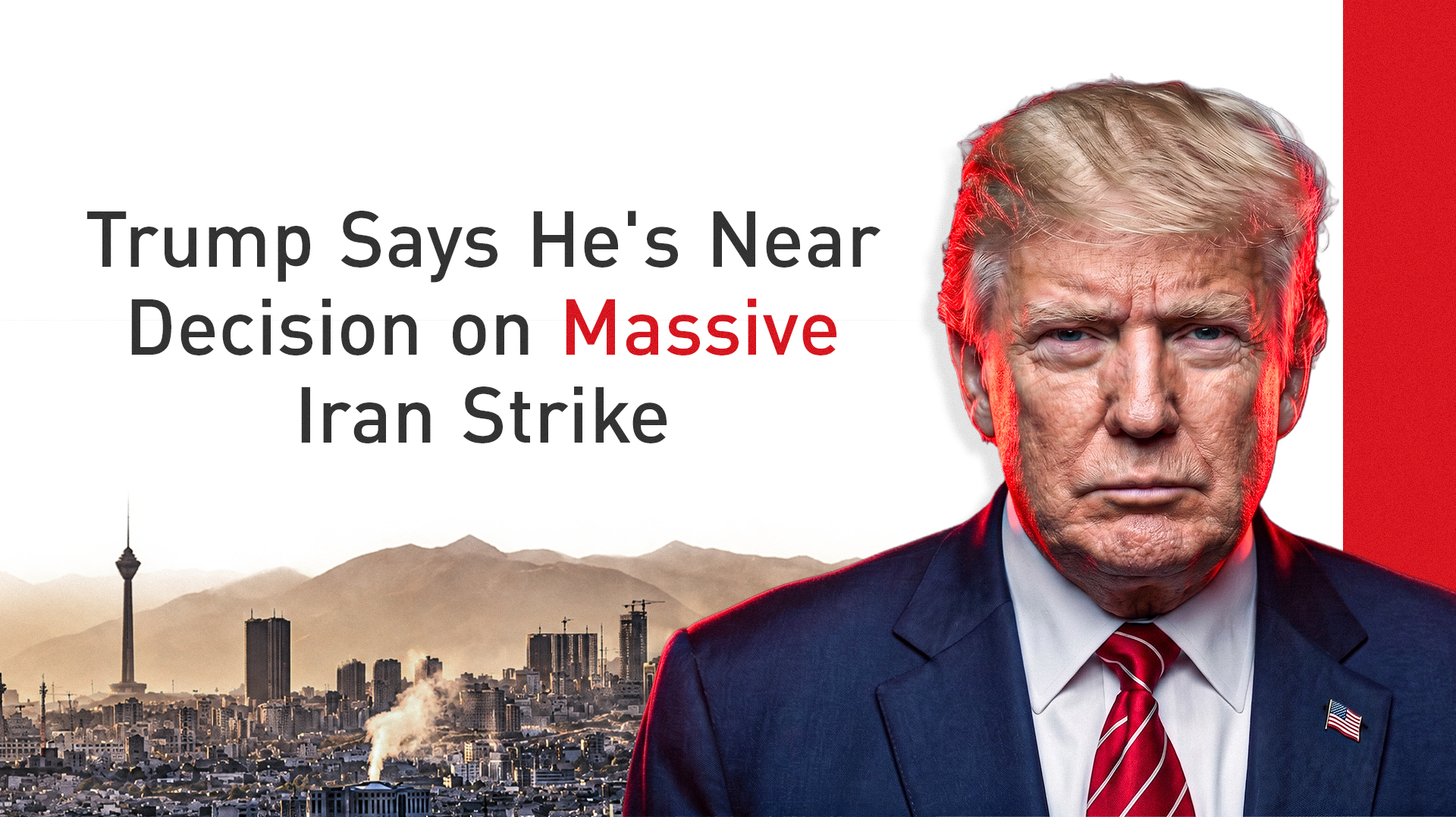
ERBIL (Kurdistan24) - President Donald Trump said he is approaching a decision on what he described as a military operation against Iran that would surpass any previous U.S. action in scale, signaling that Washington may be preparing for another major escalation even as questions persist over whether diplomacy still has room to avert a wider conflict.
Speaking to Axios in remarks reported by The Times of Israel's Lazar Berman, Trump portrayed military pressure, not negotiations, as the immediate priority, arguing that Tehran has yet to absorb sufficient costs to alter its position.
His comments suggest an administration that increasingly views additional force as a prerequisite for renewed diplomacy rather than an alternative to it.
"I am considering a massive attack. Bigger than ever before. I am close to making a decision. We are all set for it," Trump said.
According to the Associated Press (AP), President Donald Trump has repeatedly warned that the United States could strike Iran's deeply buried Pickaxe Mountain nuclear site, located near the Natanz enrichment complex, as tensions between Washington and Tehran persist.
The facility, formally known as Kuh-e Kolang Gaz La, was not targeted during the U.S. Operation Midnight Hammer in the 2025 Iran-Israel conflict, despite nearby Natanz being bombed.
AP reported that the purpose of the underground site remains unclear because inspectors from the U.N.'s nuclear watchdog have never been granted access.
Speaking to reporters at the White House, Trump suggested Iran may have relocated centrifuges to the mountain and warned that the area could soon become a target, asserting there was little Tehran could do to prevent such an attack.
The remarks come at a moment when both the military confrontation and the political debate surrounding it are widening.
On Thursday, the U.S. House of Representatives approved a largely symbolic resolution urging Trump to halt military operations against Iran without explicit congressional authorization, reflecting growing concern in Washington over the expanding conflict.
At nearly the same time, Iranian media reported that a U.S. missile had struck a site near Suza on Qeshm Island in the Strait of Hormuz, underscoring the continued pace of military operations in one of the world's most strategically important waterways.
Although the House measure carries little practical legal force and is unlikely to alter White House policy, the vote illustrated increasing divisions over presidential war powers as military operations continue into their twelfth consecutive night.
The debate has unfolded alongside an increasingly volatile regional security environment, where battlefield developments and domestic political pressures are advancing simultaneously.
Trump's latest comments offered perhaps the clearest indication yet that the administration believes additional military action could strengthen Washington's negotiating position rather than undermine it.
"They haven't received enough pain yet," the president said, arguing that Iran must face greater military pressure before it will seriously consider an agreement.
His remarks marked a notable shift away from expectations that diplomatic channels might soon regain momentum.
Instead, Trump suggested that further coercive action could precede any meaningful negotiations, reinforcing an approach that combines sustained military operations with the prospect of eventual diplomacy.
The president also addressed Israel's possible involvement in any future operation, emphasizing that Washington retains the capability to act independently while portraying Israel as prepared to participate if requested.
"Israel would join in two minutes if I asked them to," Trump said, before adding that "we don't need anybody."
His observation appeared intended to demonstrate both the depth of U.S.-Israeli military coordination and Washington's confidence in its own capabilities.
Trump also suggested that Israeli participation would carry additional consequences, an apparent reference to the likelihood of renewed Iranian retaliation against Israeli territory.
Rather than announcing an imminent strike, however, Trump's comments projected strategic ambiguity.
By emphasizing that a final decision has not yet been made while stressing that preparations are complete, the administration appeared to preserve uncertainty over both the timing and scope of any potential operation.
That uncertainty has become increasingly significant as the broader regional conflict continues to expand beyond direct exchanges between Washington and Tehran.
According to Agence France-Presse (AFP), Iran has continued attacks targeting U.S. military facilities and allied states, while Yemen's Iran-backed Houthi movement has intensified assaults on commercial shipping in the Red Sea, including strikes against Saudi oil tankers.
Those attacks have renewed concerns over the security of maritime trade routes linking Europe, Asia and the Gulf, while keeping attention focused on the Strait of Hormuz, through which a significant share of global energy supplies passes.
Reports from Iranian media that a U.S. missile struck an area near Suza on Qeshm Island further highlighted the continuing military activity around the strategic waterway, although Iranian authorities said they were still assessing the extent of any damage.
The deteriorating security picture has also produced growing international concern over wider economic consequences.
Brent crude briefly climbed above $100 per barrel following attacks on shipping in the Red Sea, while European Central Bank President Christine Lagarde warned that the conflict could increase inflationary pressures.
The International Energy Agency similarly cautioned that persistent disruption to energy flows through the Strait of Hormuz has already begun reshaping global fuel markets, prompting some countries to increase coal consumption as natural gas supplies become more uncertain.
European governments have likewise expressed concern over the conflict's trajectory.
Germany warned that attacks on commercial shipping risk further escalation across the Middle East, while Britain temporarily withdrew its remaining diplomatic personnel from Iran because of the deteriorating security environment.
Military activity has also expanded across the Gulf. Bahrain activated air raid sirens after Iranian attacks targeting U.S. assets, while Jordan and Kuwait reported intercepting Iranian missiles and drones aimed toward their territories.
Against that backdrop, Trump's latest remarks suggest an administration that continues to prioritize military leverage as the principal means of shaping Iran's strategic calculations.
While he stopped short of announcing new action, his insistence that Tehran must endure greater pressure before negotiations can resume indicates that Washington currently sees additional coercion, not immediate diplomacy, as the more likely path forward.
Whether that approach ultimately creates space for negotiations or instead accelerates another phase of regional confrontation remains uncertain.
What is increasingly clear, however, is that Trump's latest statements have reinforced expectations that the United States is weighing not de-escalation, but the possibility of its most expansive military operation against Iran to date.
|
Summary President Donald Trump said he is nearing a decision on what could become the largest U.S. strike against Iran, while Congress debated war powers, reports emerged of another U.S. strike near the Strait of Hormuz, and regional tensions continued to escalate. |