Justice, Reconstruction and Return Remain Elusive for Sinjar
A decade after ISIS's assault devastated the Ezidi community, displacement, missing persons, stalled reconstruction, and unresolved security challenges continue to define Sinjar's future
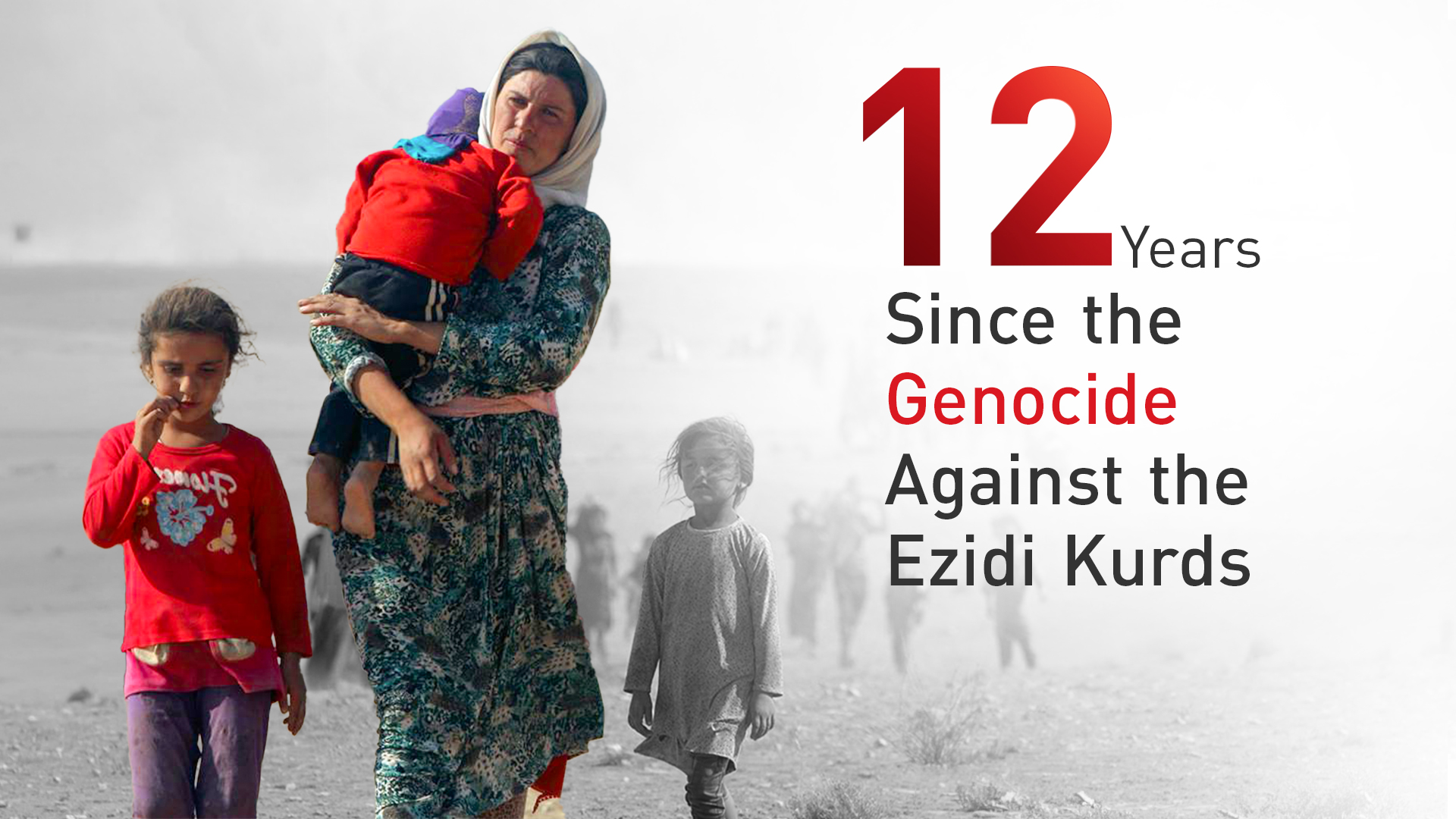
ERBIL (Kurdistan24) - Twelve years after ISIS launched its assault on Sinjar, the anniversary of the Ezidi genocide (also known as Yazidi or Yezidi) serves as more than a day of remembrance. It is a reminder that one of Iraq's darkest chapters remains unfinished, with tens of thousands of survivors still displaced, thousands of relatives unaccounted for, and the district at the heart of the tragedy struggling to achieve lasting stability.
The attack that began on Aug. 3, 2014, fundamentally altered the future of Iraq's Ezidi community.
While ISIS was militarily defeated years ago and Sinjar itself was liberated, the humanitarian, political, and security consequences of the genocide continue to shape life across northern Iraq.
For many survivors, the anniversary marks not only the memory of those who were killed but also another year spent waiting for justice, reconstruction, and the safe return home.
Twelve years on, progress has proven uneven. International recognition of the atrocities as genocide has expanded steadily, yet many of the conditions that prevented displaced families from returning remain unresolved.
Large numbers of Ezidis continue to live in camps across the Kurdistan Region, while thousands of families are still searching for loved ones who disappeared during the ISIS campaign.
Fragmented security arrangements, damaged infrastructure, and stalled governance reforms have combined to slow Sinjar's recovery, leaving the genocide as both a historical tragedy and an ongoing policy challenge for Iraq and its international partners.
The ISIS Assault
The Ezidi genocide began after ISIS seized Mosul and rapidly advanced into Sinjar on Aug. 3, 2014, overwhelming the district and targeting the Ezidi population through systematic killings, kidnappings, and forced displacement.
As villages fell, thousands of civilians fled toward Mount Sinjar, which became the community's last refuge from advancing militants.
Families remained stranded there under dire humanitarian conditions before evacuation corridors enabled many to reach safety through Rojava and eventually the Kurdistan Region, where large numbers settled in displacement camps.
The offensive left an enormous human toll.
According to official figures obtained by Kurdistan24, more than 5,000 Ezidis were killed, while approximately 2,745 children were orphaned during the campaign.
Entire communities were uprooted, and hundreds of thousands fled their homes in one of the largest displacement crises to affect Iraq in recent decades.
The Scale of the Genocide
Beyond the immediate loss of life, the genocide devastated the social and cultural fabric of the Ezidi community.
Women and girls were subjected to systematic abduction and enslavement, while men and elderly residents were executed in numerous locations across Sinjar.
Religious shrines were destroyed, neighborhoods were left in ruins, and generations of Ezidi families were dispersed across displacement camps or forced into migration abroad.
The search for evidence has continued long after ISIS lost territorial control.
More than 85 mass graves and numerous individual burial sites have been uncovered in and around Sinjar, underscoring both the scale of the atrocities and the continuing effort to identify victims and provide families with answers.
Liberation Without Full Recovery
A major turning point came on Nov. 13, 2015, when Kurdish Peshmerga forces, under the direct command of President Masoud Barzani and supported by International Coalition airstrikes, launched an operation that liberated Sinjar within 24 hours.
Military success, however, did not resolve the broader crisis.
Although ISIS no longer controlled the district, survivors returned to communities where homes, schools, public services, and religious sites had been devastated.
The end of occupation marked the beginning of a far longer struggle centered on rebuilding communities, restoring governance, and creating conditions that would encourage displaced families to return.
Sinjar Today: Recovery Still Stalled
Despite years of reconstruction efforts, Sinjar continues to face significant obstacles that have slowed its recovery.
According to UN-verified figures obtained by Kurdistan24, Iraq is home to roughly 550,000 Ezidis, yet most remain displaced.
Data from the Duhok Bureau of Migration and Crisis Response indicate that more than 400,000 people fled to the Kurdistan Region during the initial assault.
While only about 100,000 have returned to Sinjar, more than 270,000 survivors continue living in displacement camps, and another 100,000 have sought refuge abroad.
For many families, returning remains an uncertain prospect.
Survivors have repeatedly pointed to damaged infrastructure, limited public services, security concerns, and the continued presence of illegal armed groups as reasons they remain unwilling to resettle in their hometowns.
The district's slow recovery has also become a broader governance challenge, with competing security actors and unresolved administrative arrangements complicating efforts to restore normal civilian life.
As a result, reconstruction has advanced more slowly than many displaced residents had hoped, prolonging dependence on humanitarian assistance and delaying long-term recovery.
The Sinjar Agreement
In an effort to stabilize the district, Baghdad and the Kurdistan Regional Government signed the Sinjar Agreement on Oct. 9, 2020, under the auspices of former Iraqi Prime Minister Mustafa al-Kadhimi.
The agreement envisioned administrative reforms, coordinated governance between Baghdad and Erbil, restructuring security under federal authority, recruiting local residents into new security forces, ending the presence of the Kurdistan Workers' Party (PKK) and affiliated groups, and advancing reconstruction.
Yet implementation has remained largely stalled.
Many Ezidis view the agreement as an important framework that has yet to translate into meaningful change on the ground.
Survivors have argued that the continued presence of illegal armed groups and delays in implementing security arrangements have prevented the district from achieving the stability needed for large-scale returns and reconstruction.
Justice Still Unfinished
As this year's anniversary approaches, remembrance activities across displacement camps have highlighted how deeply the genocide continues to shape daily life.
In one camp, young Ezidi volunteers erected a memorial tent covered with photographs of those killed and those still missing, transforming it into a place where families gather each year to remember loved ones and renew calls for accountability.
For many survivors, commemoration is inseparable from demands for action.
"The Iraqi government must seriously intervene to find a fundamental solution to the situation of the Ezidis and end our suffering," displaced Ezidi Bir Tahsin said, adding that annual commemorations would continue "so that our cause is never forgotten."
Volunteer Sardar Khalil described preserving victims' stories as "our humanitarian and moral duty," saying the community remains committed to ensuring that the voices of those affected continue to reach the international community.
The anniversary also revives deeply personal grief. Standing before photographs inside the memorial tent, survivor Nuriya Hussein said four members of her family remain missing.
"All I ask and hope for is that they are rescued, or that we learn anything about their fate," she said.
Thousands Still Missing
The search for those abducted during the 2014 assault remains one of the genocide's most painful legacies.
According to the latest figures, 6,417 Ezidi men, women, and children were abducted during the ISIS attack.
Since then, 3,597 survivors have been rescued, but 2,820 Ezidis remain missing, leaving thousands of relatives without answers more than a decade later.
Meanwhile, approximately 97 mass graves have now been identified, illustrating both the scale of the crimes and the continuing effort to recover victims and establish their identities.
For many families, the absence of definitive answers means the genocide has never truly ended.
International Recognition and the Road Ahead
International recognition of the Ezidi genocide has expanded steadily in recent years.
France recognized the atrocities in 2016, followed by the Netherlands and Belgium in 2021, Germany in 2023, and the United Kingdom later that year.
According to the Kurdistan Region's Office of International Recommendations, more than 10 countries have formally recognized the genocide.
Such recognition has elevated international awareness and reinforced calls for accountability. Yet survivors continue to stress that symbolic recognition alone cannot substitute for practical recovery.
Twelve years after ISIS's assault, Sinjar's future remains tied to unresolved questions of security, governance, reconstruction, and justice.
As families continue searching for missing relatives and thousands remain unable to return home, the anniversary stands not only as a remembrance of past atrocities but also as a measure of the work still required to help one of Iraq's most deeply affected communities achieve lasting recovery.