Final push to 'destroy Islamic State' in Syria underway: Coalition
Maj. Gen. Felix Gedney, Deputy Commander for Strategy and Support in the US-led Coalition against the Islamic State (IS), announced to reporters on Tuesday that the Coalition’s last push against IS in Syria, Operation Roundup, had begun.
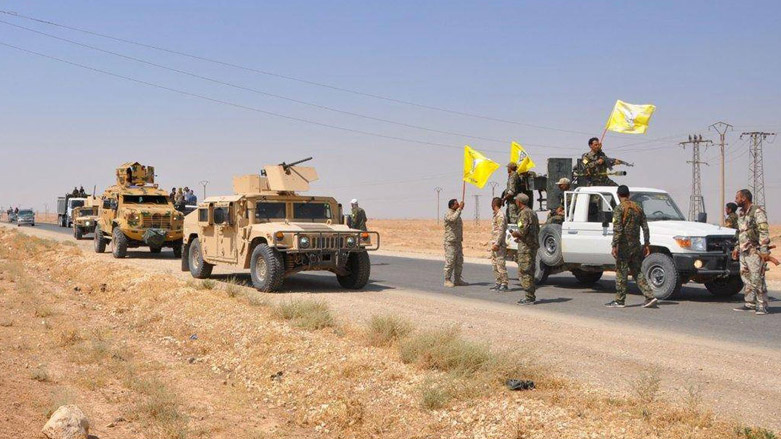
WASHINGTON DC (Kurdistan 24) - Maj. Gen. Felix Gedney, Deputy Commander for Strategy and Support in the US-led Coalition against the Islamic State (IS), announced to reporters on Tuesday that the Coalition’s last push against IS in Syria, Operation Roundup, had begun.
The aim of Operation Roundup is “to destroy” IS “in the final areas” where the terrorist organization still holds ground east of the Euphrates River.
The Kurdish-led Syrian Democratic Forces (SDF) resumed offensive operations, as they announced on May 1, Gedney explained. The start of the SDF’s offensive followed increased coalition airstrikes against the last territory that IS holds in Syria.
The renewal of the SDF offensive comes after an extended “operational pause,” following Turkey’s Jan 20 assault on the Kurdish canton of Afrin. The fighters who left to defend Afrin have now, evidently, returned to the anti-IS fight.
Gedney characterized the combination of the SDF’s offensive operations, along with coalition fire support in the form of air, artillery, and mortar strikes against IS targets, as having “a devastating effect.”
“Frictions are mounting between native and foreign-born [IS] fighters,” he said, and its “privileged leadership” is fleeing, “leaving fighters with dwindling resources and low morale.”
Gedney noted that there was now a “larger proportion of foreign fighters” in IS than before. He suggested that was probably due to the fact that it is more difficult for foreign fighters to flee than it is for a Syrian or Iraqi.
Indeed, Dr. Najmaldin Karim, Governor of Kirkuk Province until the Iraqi-Iranian assault on Kirkuk and the disputed territories last October, recently explained that in his province, IS fighters “were all local people, from the same place.”
“They just shaved,” Karim said, and “changed their clothes,” and “they are doing their dirty work, even now.”
A recent BBC Monitoring analysis stated that IS had “significantly stepped up attacks in Iraq recently”— in Kirkuk Province “particularly,” and in neighboring Salah al-Din Province, as well as Diyala.
However, when Kurdistan 24 asked Gedney if that was also his assessment, he seemed to dismiss its significance.
“There are still occasional spikes of violence within Iraq,” he replied. But “the Iraqi Security Forces are showing themselves” to be “very effective” in “maintaining security throughout Iraq.”
Several journalists, including from Kurdistan 24, asked about the likely impact of Washington’s abrogation of the Iran nuclear deal on the fight against IS in Syria and Iraq, including the possibility that Iran might respond with terrorist attacks on US and other coalition forces.
However, Gedney seemed to dismiss that concern as well. “I’m absolutely confident that we can manage the force protection to our troops,” he said.
Others, however, disagree, including former US ambassador to Iraq, Ryan Crocker, who warned last month about the possibility that Iran and Syria might join together to carry out terrorist attacks against the US, as they did in Lebanon in the 1980s.