Ocalan’s Address Read At Istanbul Peace Conference: 'It Is Time for Reconstruction'
Imprisoned PKK leader Abdullah Ocalan declares the end of armed struggle, calling for "reconstruction" and "Democratic Unity" in a message read at the Istanbul Peace Conference.
ERBIL (Kurdistan24) – Abdullah Ocalan, the imprisoned leader of the Kurdistan Workers' Party (PKK), reiterated the conclusion of the half-century phase of armed conflict, declaring from his isolation on Imrali Island that the time has arrived for a new epoch of "reconstruction" and democratic negotiation.
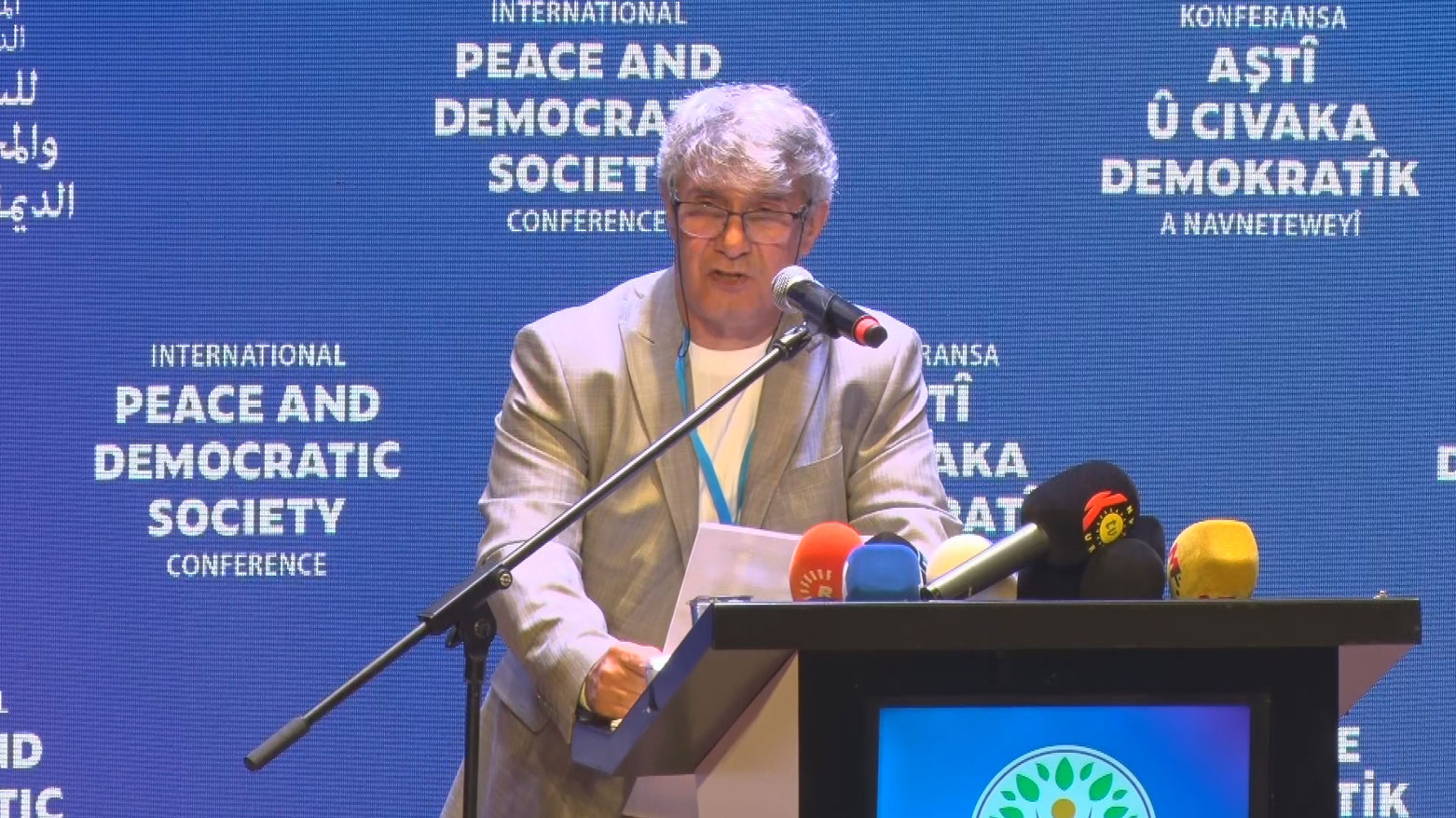
The message was delivered on Saturday in Istanbul during the opening session of the "International Conference on Peace and Democratic Society," where Ocalan’s roadmap for a non-violent political solution was unveiled before an assembly of international politicians, jurists, and activists.
The message, which was conveyed to the conference by Veysi Aktaş, a former fellow inmate released from Imrali Prison, articulates a fundamental strategic pivot for the Kurdish movement.
Ocalan characterized the current geopolitical moment as a distinct "new" phase, asserting unequivocally that the kinetic aspects of the movement's history have achieved their preliminary goals.
In the text read by Aktaş, Ocalan stated that the PKK’s "52-year struggle for existence and dignity has concluded," a phrasing that suggests the existential threat that drove the armed insurgency has been sufficiently countered to allow for a transition to purely political engagement. This declaration serves as a definitive bookend to decades of violence, shifting the focus entirely toward what Ocalan termed "reconstruction."
This new strategic vision is anchored in the concept of "Democratic Unity," a framework Ocalan proposed as the successor to the era of conflict. In his address, he outlined a path toward "democratic liberation based on democratic socialism," rejecting the notion of the nation-state as a monolithic oppressor in favor of a reformed "Democratic Republic."
Central to this vision is the establishment of a "Democratic Nation" and a society defined by the liberation of women and ecological stewardship.
Ocalan expressed deep confidence in this paradigm, positing that success will be achieved not through the barrel of a gun, but through the rigorous application of democratic principles that allow for the coexistence of diverse identities within a unified political structure.
To operationalize this transition, the PKK leader laid out three specific legal foundations that must underpin the new order: the Law of Free Citizenship, the Law of Peace and Democratic Society, and the Laws of Freedom.
Ocalan emphasized that the law must serve as a "democratic guarantee" between the state and the people, acting as the primary mechanism to prevent a recurrence of violence.
The timing of this message is critical, landing amidst a palpable intensification of political momentum aimed at resolving the Kurdish issue.
The conference in Istanbul, organized by the Peoples' Equality and Democracy Party (DEM Party), is taking place against a backdrop of renewed engagement between Kurdish political representatives and the Turkish state.
In recent months, the DEM Party and the Turkish government have held numerous meetings, signaling a thawing of relations that had been frozen for years.
Furthermore, the formation of a special commission within the Turkish Parliament dedicated to these issues suggests that the state is reciprocating the openness to dialogue, creating a fragile but promising window for a lasting settlement.
Ocalan’s message also broadened the scope of the issue beyond Türkiye’s borders, reflecting on the complex demographic mosaic of the wider region.
In his concluding remarks, he highlighted the multi-ethnic and multi-religious structure of the Middle East, arguing that the imposition of singular identities is a recipe for continued strife. Instead, he advocated for dialogue and democratic discussion as the only viable methods for resolving the deep-seated conflicts that plague the region.
His vision of a "women-liberating, ecological democratic society" is presented not merely as a Kurdish solution, but as a model for the democratization of the Middle East as a whole.
The conference, which is scheduled to continue through Sunday, December 7, has drawn a significant international audience, including Nobel Peace Prize laureates, underscoring the global interest in the potential resolution of one of the region's longest-standing conflicts.