Beyond Energy: Russia and Iran Commit to Full Implementation of 20-Year Strategic Pact
Russian President Vladimir Putin and Iranian President Masoud Pezeshkian reaffirmed deepening cooperation in energy, nuclear projects, and trade corridors during a meeting in Turkmenistan, as leaked documents reveal Russia has begun manufacturing 16 Su-35 fighter jets for Iran.
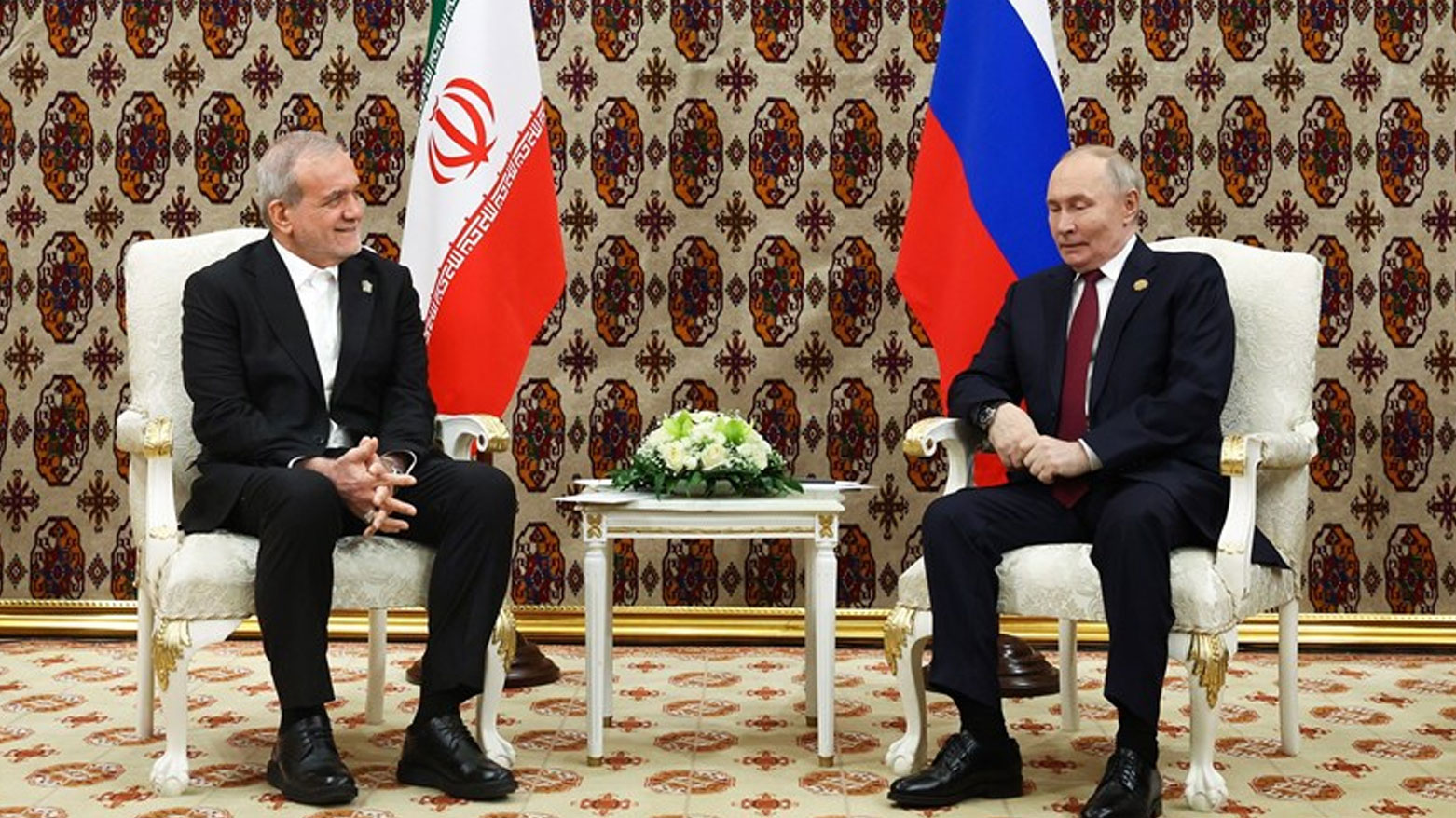
ERBIL (Kurdistan24) - Russian President Vladimir Putin reaffirmed the “very natural and dynamic” development of relations between Moscow and Tehran during a high-level meeting with Iranian President Masoud Pezeshkian, held Friday on the sidelines of the “Peace and Trust: A Path to Sustainable Future” forum in Turkmenistan’s capital.
The talks, reported by Spotnik Agency on Friday, highlighted expanding cooperation across energy, infrastructure, and nuclear sectors, while Iran reiterated its commitment to implementing all provisions of the recently activated 20-year Comprehensive Strategic Partnership Agreement with Russia.
During the meeting, Putin stated that Russia and Iran are deepening collaboration in both the gas and electricity sectors, describing these developments as a new pathway for joint work in strategically critical fields.
He emphasized that Moscow and Tehran cooperate across a broad array of domains, including the Bushehr nuclear power plant project, the expansion of subterranean infrastructure, and the development of the North–South International Transport Corridor — one of the most significant trade routes connecting Russia to the Indian Ocean.
Putin also noted that Russia maintains active diplomatic engagement with Iran at the United Nations regarding Tehran’s nuclear program, underscoring ongoing dialogue between both countries on this sensitive dossier.
President Pezeshkian affirmed that Iran remains firmly committed to implementing all agreements outlined in the Comprehensive Strategic Partnership, which entered its execution phase in October. The accord is designed to last 20 years and establishes an expansive framework for bilateral cooperation across political, security, economic, and infrastructural fields.
“We are committed to fulfilling every provision agreed upon within the framework of the comprehensive strategic partnership,” Pezeshkian said, noting that the agreement serves as the foundation for strengthened ties with Moscow.
The Ashgabat meeting comes amid new revelations indicating that Russia has begun manufacturing 16 Su-35 fighter jets specifically for Iran — marking what could become the most significant qualitative enhancement of Tehran’s airpower in decades.
Recently leaked documents from Russia’s military-industrial sector, first published on 28 November by Ukrainian outlet UNITED24 and examined by regional media including Al-Monitor, reveal coordinated production linked to export contract R/1936411141768, identifying the customer as “K10,” a designation tied to Iran.
The documents, dated between March 2024 and September 2025, indicate that:
-Russia has initiated full production of new Su-35 airframes rather than refurbishing older jets.
-Manufacturing is centered at the Yuri Gagarin Komsomolsk-on-Amur Aircraft Plant (KnAAZ), with additional components supplied by Zvezda near Moscow.
-All jets will be delivered in export configuration, suitable for multiple climates, with English-language system labeling using the “Anglo-Saxon” measurement standard.
-Tehran has already made three tranche payments throughout 2024, suggesting the program is fully financed despite Russia’s wartime production pressures.
Deliveries are expected between 2025 and 2027, according to the leaked papers.
Analysts note that while the Su-35 would not match the advanced F-35s or Rafales fielded by Israel and Gulf states, it would significantly extend Iran’s operational reach and force regional planners to reevaluate assumptions about Tehran’s air defense and deterrence capabilities.
Defense journalist Akram Kharief, speaking to Al-Monitor, cautioned that Russia’s industrial capacity remains limited, producing “four to six Su-35s per year at most,” but affirmed the credibility of the documents and their implications for regional military balance.
The timing is especially notable following the June “12-day conflict” between Iran and Israel, during which Israeli strikes reportedly destroyed at least 15 older Iranian aircraft and exposed structural gaps in Iran’s air defenses.
Many observers see Moscow’s willingness to proceed with the Su-35 transfer as part of a broader effort to compensate Tehran for its supply of Shahed drones and missiles used by Russian forces in Ukraine.
The Ashgabat talks — reinforcing Russia and Iran’s expanding cooperation while leaked documents reveal advanced military coordination — underscore a rapidly deepening strategic alignment between Moscow and Tehran. As both sides commit to the long-term execution of their 20-year strategic partnership, developments spanning energy networks, nuclear infrastructure, and next-generation military systems signal a pivotal shift with broad implications for regional stability and the evolving security landscape.