Trump Signs Executive Order to Override State AI Laws, Citing Threat to U.S. Dominance
President Trump signed an executive order to establish a national AI policy framework, arguing state regulations threaten US innovation and ordering legal challenges against conflicting state laws like Colorado's.
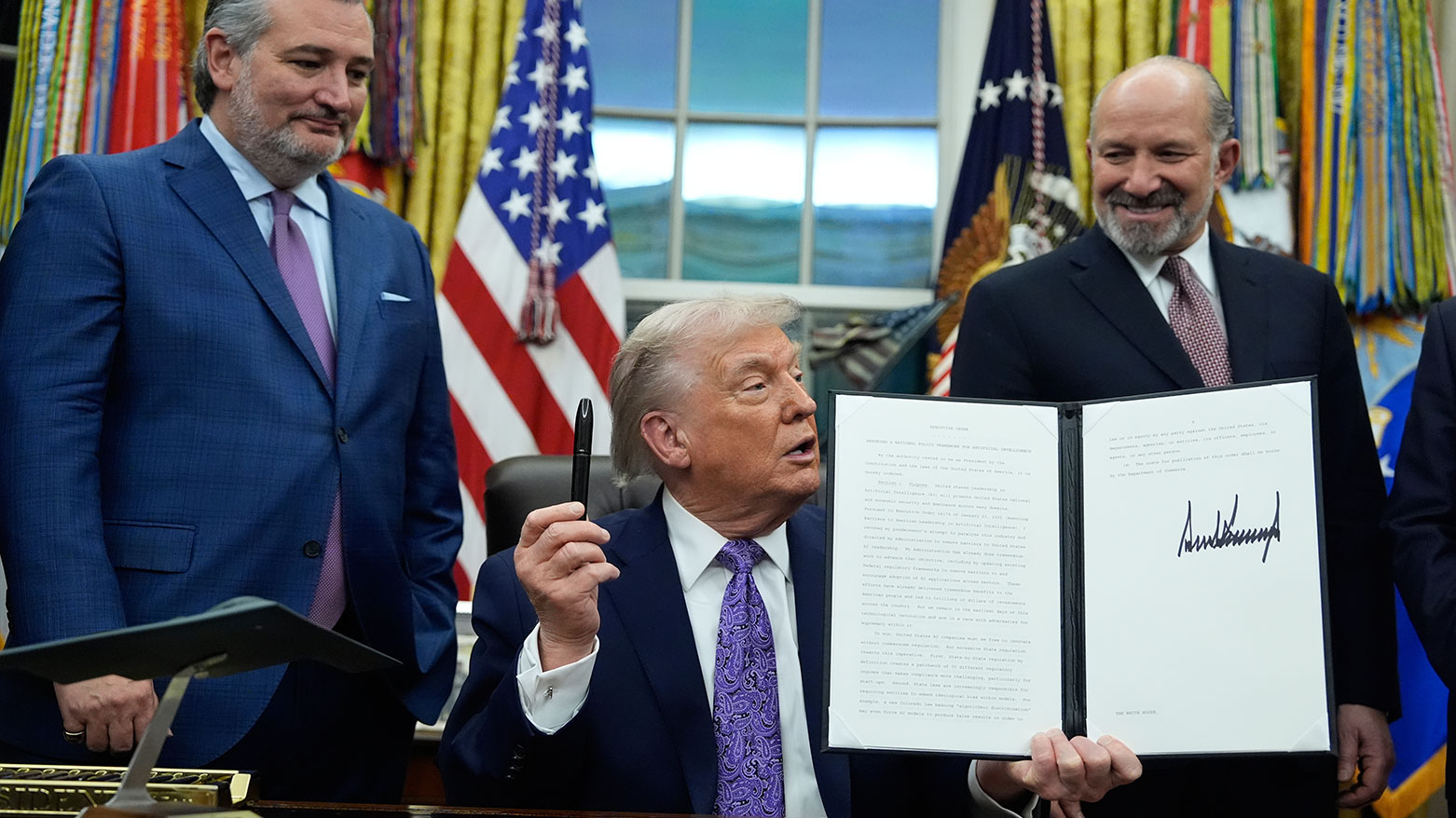
ERBIL (Kurdistan24) - U.S. President Donald J. Trump on Thursday signed a sweeping Executive Order aimed at creating a unified national policy framework for Artificial Intelligence (AI), declaring that fragmented state regulations threaten American technological dominance and impose unconstitutional burdens on interstate commerce.
Signed on Thursday, the order—titled Ensuring a National Policy Framework for Artificial Intelligence—asserts that U.S. leadership in AI is essential to national security, economic strength, and global influence. President Trump framed the initiative as a necessary response to what he described as growing regulatory barriers imposed by individual states.
Trump said his administration had already “removed barriers to United States AI leadership” under a prior directive, Executive Order 14179, and emphasized that these efforts had “led to trillions of dollars of investments across the country.” Nevertheless, he warned that the United States remains “in the earliest days of this technological revolution and is in a race with adversaries for supremacy.”
The Executive Order argues that state-level laws—particularly those targeting “algorithmic discrimination”—could force AI systems to produce altered or false outputs. Trump cited Colorado’s recent legislation as an example, saying it may compel models to avoid truthful outcomes if they result in “differential treatment or impact” on protected groups.
The order states that a “minimally burdensome national standard” is necessary to protect innovation, prevent censorship, respect copyright, safeguard communities, and ensure the United States “wins the AI race.”
Within 30 days, the Attorney General must establish a dedicated AI Litigation Task Force tasked with challenging state laws deemed inconsistent with federal policy. Such challenges may argue unconstitutional interference with interstate commerce or conflicts with federal regulations.
Evaluation of State AI Laws
The Secretary of Commerce is required, within 90 days, to publish an assessment identifying state laws that:
-conflict with federal AI policy,
-require altering truthful AI outputs,
-compel disclosures that violate constitutional protections.
States with such “onerous” AI laws may lose eligibility for certain federal BEAD Program funds. Federal agencies are also instructed to consider conditioning grants on states agreeing not to enforce conflicting AI laws.
The FCC must evaluate a potential federal reporting and disclosure standard for AI that would override conflicting state regulations.
The FTC is directed to issue a policy statement outlining how federal law preempts state mandates that require “deceptive” changes to AI outputs.
White House advisors must prepare draft legislation establishing a uniform federal AI framework preempting conflicting state laws—while exempting areas such as child safety, data-center infrastructure, and state government procurement.
President Trump’s order places federal authority at the center of future AI governance in the United States, positioning national uniformity as a prerequisite for technological dominance. The directive underscores the administration’s belief that fragmented state regulations threaten innovation, economic growth, and U.S. strategic advantage. The order will now initiate a series of federal reviews, legal challenges, and legislative proposals designed to reshape the regulatory landscape for AI across the country.