Kim Jong-un Embraces Returning Troops as North Korea Publicly Acknowledges Role in Russia’s War
Kim Jong-un welcomed troops back from Russia, publicly honoring nine combat engineers killed in action while cementing Pyongyang's role in the war.
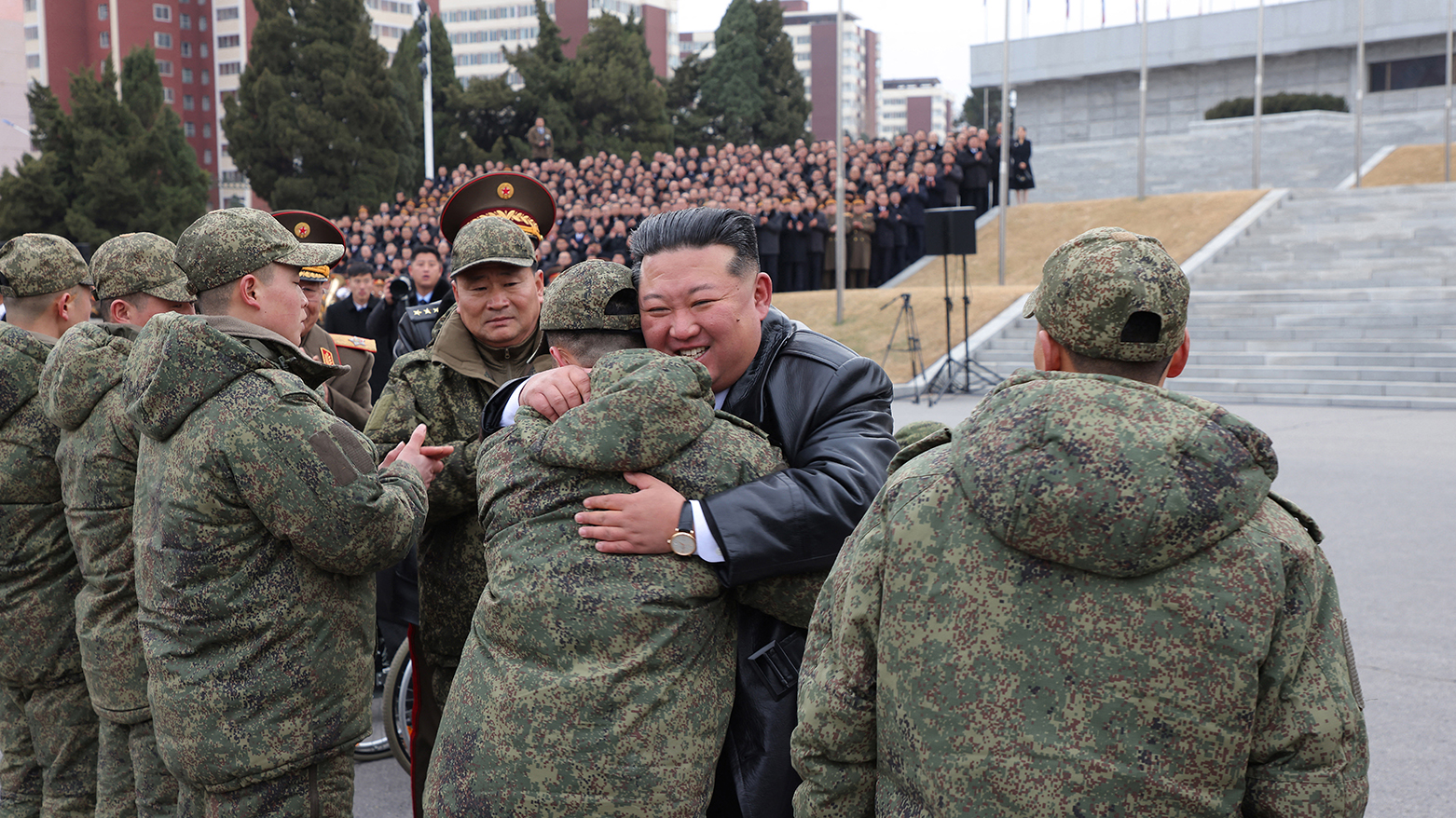
ERBIL (Kurdistan24) – In a grand display of state theater that marks a pivotal shift in Pyongyang's public posture regarding the conflict in Europe, North Korean leader Kim Jong-un presided over a hero's welcome this week for specialized troops returning from the front lines of Russia’s war against Ukraine.
This elaborate homecoming, reported by The New York Times on Saturday, serves as the isolated regime’s first official and public acknowledgment that it has deployed specialized combat personnel to aid Moscow’s war effort.
The ceremony not only confirmed the presence of North Korean boots on the ground in the battle-scarred Kursk region but also glorified the sacrifices of those who perished, with Kim personally bestowing the nation’s highest military honors upon the fallen.
According to the report by The New York Times, state media outlets released imagery on Saturday documenting a large and emotionally charged ceremony held on Friday in a plaza in Pyongyang.
The event was centered on the return of the 528th Regiment of Engineers, a unit that had been tasked with hazardous mine-clearing operations in territory reclaimed by Russian forces.
The spectacle offered a rare glimpse into the deepening military integration between North Korea and Russia, a relationship that has evolved from diplomatic support to direct martial participation. Kim Jong-un, dressed in a leather jacket, was photographed hugging returning officers and soldiers, including five men who were seated in wheelchairs, underscoring the physical toll of their deployment.
The event was characterized by a narrative of martyrdom and "brilliant military exploits." In his address to the assembled troops, Mr. Kim framed their intervention in the European theater as a "sacred mission." He lauded the engineering regiment for their efficiency and bravery, crediting them with transforming a volatile combat environment into a stabilized zone in record time.
"You could work a miracle of turning a vast area of danger zone into a safe and secure one in a matter of less than three months," Kim stated in his speech. However, the tone of triumph was tempered by the admission of fatalities. The North Korean leader acknowledged the "heart-rending loss of nine lives," noting that aside from these casualties, the remainder of the regiment had returned to the motherland.
The ceremony included poignant rituals intended to canonize the dead. State media photographs depicted Kim kneeling to place white chrysanthemums before a memorial wall and affixing medals designating the fallen as "heroes" of the Democratic People's Republic of Korea directly onto their portraits.
The images also captured the raw grief of the bereaved families, showing relatives touching the portraits of their sons and weeping. This public mourning represents a calculated effort by the regime to bolster domestic support for Kim’s decision to join a foreign war, presenting the conflict not as a distant geopolitical maneuver but as a noble endeavor requiring national sacrifice.
The disclosure of this specific deployment aligns with earlier geopolitical signals regarding the scope of Pyongyang’s involvement in the war.
The New York Times notes that the Kremlin had announced in July that North Korea agreed to dispatch 1,000 combat engineers and 5,000 military construction workers to assist in rebuilding the war-torn Kursk region.
This engineering support, however, appears to be the tail end of a much larger commitment. Earlier reports indicated that up to 15,000 North Korean troops had fought alongside Russian forces in the same region to drive out Ukrainian soldiers.
While the Friday ceremony focused on the engineering corps, the acknowledgment of their presence validates long-standing assertions by Western and South Korean intelligence agencies regarding the depth of North Korean participation.
The strategic logic behind this deployment is rooted in a revival of Cold War-era alliances. Throughout the war, Moscow and Pyongyang have reinvigorated a treaty of mutual defense and cooperation, creating a framework for the exchange of personnel and materiel.
North Korea has supported Russia’s campaign not only with manpower but with substantial shipments of artillery shells, missiles, and other weaponry essential for sustaining high-intensity conventional warfare. In return, the relationship has provided a lifeline for the sanctioned North Korean economy and military industrial base.
South Korean intelligence officials and analysts cited in the report state that Russia has reciprocated by providing fuel, food, and critical military materials and technologies. There are growing fears in Seoul and Washington that this technology transfer could accelerate the modernization of North Korea’s own military capabilities, posing a renewed threat to stability on the Korean Peninsula.
Despite the official narrative focusing on the nine soldiers killed from the engineering regiment, the actual human cost of North Korea's involvement may be significantly higher. Intelligence assessments suggest that at least hundreds of North Korean troops are believed to have been killed during the broader conflict.
The disparity between the official figures and intelligence estimates suggests that the Friday ceremony was a carefully curated event designed to manage the domestic narrative, honoring a specific, successful unit while perhaps obscuring the wider scale of losses incurred by combat infantry units.
To reinforce the narrative of heroism, state media has been broadcasting propaganda footage since June that purportedly shows North Korean troops displaying fanatical bravery.
The New York Times describes these clips as showing soldiers charging into minefields or through heavy gunfire without hesitation. In some of the most graphic examples of this propaganda, wounded soldiers are depicted detonating grenades to kill themselves rather than facing capture by the enemy.
This imagery is intended to project an image of ideological purity and martial invincibility to the North Korean public.
The return of the 528th Regiment of Engineers serves as a potent symbol of the new axis emerging between Moscow and Pyongyang.
By publicly celebrating these troops, Kim Jong-un has signaled that North Korea is no longer a passive observer of global conflicts but an active participant willing to export its military power in exchange for economic and technological vitality.
As the returning soldiers received their accolades in Pyongyang, the event underscored the reality that the war in Ukraine has reshaped alliances thousands of miles away, turning North Korean engineers into "heroes" of a Russian war and solidifying a partnership that challenges the established international order.