Iraq Busts Foreign-Run Meth Lab in Basra, Arrests 17 in Multi-City Raids
INSS dismantled a "Breaking Bad"-style meth lab in Basra, arresting a foreign "cook" and 16 others in a raid that seized 20kg of drugs.
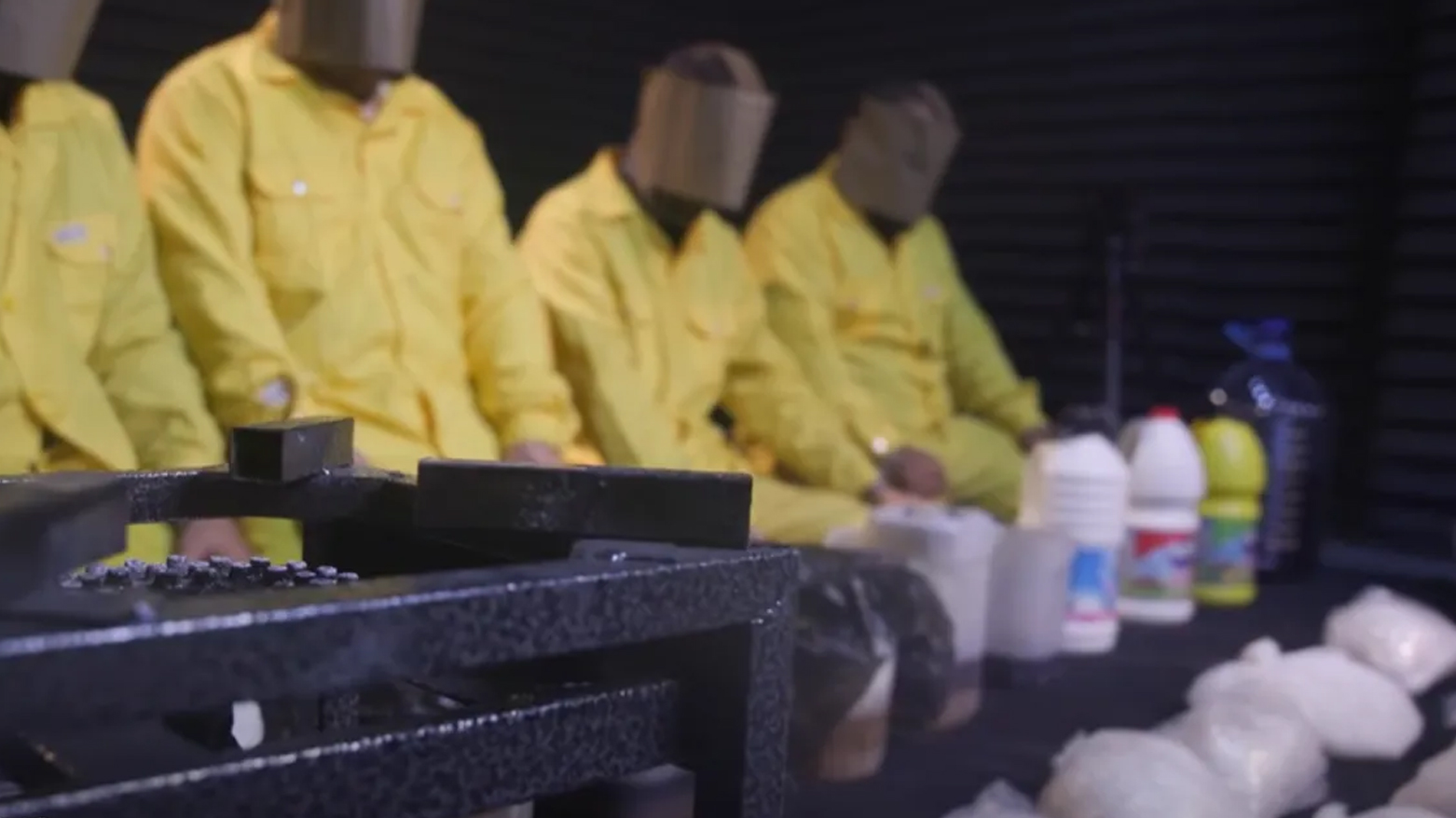
ERBIL (Kurdistan24) – The quiet residential streets of Basra concealed a sophisticated industrial operation that mirrors the darkest plotlines of television’s most notorious crime saga, as the Iraqi National Security Service (INSS) uncovered a clandestine laboratory run by a foreign "chemist" dedicated to the mass production of Crystal Meth.
In a synchronized, multi-governorate offensive that strikes at the heart of the region’s burgeoning narcotics trade, Iraqi federal security forces announced the dismantling of a sprawling international criminal syndicate, arresting seventeen individuals and shutting down a domestic production line that marks a dangerous evolution in Iraq's war on drugs.
The operation, details of which were released in a formal statement on the organization's official Facebook account on Sunday, December 14, 2025, exposes a reality where fiction has bled into fact, revealing a network defined by technical expertise, ruthlessness, and a transnational reach.
The crackdown, described by security officials as a "qualitative security operation," was the culmination of months of precise intelligence gathering and intensive field surveillance.
It targeted a supply chain that extended from the southern port city of Basra through the holy city of Najaf, into the agricultural heartland of Diwaniyah, and reaching into the capital, Baghdad.
The INSS statement highlighted that the raids resulted in the "complete paralysis" of the network’s activities, a claim substantiated by the arrest of the syndicate’s primary dealers and the seizure of substantial quantities of narcotics and precursor chemicals.
Central to the network’s operations was a figure reminiscent of the archetypal "cook"—a foreign national who had entered Iraq from a neighboring country, bringing with him the specialized technical expertise required to manufacture synthetic drugs.
According to the INSS, this individual served as the primary architect of the group's production capabilities. Upon arrival, he rented a residential property in the Basra Governorate, ostensibly for living purposes, but covertly converted the house into a secret laboratory.
Inside this facility, he exploited his specialized criminal knowledge to manufacture Crystal Meth, turning a nondescript home into a hub for illicit chemical synthesis.
The discovery of this lab marks a troubling shift in the drug trade within Iraq, moving from a transit route for narcotics to a base for domestic manufacturing, echoing the shift from importation to production seen in global drug empires.
The security forces’ breach of this facility yielded undeniable evidence of the group's activities.
Agents seized approximately twenty kilograms of Crystal Meth during the raids, with a portion of the narcotics discovered in flagrante delicto—caught in the very act of being processed inside the secret laboratory.
This "hot" seizure provided irrefutable proof of the site’s function as an active factory.
Alongside the finished product, authorities confiscated eight liters of raw chemical materials essential for the manufacturing process.
These precursors are the lifeblood of synthetic drug production, and their presence confirms that the syndicate had established a sustainable supply chain for the ingredients necessary to keep the lab running.
While the "chemist" operated the production line, a second main accused individual managed the logistical flow of raw materials into the country.
The INSS identified this figure as a fugitive already wanted by the Service on charges of smuggling narcotics and raw materials. His capture was the result of a meticulously planned tactical operation; intelligence units lured him into a "tight ambush" executed by the Tactical Regiment in Basra Governorate, effectively decapitating the network’s supply wing.
The demographic composition of the arrested cohort underscores the transnational nature of the threat facing Iraq.
Of the seventeen accused individuals taken into custody, fourteen were identified as foreign nationals. This high concentration of non-Iraqi actors suggests that international criminal elements are increasingly embedding themselves within Iraq's borders to establish production capabilities closer to consumer markets.
The dismantling of this cell disrupts what the INSS described as an "organized criminal network," implying a hierarchy and operational sophistication far exceeding that of street-level dealing.
The investigation into the syndicate’s methods revealed a disturbing level of ingenuity and cruelty in their smuggling operations, tactics that stripped away any glamorous veneer of the drug trade.
To evade detection at checkpoints and during transport between governorates, the accused employed a variety of concealment techniques.
Narcotics and raw materials were hidden in remote wilderness areas to avoid direct association with the traffickers’ residences, utilizing the vast, empty landscapes of Iraq as dead drops.
When moving the product, the network concealed contraband inside clothing and utilized cargo transport vehicles to blend in with commercial traffic.
Most harrowingly, the INSS investigation uncovered that the syndicate went as far as "exploiting disabled persons" to transport these dangerous materials.
By using the most vulnerable citizens as unwitting or coerced mules to bypass security scrutiny, the network demonstrated a level of moral depravity that complicates the narrative of a victimless crime.
This exploitation of the marginalized highlights the predatory nature of the syndicate, which viewed human beings merely as another vehicle for distribution.
The geographical scope of the operation highlights the reach of the network. Simultaneous security strikes were executed across Baghdad, Basra, Holy Najaf, and Diwaniyah, a coordination challenge that speaks to the growing capabilities of the Iraqi security apparatus.
By hitting multiple nodes of the network at once, the INSS prevented the destruction of evidence and the flight of key suspects, ensuring that both the manufacturing base in the south and the distribution arms in the center of the country were neutralized in a single sweep.
Following the raids, the accused and the seized items have been duly referred to the competent judicial authorities. They now face legal measures that will likely result in severe penalties given the scale of the manufacturing and the international dimensions of the crime.
The Directorate of Relations and Media at the Iraqi National Security Service framed the success of the operation as a testament to the efficacy of intelligence-led policing, emphasizing that the dismantling of this network has removed a significant source of poison from Iraqi streets.
As the legal process begins, the details provided by the INSS on Sunday offer a grim glimpse into the evolving drug landscape in Iraq—one where foreign expertise, domestic production, and ruthless exploitation converge.
The seizure of the Basra lab serves as a critical victory for the state, but the presence of such a sophisticated infrastructure suggests that the battle against synthetic narcotics is entering a new phase.
In this real-life drama, there are no anti-heroes, only a concerted effort by the state to stop a criminal enterprise from turning Iraq’s neighborhoods into the backdrop for a global drug trade.