CHP and Imrali Delegation Unite on Peace Efforts; ‘Negotiation, Not Altercation’
CHP and DEM Party leaders emphasize peace and negotiation in meeting, supporting the ongoing process to end armed conflict in Türkiye.
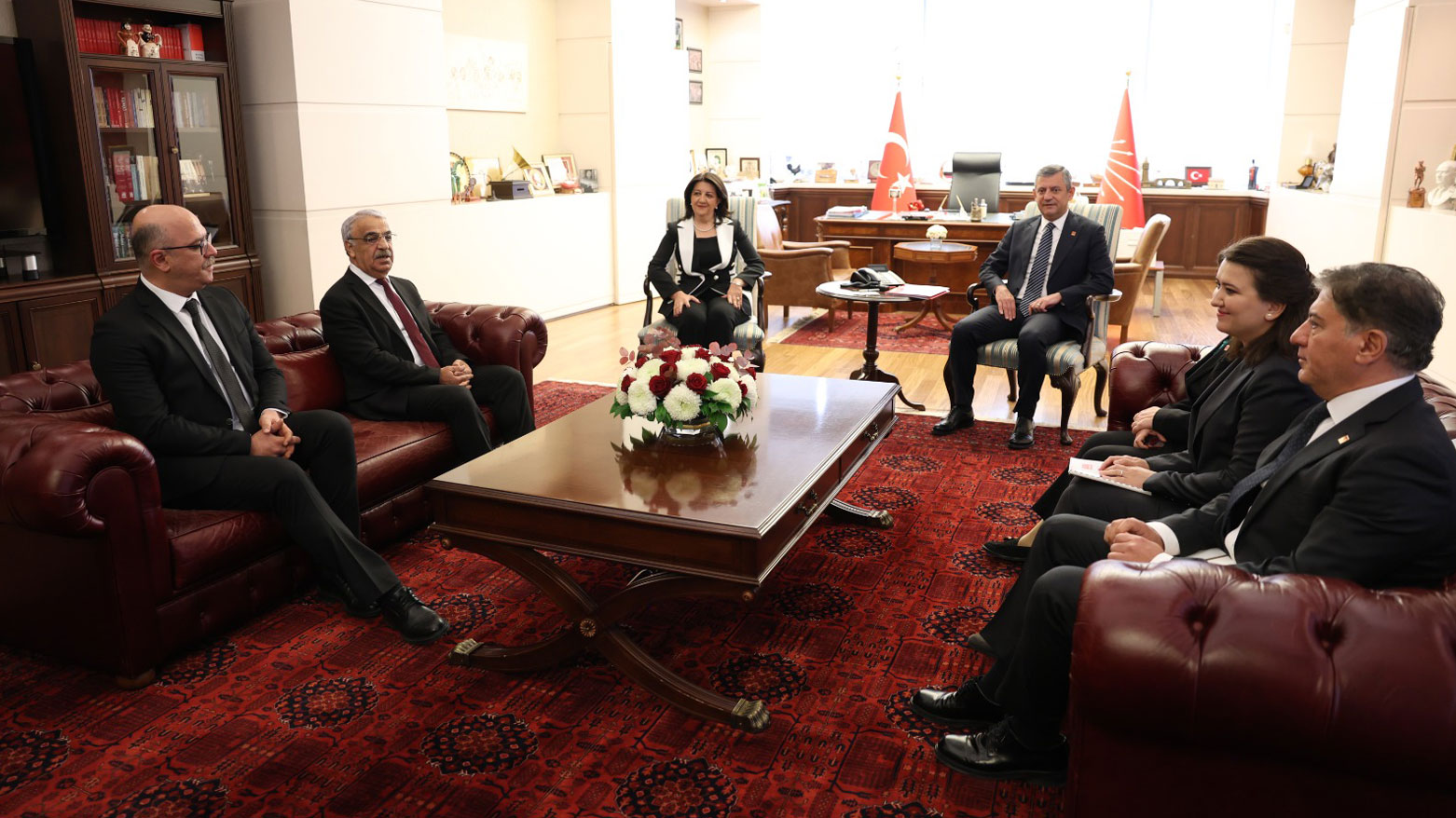
ERBIL (Kurdistan24) — In a significant development for the ongoing peace process in Türkiye, the leadership of the Republican People's Party (CHP) and the delegation representing the Peoples' Equality and Democracy Party (DEM Party) for Imrali convened on Monday, issuing a unified call for the permanent cessation of armed conflict and the prioritization of dialogue over political confrontation.
The high-profile meeting, held on Monday, brought together Özgür Özel, the Chairman of the CHP, and key members of the Imrali delegation at the CHP’s general headquarters.
The discussions, which lasted for more than an hour, concluded with both sides emphasizing that the time for peace has arrived and that the nation must ensure war does not erupt again.
The joint press conference that followed offered a detailed endorsement of the current diplomatic trajectory, with leaders from both the Turkish opposition and the Kurdish political movement advocating for a future defined by "negotiation, not altercation."
A Vision for Domestic and Regional Stability
Özgür Özel, speaking as the General Chairman of the CHP, utilized the platform to articulate a vision of stability that extends beyond the borders of Türkiye to include neighboring Syria.
Özel expressed a profound desire for the cessation of suffering within the country, framing the peace process as a vehicle to secure the future for all citizens regardless of their ethnic background.
"We hope that the shedding of tears in this country stops and that brotherhood and peace prevail," Özel said during the press conference. He described an aspiration for the country’s diverse demographics to stand "hand in hand and shoulder to shoulder with each other in peace in the future of Türkiye."
The CHP Chairman emphasized that the dividends of peace should be tangible, particularly for the younger generation. "Turks, Kurds, and everyone should be assured of their children's future, receive the best education, progress together rapidly, and have a future that we share fairly," he stated.
Notably, Özel expanded the scope of his comments to address the geopolitical situation in Syria, linking the stability of the two nations. He advocated for a parallel emergence of democratic structures in both Ankara and Damascus.
"Both in Türkiye and in Syria, for the Turks, for the Kurds, for the Druze, for the Alevis, and for the Turkmens, we wish for two constitutional, democratic, and peaceful states," Özel said.
He underscored the necessity of fostering a "true environment of peace" in both countries, suggesting that the establishment of good relationships between Türkiye and Syria would strengthen the bonds of brotherhood on both sides of the border.
The Kurdish Issue ‘Above Politics’
Pervin Buldan, the DEM Party Member of Parliament for Van and a member of the Imrali delegation, characterized the meeting as a "historical turning point."
Following Özel’s remarks, Buldan thanked the CHP Chairman and his delegation for hosting what she described as a "very important and productive meeting."
Buldan’s comments focused heavily on the moral and social imperatives of the peace process, arguing that the resolution of the Kurdish issue transcends partisan divides. "The reason for our presence here is that the Kurdish issue is an issue above politics, and resolving it is the duty and responsibility of us all," she announced.
Reflecting on the decades of conflict that have preceded the current diplomatic breakthrough, Buldan invoked the memory of the human cost of the war.
"For many long years, a process full of clashes took place. Much blood was shed in this geography, mothers wept, young people went under the soil, and the bodies of young people were buried," she said.
Buldan asserted that ensuring such a cycle of violence does not recur requires a collective assumption of responsibility by the entire political spectrum.
"The time has come for all of us to put our hands and bodies under the burden of responsibility," she emphasized. Concluding her remarks, she stated that the efforts of all parties working toward this goal are valuable, declaring that "presenting peace to 86 million people is the duty of us all."
The Art of Negotiation
Mithat Sancar, the DEM Party Member of Parliament for Urfa and a fellow member of the Imrali delegation, provided a philosophical framework for the ongoing talks.
Sancar acknowledged the complexities inherent in the reconciliation efforts, reiterating that the process is "multi-dimensional and difficult."
Sancar cautioned that different opinions and mutual criticism are natural byproducts of such a significant political shift, but he urged all participants to remember the fundamental spirit of the engagement. "We must remember once again that the spirit of these processes is negotiation, not altercation," he said.
Elaborating on this distinction, Sancar critiqued the politics of confrontation.
"Altercation is based on defeating each other and proving your own legitimacy; but negotiation is the art of listening to each other, dialogue, and progress through dialogue," he clarified.
He cited the meeting with the CHP as a "very valuable example of negotiation," noting that the two sides had exchanged respect, criticism, and observations bilaterally.
Sancar praised the CHP for showing the will to continue its "constructive role positively" in the process.
He emphasized the vital importance of "political agreement and social consensus" in managing the transition through dialogue.
"We are compelled to struggle jointly with democratic unity and peace against the environment of tension, clashes, and racist incitement they want to spread," Sancar stated, expressing his belief that such unity ensures the strengthening of peace and democracy.
Diplomatic Traffic Intensifies
The meeting with the CHP is part of a broader series of engagements by the DEM Party delegation with Türkiye’s major political entities.
In the days leading up to Monday’s event, the delegation met with the Future Party, the Nationalist Movement Party (MHP), the Workers' Party of Turkey (TİP), and the ruling Justice and Development Party (AK Party).
The diplomatic schedule remains active, with the Imrali delegation set to conduct two additional high-level meetings on Tuesday, December 23, 2025.
According to the schedule announced, the delegation will meet with Yılmaz Tunç, the Minister of Justice, at the Ministry of Justice building at 10:30 AM. Following that engagement, they are scheduled to meet with Numan Kurtulmuş, the Speaker of the Turkish Parliament, at 12:30 PM.
Context of the New Peace Process
Monday’s meeting and the flurry of diplomatic activity take place within the framework of a new peace process in Türkiye and Northern Kurdistan that has rapidly evolved over the past year. The initiative began at the end of last year, sparked by Devlet Bahçeli, the Chairman of the Nationalist Movement Party (MHP).
Following a series of meetings initiated by that political opening, a major breakthrough occurred in February 2025, when Abdullah Öcalan, the imprisoned leader of the Kurdistan Workers' Party (PKK), called on his party to hold a congress and end the armed struggle.
In response to Öcalan’s call, the PKK held its congress in May 2025.
During this congress, the organization made the decisive move to dissolve itself and lay down arms. This was followed in October by the announcement that the PKK had completed the withdrawal of its forces from Turkish territory.
Turkish officials have publicly described these steps as "positive and historic," creating the environment that allowed for the high-level political dialogue witnessed on Monday between the CHP and the DEM Party. The convergence of the country’s main opposition party and the Kurdish delegation on the necessity of peace signals a potentially enduring shift in the political landscape of Türkiye.