Trump Says US ‘Needs’ Greenland for National Security, Citing Russian and Chinese Arctic Presence
“We need Greenland for national security. Not for minerals,” Trump told reporters at a news conference in Palm Beach, Florida, adding that Russian and Chinese ships were active along Greenland’s coastline.
ERBIL (Kurdistan24) — US President Donald Trump on Monday renewed his assertion that the United States needs Greenland for “national security,” escalating tensions with Denmark after appointing a special envoy to the autonomous Danish territory in the Arctic.
“We need Greenland for national security. Not for minerals,” Trump told reporters at a news conference in Palm Beach, Florida. Pointing to growing geopolitical competition in the Arctic, he claimed Russian and Chinese ships were active along Greenland’s coastline.
“We need it for national security. We have to have it,” he said, adding that Landry “wanted to lead the charge.”
Since returning to the White House in January, Trump has repeatedly said the United States “needs” Greenland and has refused to rule out the use of force to secure it. The latest controversy followed his decision on Sunday to name Louisiana Governor Jeff Landry as special envoy to Greenland, a move that prompted Denmark to summon the US ambassador.
Landry, upon his appointment, vowed to work to make the Danish territory “a part of the US,” further inflaming diplomatic tensions.
Deputy White House Press Secretary Anna Kelly said the administration created the special envoy role because it views Greenland as “a strategically important location in the Arctic for maintaining peace through strength.”
Denmark and Greenland swiftly rejected Washington’s stance. Danish Prime Minister Mette Frederiksen and Greenlandic Prime Minister Jens-Frederik Nielsen said in a joint statement that Greenland belongs to Greenlanders.
“You cannot annex another country,” they said. “We expect respect for our joint territorial integrity.”
Danish Foreign Minister Lars Lokke Rasmussen said he was “deeply angered” by the move and warned Washington to respect Denmark’s sovereignty. The European Union later expressed its “full solidarity” with Denmark.
Rasmussen said the appointment and Trump’s statements were “totally unacceptable,” adding that the US ambassador had been summoned to the foreign ministry. “We very clearly drew a red line and also asked for an explanation,” he told public broadcaster DR, noting the meeting included a representative from Greenland.
European Commission President Ursula von der Leyen and European Council President Antonio Costa stressed that territorial integrity and sovereignty are “fundamental principles of international law.”
Leaders in Copenhagen and Nuuk have repeatedly said Greenland is not for sale and will determine its own future. While most of Greenland’s roughly 57,000 residents favor eventual independence from Denmark, an opinion poll in January found they do not wish to become part of the United States.
Rasmussen said Trump’s decision confirmed sustained US interest in the Arctic island but insisted that “everyone—including the US—must show respect for the territorial integrity of the Kingdom of Denmark.”
Washington argues that Greenland’s position between North America and Europe offers strategic and economic advantages amid intensifying competition in the Arctic. The island is believed to hold significant untapped rare earth minerals and could become increasingly important as melting ice opens new shipping routes.
Its location also places it on the shortest missile trajectory between Russia and the United States.
The US already maintains the Pituffik military base in Greenland and opened a consulate there in June 2020. In August, Denmark summoned the US chargé d’affaires after several US officials close to Trump were seen in Nuuk gauging local attitudes toward closer ties with Washington.
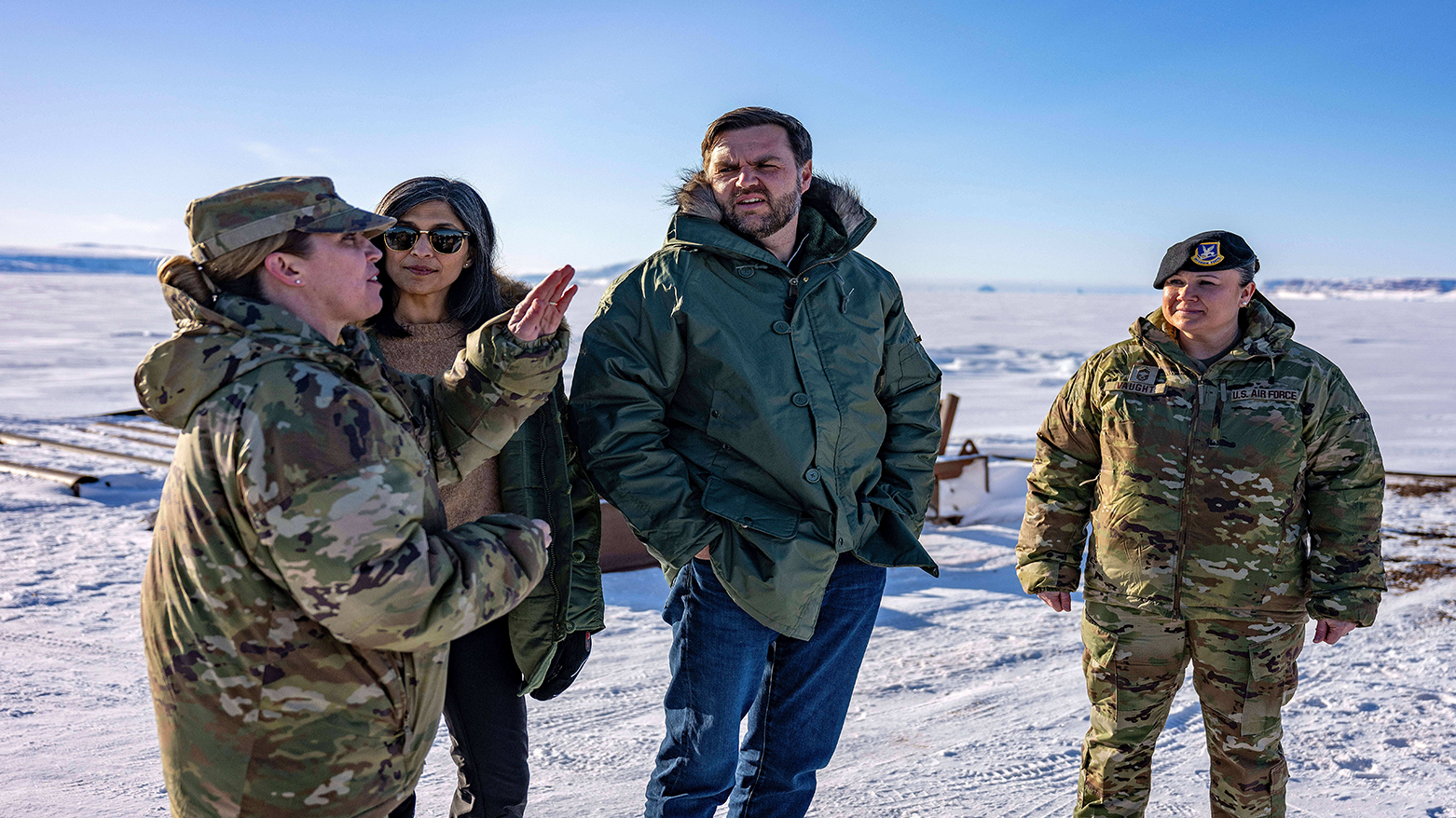
Tensions escalated further at the end of March when U.S. Vice President JD Vance made an uninvited visit to Greenland. Originally planned as a multi-town tour, the trip was widely criticized as provocative and was ultimately shortened to a one-day visit limited to the U.S. military base following strong reactions in Greenland, Denmark, and across Europe.
Economically, Greenland remains heavily dependent on Denmark, receiving subsidies equivalent to roughly one-fifth of its gross domestic product, with fishing forming the backbone of its local economy.
While Greenland manages most domestic affairs, Copenhagen retains control over foreign policy, defense, monetary policy, and judicial matters.
Observers say Trump’s appointment of a special envoy signals a renewed and more assertive U.S. approach to the Arctic, one that could strain relations with close allies even as Washington seeks to counter growing Russian and Chinese influence in the region.
Trump’s renewed push has stunned Denmark, a fellow NATO member that has fought alongside the United States in Afghanistan and Iraq. In January, Copenhagen announced a $2 billion plan to bolster its military presence in the Arctic region, underscoring growing security concerns amid heightened geopolitical rivalry.