Iraqi Militias Reject Disarmament Demands Amid Warnings of Possible Airstrikes
Hashd al-Shaabi supporters rallied in Baghdad Friday to reject disarmament, defying US pressure and ignoring warnings of imminent airstrikes.
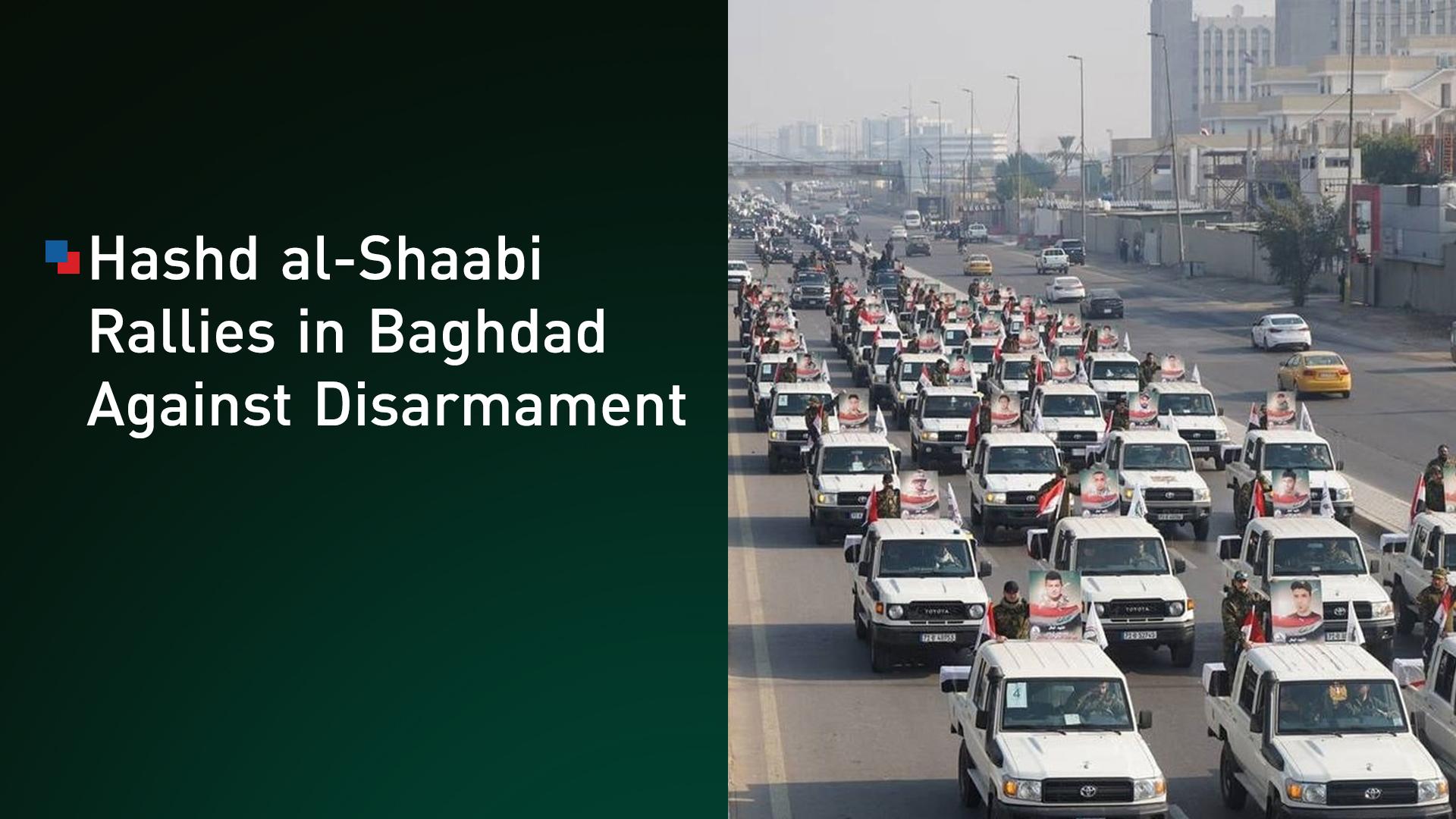
ERBIL (Kurdistan24) — Thousands of gunmen and supporters of the Hashd al-Shaabi armed groups (also known as the Popular Mobilization Forces - PMF) poured into central Baghdad’s Tahrir Square on Friday, staging a defiant military ceremony that sharply contradicted recent diplomatic signals suggesting a willingness among Iraqi armed factions to disarm.
The gathering, held on December 26, 2025, served as a stark commemoration of fighters killed in American airstrikes over the past decade and was characterized by a forceful rejection of Washington’s calls for the dissolution of armed groups operating outside full state control.
The demonstration comes at a moment of extreme volatility for Iraq, as the government faces mounting international pressure to consolidate control over its security apparatus following the November parliamentary elections.
While some political leaders within the ruling Shiite alliance have hinted at restricting weapons to the state, the scene in Tahrir Square offered a visual and rhetorical rebuttal.
Participants carried symbolic coffins and chanted harsh slogans against the United States and Israel, declaring that their arsenal would remain intact and under their command regardless of external demands.
A Show of Force in Tahrir Square
The rally, organized to mark a designated "week of remembrance" for members of the paramilitary forces killed in confrontations with U.S. forces, effectively shut down parts of the capital.
The Hashd al-Shaabi leadership utilized the event to galvanize its base, invoking historical grievances to justify their continued mobilization.
A focal point of the commemoration was the 2019 U.S. airstrike on the bases of the Iraqi Hezbollah group in the town of Qaim, Anbar Governorate. That attack, which resulted in the deaths of nearly 50 gunmen, remains a potent rallying cry for the factions, who view their armed status as a necessary deterrent rather than a challenge to state sovereignty.
During the ceremony, speakers emphasized the retention of their forces, directly addressing the ultimatums issued by Western officials.
“We will not hand them over to any party,” was the prevailing message regarding their weapons stockpiles, a stance that complicates the efforts of Prime Minister Mohammed Shia al-Sudani’s government to navigate between the demands of its Iranian-aligned coalition partners and the security requirements of the United States.
Diplomatic Optimism Meets Hardline Reality
The belligerent tone of Friday’s rally stands in contrast to the tentative diplomatic progress reported earlier in the week.
On December 22, the United States Special Envoy to Iraq, Mark Savaya, had publicly welcomed reported steps by Iraqi armed groups toward disarmament. In a statement, Savaya praised these moves as a "positive response" to the guidance of the religious Marjaeya in Najaf, which has long advocated for the state’s monopoly on the use of force.
However, Savaya also issued a caveat that now appears prescient in light of the Tahrir Square demonstration. He warned that "verbal commitments alone are insufficient" and demanded that disarmament be "comprehensive, irreversible, and implemented through a clear and binding national framework."
The U.S. envoy stressed that under the Iraqi Constitution, no political party or organization has the right to possess armed formations outside the authority of the state—a principle the gunmen in Baghdad openly flouted on Friday.
Intelligence Warnings and the Threat of Strikes
The urgency behind the U.S. push for disarmament—and the factions' defensive posturing—is driven by credible intelligence warnings of potential large-scale military strikes inside Iraq.
According to a report by Asharq Al-Awsat, Iraqi government officials and key political actors received unprecedented messages over the past two weeks from an Arab state and a Western intelligence service.
These messages warned that Iraq was on the precipice of facing a swift military campaign, potentially by Israel with tacit U.S. approval, aimed at dismantling the infrastructure of Iran-backed militias.
The warnings were described as "extremely serious," comparable to the targeting of Hamas’s political infrastructure in Doha in September 2025.
The Arab state, which maintains relations with both Washington and Tehran, cautioned Baghdad that the threat level had escalated significantly.
Subsequently, a Western intelligence service reportedly provided Iraqi officials with a "massive file" containing detailed lists prepared by an Israeli security agency. This file allegedly exposed the factions’ operational networks, covert operatives, financial fronts, and the locations of depots housing drones and ballistic missiles.
Sources briefed on the intelligence indicated that the precision of the data stunned Iraqi officials.
The potential targets included government institutions used as fronts for militia influence, training camps north and south of Baghdad, and specific leadership figures.
It was this looming threat that reportedly accelerated the wave of political statements by some faction leaders earlier in the week calling for "restricting weapons to the state"—a tactical pivot that the rank-and-file at Tahrir Square appeared to reject.
Judicial Intervention and Factional Splits
The crisis has drawn in Iraq’s judiciary, leading to a rare and controversial intervention by Faiq Zidan, the head of the Supreme Judicial Council.
On December 21, Zidan announced that leaders of armed factions had agreed to coordinate on the issue of weapons control. In a public statement, the chief justice thanked the faction leaders "for heeding his advice" to enforce the rule of law and transition to purely political action.
This judicial involvement sparked immediate backlash from U.S. lawmakers.
Representative Joe Wilson sharply criticized Zidan, accusing him of undermining judicial independence by treating armed militias as legitimate partners in dialogue rather than entities subject to the law.
"The corrupt president of the Iraqi Supreme Judicial Council publicly thanked armed factions for their stated intention to disarm," Wilson wrote on X, arguing that such language did not reflect the conduct of a neutral judiciary.
Despite Zidan’s announcement of a consensus, deep divisions remain among the armed groups.
While some factions within the Coordination Framework—such as Asaib Ahl al-Haq, led by Qais al-Khazali—have signaled a readiness to integrate into the state (claiming they are already "part of the state"), others have adopted a more confrontational stance.
Kataeb Hezbollah, one of the most powerful pro-Iran factions, issued a statement declaring it would only consider relinquishing arms once foreign troops have fully withdrawn from Iraq. "The resistance is a right, and its weapons will remain in the hands of its fighters," the group stated, a sentiment echoed by the crowds in Baghdad on Friday.
Internal Security Crackdown
Amidst the geopolitical standoff involving the PMF, the Iraqi Ministry of Interior has launched a parallel domestic campaign to reassert state authority over tribal violence, utilizing counterterrorism laws to prosecute offenders.
On December 22, Interior Ministry spokesperson Col. Abbas al-Bahadli announced that the practice known as dakka al-ashairiya—tribal armed raids used for intimidation—would be treated as a terrorist crime.
Col. Bahadli emphasized that the ministry would not tolerate "any weapon outside the framework of the state," warning that tribal disputes involving firearms pose a direct threat to civil peace.
While this crackdown targets tribal actors rather than the politically powerful Shiite militias, it represents a broader government effort to signal a commitment to law and order. However, critics argue that prosecuting tribes for small-arms use while allowing PMF brigades to parade heavy weaponry in the capital highlights the selective nature of the state’s monopoly on force.
Political Deadlock and Government Formation
The struggle over weapons is inextricably linked to the ongoing negotiations to form a new government following the November 11 general elections.
Prime Minister Mohammed Shia al-Sudani is seeking a second term, supported by a significant bloc within the Coordination Framework. However, his bid is contested by former Prime Minister Nouri al-Maliki, who favors a consensus candidate.
The armed factions, many of which secured seats in the new parliament, are leveraging their military capabilities as bargaining chips.
According to reports, while they publicly discuss "restricting weapons," they are simultaneously demanding "freedom of action" and more time to adapt to regional changes. They are wary of submitting to disarmament protocols that might leave them vulnerable to U.S. or Israeli strikes, or diminish their political leverage in the incoming administration.
Western diplomatic sources have indicated that Col. Stephanie Bagley, the new head of the U.S. Office of Security Cooperation, arrived in Iraq recently with a mandate to seek a clear and verifiable timeline for reducing the operational capacity of Iran-aligned groups.
The U.S. defense budget for 2025 has introduced conditions tying security cooperation funding to Baghdad’s ability to rein in these actors.
The Road Ahead
The military ceremony in Tahrir Square serves as a tangible reminder of the disconnect between the diplomatic assurances given in closed-door meetings and the reality on the Iraqi street.
While the threat of foreign airstrikes has forced the leadership of the Coordination Framework to consider concessions regarding heavy weaponry, the grassroots and hardline elements of the Hashd al-Shaabi remain mobilized and defiant.
As the "week of remembrance" continues, the risk of escalation remains high. The U.S. State Department has reaffirmed its intention to press for the dismantling of militias that undermine Iraq’s sovereignty.
Meanwhile, the factions’ refusal to hand over weapons, coupled with their public display of force in the heart of the capital, suggests that the transition to a state-monopolized security architecture remains a distant and perilous goal.
With warnings of "imminent" strikes hanging over Baghdad, the coming weeks may prove decisive in determining whether the Iraqi state can assert control or if the country will be drawn further into a cycle of regional conflict.