Thousands of Alawites Rally in Syria Seeking Autonomy After Deadly Homs Mosque Bombing
Thousands of Alawites protested in Syria, clashing with security forces after a mosque bombing killed eight. They demanded federalism and protection amid rising sectarian violence.
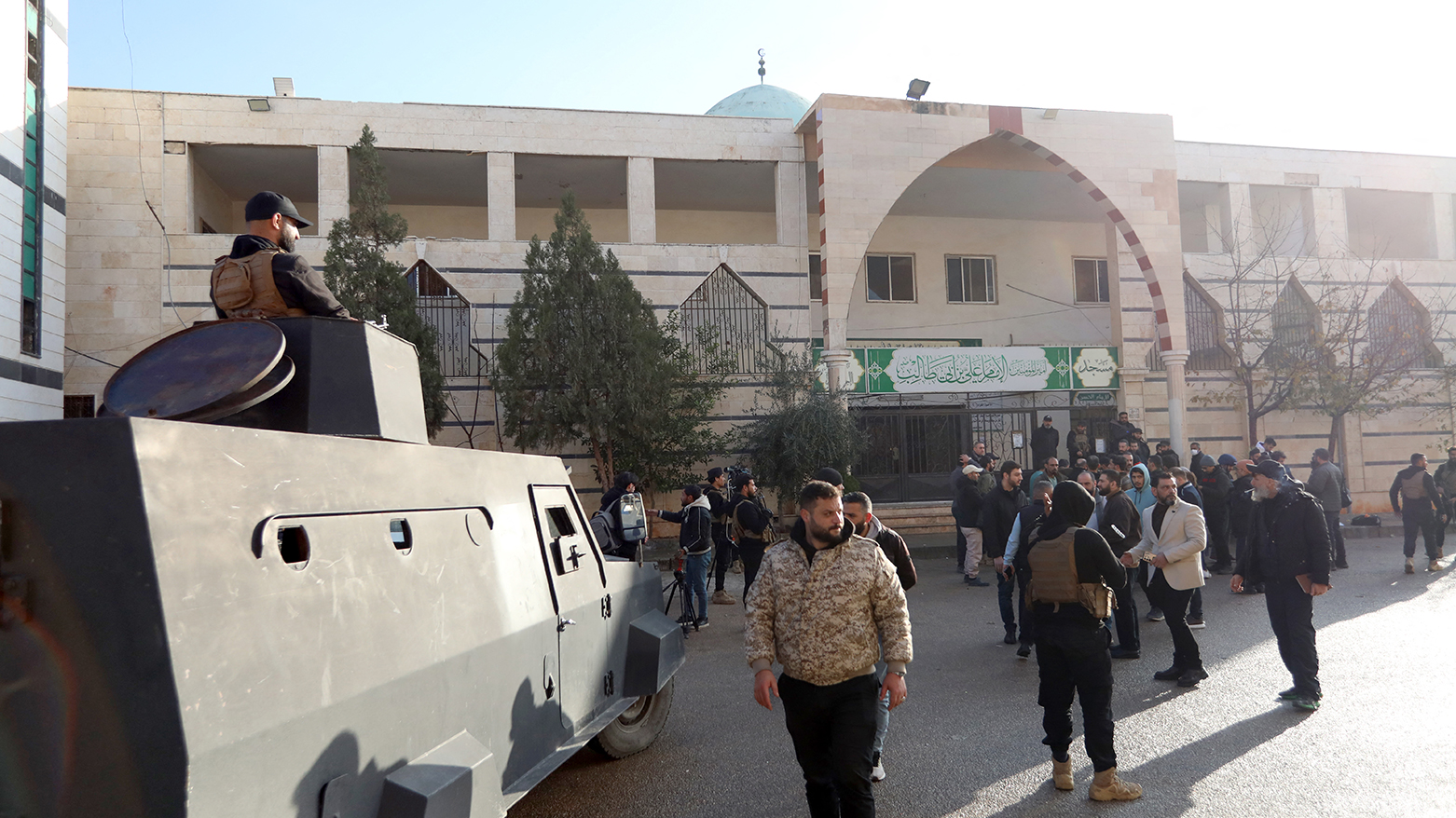
ERBIL (Kurdistan24) – Thousands of demonstrators from Syria’s Alawite minority gathered in coastal and central cities on Sunday to demand greater regional autonomy and security protections, according to a report by Agence France-Presse (AFP), following a mosque bombing that killed eight people and reignited sectarian tensions under the country’s new Islamist leadership.
The protests, which swept through the coastal heartlands of Latakia and Tartus as well as the central city of Homs, marked a significant escalation in unrest just two days after the attack on a place of worship in an Alawite district.
The demonstrations underscored the deepening fracture between the minority community and the new Islamist authorities who assumed power following the fall of longtime ruler Bashar al-Assad in December 2024.
According to AFP, the Sunday gatherings devolved into violence in several locations, with security forces intervening to break up clashes between Alawite protesters and supporters of the new government.
An AFP correspondent in the coastal city of Latakia, a traditional stronghold of the Alawite community, observed security forces moving to disperse the crowds as confrontations erupted. Similar scenes of unrest were reported in the town of Jableh, where another correspondent witnessed clashes.
The Syrian Observatory for Human Rights, a war monitor, reported that violence also broke out in the city of Homs itself, resulting in several injuries. The unrest reflects a volatile security environment where communal grievances are increasingly spilling into the streets.
The catalyst for Sunday's mobilization was a bombing on Friday that targeted a mosque in an Alawite neighborhood of Homs. While Homs is a predominantly Sunni Muslim city, it contains significant Alawite enclaves.
The attack, which left eight dead, was viewed by the community as the latest in a series of targeted assaults against the religious minority. The Alawite faith, which stems from Shiite Islam, was the sect of former President Assad, a fact that has complicated the community's standing in the post-Assad era.
In Latakia, demonstrators expressed a mix of fear and political frustration, attempting to distance themselves from the legacy of the former regime while demanding accountability from the current rulers. Numeir Ramadan, a 48-year-old trader participating in the protests, articulated the community’s sense of vulnerability.
"Why the killing? Why the assassination? Why the kidnapping? Why these random actions without any deterrent, accountability or oversight?" Ramadan asked. He emphasized that the community should not be collectively punished for the past, stating, "Assad is gone, and we do not support Assad... Why this killing?"
The protests were organized in part following a public appeal by Ghazal Ghazal, a prominent spiritual leader and the head of the Islamic Alawite Council in Syria and Abroad.
On Saturday, Ghazal issued a video message on Facebook urging his followers to take to the streets to "show the world that the Alawite community cannot be humiliated or marginalized." His message framed the demonstrations not merely as a reaction to the bombing, but as a political assertion of the community’s right to self-determination within the new Syrian order.
"We do not want a civil war, we want political federalism. We do not want your terrorism. We want to determine our own destiny," Ghazal stated in the video. This call for "political federalism" has become a central rallying cry for the demonstrators, who carried banners supporting Ghazal and chanted slogans demanding a decentralized government authority that would grant them a degree of regional autonomy.
The demand for federalism represents a direct challenge to the new Islamist authorities in Damascus, who have thus far rejected calls for decentralization, favoring a unified, centralized state structure. However, the protesters argue that autonomy is the only viable mechanism to ensure their physical safety.
Hadil Salha, a 40-year-old housewife at the protest, told AFP, "Our first demand is federalism to stop the bloodshed, because Alawite blood is not cheap, and Syrian blood in general is not cheap." She added bluntly, "We are being killed because we are Alawites."
Placards visible at the demonstrations called for an end to "sectarian speech," highlighting the dangerous rhetoric that has accompanied the political transition.
Since the fall of the Assad government, the Syrian Observatory for Human Rights and residents of Homs province have reported a sustained pattern of kidnappings and killings targeting members of the minority community. These incidents have fueled a perception among Alawites that the central government is either unable or unwilling to protect them.
The fears expressed on Sunday are rooted in recent episodes of mass violence.
AFP reported that the country has witnessed several bloody flare-ups of sectarian conflict in the year since the change in government. In March, coastal areas experienced a massacre of Alawite civilians. At the time, authorities accused armed supporters of the former Assad regime of sparking the violence by attacking security forces, a narrative contested by community members.
The toll of the March violence was catastrophic.
A national commission of inquiry determined that at least 1,426 members of the Alawite minority were killed during that period.
The Syrian Observatory for Human Rights provided an even higher estimate, putting the death toll at more than 1,700. This history of mass casualties has created a backdrop of existential dread that animated the crowds on Sunday.
Late last month, thousands had already demonstrated on the coast to protest fresh attacks targeting Alawites in Homs and other regions, indicating that the current unrest is part of a growing trend of civil disobedience.
In addition to security and autonomy, the protesters demanded the release of detainees.
Before and after the bloodshed in March, the new authorities carried out massive arrest campaigns in predominantly Alawite areas, which were formerly strongholds of the Assad family. These security sweeps have remained a point of contention. On Sunday, demonstrators called for the freedom of those imprisoned during these operations.
In an apparent attempt to quell the rising anger, Syrian state television reported on Friday—coinciding with the mosque bombing—that 70 detainees in Latakia had been released. The state broadcaster stated that the release occurred "after it was proven that they were not involved in war crimes," and noted that more releases would follow.
However, this concession appears to have done little to assuage the community's anger, particularly in the wake of the subsequent bombing.
The situation remains legally and politically deadlocked. Despite repeated assurances from Damascus that all of Syria's diverse communities will be protected under the new administration, minorities remain deeply wary of their future.
The Islamist character of the new authorities, combined with the demographic dominance of the Sunni majority, has intensified the Alawites' sense of isolation. As the new government continues to reject the federalist model proposed by leaders like Ghazal, the path toward reconciliation appears fraught with potential for further conflict.