How the World Welcomes the New Year: Rituals from Kurdistan's Celebrations to Chile's Cemeteries
Cultures worldwide welcome the New Year through diverse rituals rooted in belief, spirituality, and heritage, each reflecting a shared hope for luck, renewal, and a better future.
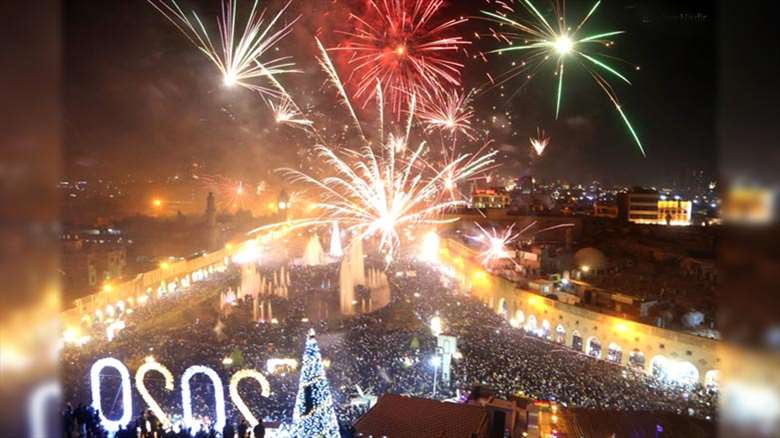
ERBIL (Kurdistan24) - The New Year is almost here, and it has arrived faster than many expected. As moments slip away, it feels as though time itself has accelerated, carrying with it a year filled with sorrow, joy, and unforgettable events. With the final seconds approaching, societies pause, reflect, and prepare to welcome what lies ahead.
The Kurdistan Region marks New Year’s Eve with a wide range of celebrations and activities. Fireworks light up the night sky, while parties, social gatherings, and live music bring people together. Homes are decorated with festive touches, and government institutions decorate public landmarks, including Erbil Castle. As midnight approaches, the traditional countdown of the final seconds of the year is observed, uniting families and communities in anticipation.
In the Kurdistan Region’s capital, Erbil, residents are fully prepared to bid farewell to 2025 and welcome 2026. The city becomes a focal point of celebration, reflecting both modern festivities and shared communal spirit.
Beyond the Kurdistan Region, New Year’s traditions vary widely across the world, with some practices appearing unfamiliar or even obscure to others. In Greece, for example, families traditionally hang an onion on their front doors as a symbol of rebirth. On New Year’s Day, parents wake their children by gently tapping them on the head with the onion, reinforcing the belief in renewal and growth.
As the clock’s hands reach twelve in the final seconds of December, the world does not simply say goodbye to a year. Instead, a symbolic doorway opens, shaped by hope for good fortune and concern about the future. At this moment, societies across the globe turn to rituals deeply rooted in myth, belief, and celebration.
With the night of Dec. 31 drawing closer and the final seconds counted down, the world looks toward the horizon of a new beginning. Expressions of joy and anticipation differ sharply from one country to another, revealing deep cultural contrasts.
In Spain, the arrival of midnight transforms public squares into gathering points filled with anticipation. Spaniards believe that eating twelve grapes in perfect harmony with the twelve chimes of the city’s main clock holds the key to good fortune for the twelve months ahead. This tradition, rooted in history, is not merely about consumption but functions as a timed ritual that tests concentration and speed at the precise moment the New Year begins.
In Denmark, an act considered destructive in many cultures takes on an entirely different meaning. On New Year’s Eve, Danes deliberately smash old plates and cups against the doors of friends and loved ones. The resulting piles of broken ceramics are not signs of anger but symbols of affection and loyalty. A larger collection of shattered dishes indicates a wider circle of friends, stronger social bonds, and greater hopes for good fortune in the year ahead.
Scotland’s New Year celebrations, known as Hogmanay, place special emphasis on the tradition of “First Footing.” According to local belief, the first person to cross the threshold of a home after midnight determines whether the coming year will bring luck or misfortune. A man arriving with a gift such as bread or coal is believed to symbolize prosperity, warmth, and abundance for the household throughout the year.
In Japan, welcoming the New Year carries a deeply spiritual and religious dimension. Buddhist temples ring their bells 108 times during the final moments of the year. In Buddhist philosophy, the number represents 108 worldly desires or human flaws. Each bell toll serves as a symbolic act of purification, allowing individuals to cleanse their inner selves and enter the New Year with spiritual peace and emotional clarity.
In Chile, New Year’s Eve is observed by some in a markedly different way. While much of the world celebrates with music and lights, certain families choose to spend the night in cemeteries alongside the graves of loved ones. Though this tradition may seem unusual to outsiders, it reflects a deep sense of loyalty, remembrance, and family unity. The belief holds that sacred occasions should be shared with all family members, even those no longer living.
In Brazil, New Year’s Eve unfolds as a vibrant blend of color and nature. Millions of people dress in white clothing, symbolizing peace and tranquility, before heading to the coastline. There, they offer flowers to the sea and perform the ritual of jumping over seven waves. Each leap represents a wish for the coming year, reflecting the nation’s profound cultural connection to the ocean and the natural world.
In Colombia, the New Year is welcomed with movement and anticipation of travel. At midnight, people can be seen carrying empty suitcases and walking around their homes or neighborhoods. This symbolic act expresses hope that the coming year will be filled with journeys, exploration, and opportunities to discover new places.
Although these traditions differ widely in form and meaning - and some are deeply intertwined with legend and belief - they ultimately converge on a single shared aspiration: the human desire for a better future and the enduring hope of drawing luck, happiness, and renewal into life with the arrival of the New Year.