SDF Commander Arrives in Damascus for Military Integration Talks Under March 10 Accord
SDF Commander Mazloum Abdi is in Damascus discussing military integration with Syrian officials and U.S. Brigadier General Kevin Lambert. The talks aim to implement the March 10 agreement to reunify Syria.
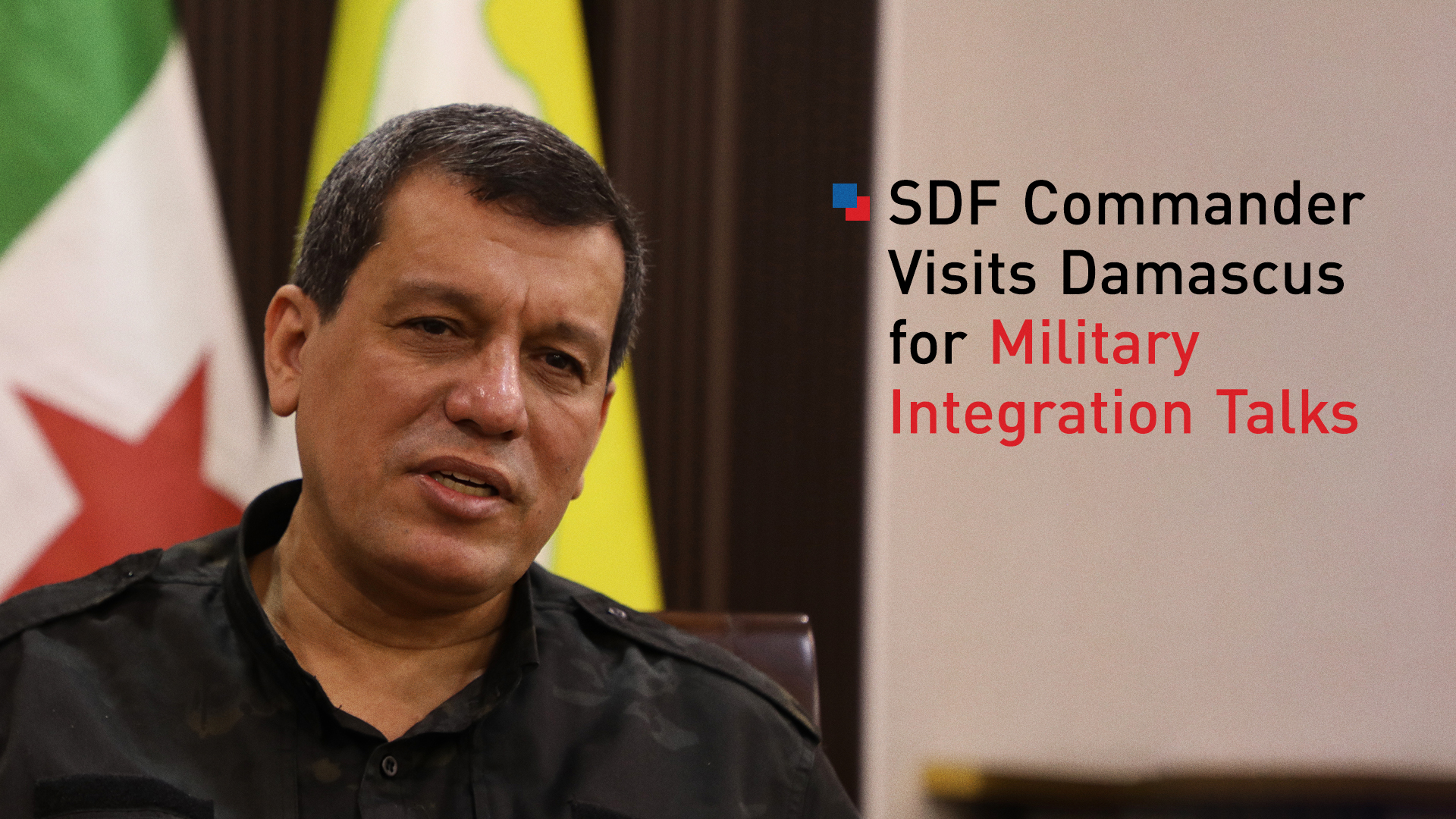
ERBIL (Kurdistan24) — Mazloum Abdi, the General Commander of the Syrian Democratic Forces (SDF), arrived in Damascus on Sunday to commence negotiations with Syrian government officials regarding the integration of his forces into the national military structure. The visit, confirmed by SDF leadership, marks a pivotal moment in the implementation of the March 10 agreement, a landmark pact designed to reunify the autonomous northeastern regions with the central Syrian state.
The arrival of the Kurdish-led delegation was announced by Farhad Shami, the spokesperson for the Syrian Democratic Forces, in a statement released on the social media platform X.
According to Shami, the delegation is currently engaged in meetings with officials of the Syrian government to determine the specific mechanisms required for the military integration of SDF forces with the "new Syrian Army."
This step is viewed as the cornerstone of the reunification process outlined in the previous year's diplomatic breakthroughs.
Leading the delegation is General Commander Mazloum Abdi, accompanied by senior military figures Sozdar Haji and Sipan Hamo, both members of the SDF General Command.
The composition of the group suggests a focus on the practical and operational aspects of merging the command structures of the SDF — which has operated with significant autonomy in northeastern Syria, also known as Western Kurdistan or Rojava — with the central state's armed forces.
Underscoring the international geopolitical weight of these discussions, the meeting is taking place in the presence of Brigadier General Kevin J. Lambert, the Commander of the Combined Joint Task Force – Operation Inherent Resolve.
The attendance of a top-ranking U.S. military official signals Washington’s continued role as a mediator and guarantor of the process, ensuring that the integration aligns with the broader security architecture established during the fight against regional insurgencies.
The high-stakes talks on Sunday follow a brief logistical delay.
The visit had originally been scheduled for Dec. 29 of last year. However, the Syrian Democratic Forces had issued a statement at the time postponing the trip due to "technical reasons," while emphasizing a commitment to conducting the visit in the near future.
The prompt rescheduling to January 4 reflects the urgency felt by both parties to address the outstanding elements of their unification roadmap.
The discussions in Damascus are anchored in the comprehensive agreement signed on March 10, 2025, between Abdi and Ahmed Sharaa, the President of Syria.
Brokered through United States mediation, the agreement was hailed as a historic measure aimed at ending the fragmentation of the country and bringing the areas under the control of the Autonomous Administration back within the framework of the Syrian state.
The terms of the accord stipulated that implementation works were to be completed by the end of 2025, a deadline that has just passed, adding impetus to Sunday’s proceedings.
Central to the current negotiations is the provision for "Military and Civil Integration."
The March 10 agreement explicitly calls for the integration of all civil and military institutions of northeastern Syria with the administration of the Syrian state.
This sweeping mandate includes the transfer of control over critical infrastructure, specifically border crossings, airports, and the region's lucrative oil and gas fields, which have been a focal point of economic and political tension throughout the conflict.
Beyond the military and economic dimensions, the March 10 agreement addresses fundamental sociopolitical issues that have long driven the wedge between the Kurdish population and Damascus.
The pact includes clauses recognizing the Kurdish community as an "indigenous component" of the Syrian state. It guarantees their citizenship rights and all constitutional rights, a significant shift from decades of marginalization.
The framework also outlines a path toward broader political inclusivity. It ensures the right of all Syrians to representation and participation in the political process and state institutions, irrespective of religious or ethnic backgrounds.
This is coupled with a "Comprehensive Ceasefire" mandated across the entire territory of Syria to facilitate the transition.
Security and humanitarian concerns remain a major part of the dialogue. The agreement obligates the state to ensure the return of all displaced Syrian persons and refugees to their places of origin, with the Syrian state assuming responsibility for their security.
Furthermore, the pact aligns the SDF and the central government against common adversaries, pledging support to the Syrian state in confronting the "remnants of the Assad regime" and other threats endangering the country's territorial integrity.
As the meetings unfold in Damascus, the presence of General Lambert and the senior SDF command indicates that the focus has shifted from the theoretical framework of the March 10 agreement to the granular details of its execution.
The successful integration of the SDF into the new Syrian Army remains the most complex hurdle in finalizing the reunification of the country and adhering to the timeline that envisioned a unified state structure by the turn of the year.
This article was updated on Sunday Jan. 4, 2026, at 01:17pm, adding new information about the SDF Commander's visit to Damascus.