Erdoğan Says No “Right to Hope” Measure for Abdullah Öcalan
According to Türkiye Gazetesi, Erdoğan cautioned against misleading information suggesting that Abdullah Öcalan could regain his freedom through a “Right to Hope” provision.
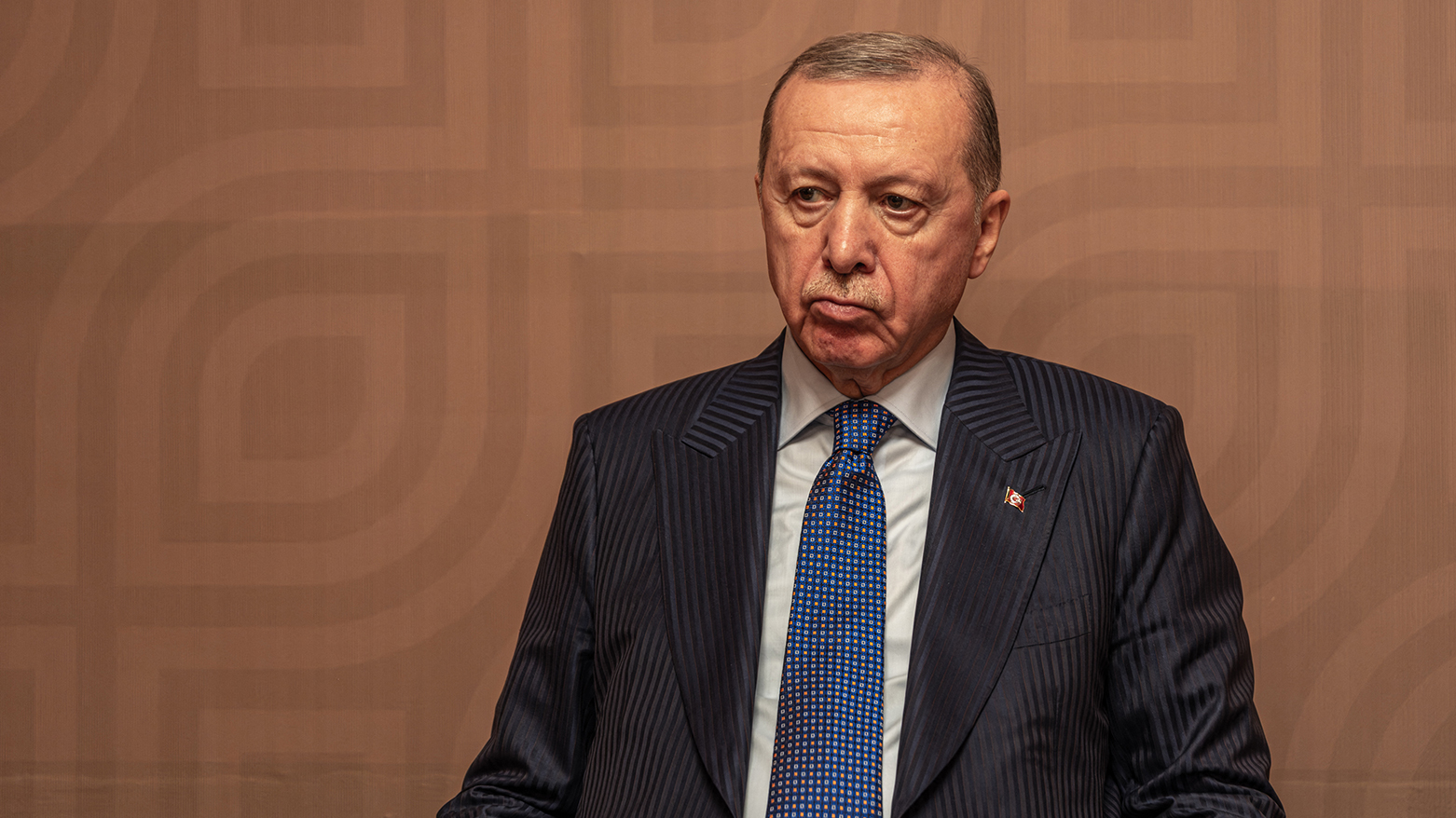
ERBIL (Kurdistan24) - Turkish President Recep Tayyip Erdoğan has instructed his staff to clearly communicate to the public that there will be no person-specific regulation regarding the so-called “Right to Hope,” amid discussions on legal steps following a parliamentary report on a “Terror-Free Türkiye,” according to a report published Sunday.
According to Türkiye Gazetesi, Erdoğan cautioned against misleading information suggesting that Abdullah Öcalan could regain his freedom through a “Right to Hope” provision.
Erdoğan was quoted as saying: “There can be no person-specific regulation. We must explain this very well to our citizens.” He also reportedly warned: “No such thing can happen; let us be very careful about this. We must explain it very well to the citizen. There will be no person-specific regulation.”
The remarks came after the emergence of a parliamentary report addressing a “Terror-Free Türkiye” initiative, which has brought renewed attention to the legal status of members of the outlawed organization if they lay down their arms. For upcoming legislative work, Erdoğan directed his staff to ensure that the public understands there will be no individualized application of a “Right to Hope.”
AK Party sources, speaking about presentations made to the president regarding legal steps to be taken after the dissolution of the organization and the laying down of arms, described the matter as sensitive.
“This is a very sensitive issue. We will see the bar set by MİT [National Intelligence Organization]. The President’s instruction is also in the direction of ‘handle this matter with seriousness,’” sources said.
The same sources stated that the concept of the “Right to Hope” is being misunderstood in public discourse.
“It is not an amnesty, not a sentence reduction, and not a release. In the field, when the ‘Right to Hope’ is mentioned, it is perceived as if an amnesty will be granted to Öcalan. Such a thing will not happen,” they said.
Discussions over the legal framework come as authorities closely monitor developments in areas where the organization has been active.
According to information obtained from AK Party sources, a “Monitoring Mechanism” will first be established by the president in the new stage of the process. The mechanism is expected to oversee the evacuation of nearly 30 caves, large and small, located on the route from the Turkish border to Qandil, where the organization is described as being nested.
Security sources reported that seven of the approximately 30 caves have so far been evacuated and cleared. The monitoring mechanism will track whether the remaining caves have been vacated. The president will be informed at short intervals about the situation on the ground, according to the report.
If developments indicate that the organization has laid down its arms, a standalone and temporary “framework law” will be enacted, AK Party lawyers said.
The proposed legislation would include articles outlining its purpose and scope, as well as provisions describing the monitoring and verification mechanism. It would also contain regulations concerning members of the organization who have not been involved in crimes.
AK Party legal experts indicated that the framework law would include a time limit specifying how long it would remain in effect. The legislation is described as temporary and process-oriented.
Subsequent legal steps are expected to follow only after it is concluded that the organization has completely laid down its arms and its legal existence has ended. At that stage, changes to the Execution Law, the Turkish Penal Code, and the Anti-Terror Law would come to the agenda, according to the report.
The issue of conditional release periods within the execution regime is also expected to be discussed. AK Party staff members, emphasizing the aim of establishing what they described as an egalitarian execution system, said they are focusing on applying a one-half execution period for other types of crimes, excluding those that provoke public indignation.
Party sources stressed that the contemplated regulations would not amount to a sentence reduction or an amnesty. “For someone who has served half of their sentence in prison, if they fulfill all conditions, the possibility of [serving the remainder of] the execution outside may be granted,” sources said.
They added that reports from observation boards and decisions by execution judges would be decisive in such cases. “Those with the potential to commit crimes outside will continue to remain in prison,” they said.
Regarding Abdullah Öcalan and individuals in similar situations, the report noted that for them to benefit from conditional release provisions, Paragraph 16 of Article 107 of the Criminal Execution Law would need to be repealed.
The developments reflect a phased approach described by AK Party sources, beginning with monitoring and verification measures, followed by a temporary legislative framework and, if conditions are met, broader amendments to existing penal legislation.
Erdoğan’s instruction to his staff, as reported, focused on ensuring that public communication is clear and that expectations are not shaped by what he characterized as misleading interpretations of the “Right to Hope.”