South Korean Leader Visits Beijing to Reset Ties as Xi Calls for ‘Correct Strategic Choices’
South Korea's Lee and China's Xi met in Beijing to reset ties, signing 15 deals and agreeing to seek peace with North Korea. Lee balanced US alliance with "pragmatic" diplomacy amid global tensions.
ERBIL (Kurdistan24) — South Korean President Lee Jae Myung met with Chinese leader Xi Jinping in Beijing on Monday, marking a significant effort to thaw diplomatic relations that had chilled under the previous administration in Seoul. In a summit that ranged from lighthearted exchanges over consumer technology to grave discussions regarding regional security and economic protectionism, both leaders signaled a desire to stabilize ties despite a geopolitical landscape characterized by intensifying rivalry between the world's superpowers.
The meeting at the Great Hall of the People was the first state visit to China by the South Korean President Lee Jae Myung since he took office in June 2025, following the impeachment and removal of his predecessor, Yoon Suk Yeol.
While the former administration had pursued a foreign policy closely aligned with Washington, Lee has advocated for a more "pragmatic" diplomatic approach, seeking to balance the country’s stalwart military alliance with the United States against the economic and geographical imperatives of maintaining functional relations with China.
The summit took place against a backdrop of global turbulence. Just days prior to Lee's arrival, a United States military operation in Caracas resulted in the capture of Venezuelan President Nicolás Maduro on drug trafficking charges, a raid that drew sharp condemnation from both Beijing and Pyongyang.
Amid this atmosphere, Xi urged Lee to join Beijing in making the "right strategic choices" in a world that is "becoming more complex and turbulent," according to reports from Agence France-Presse (AFP).
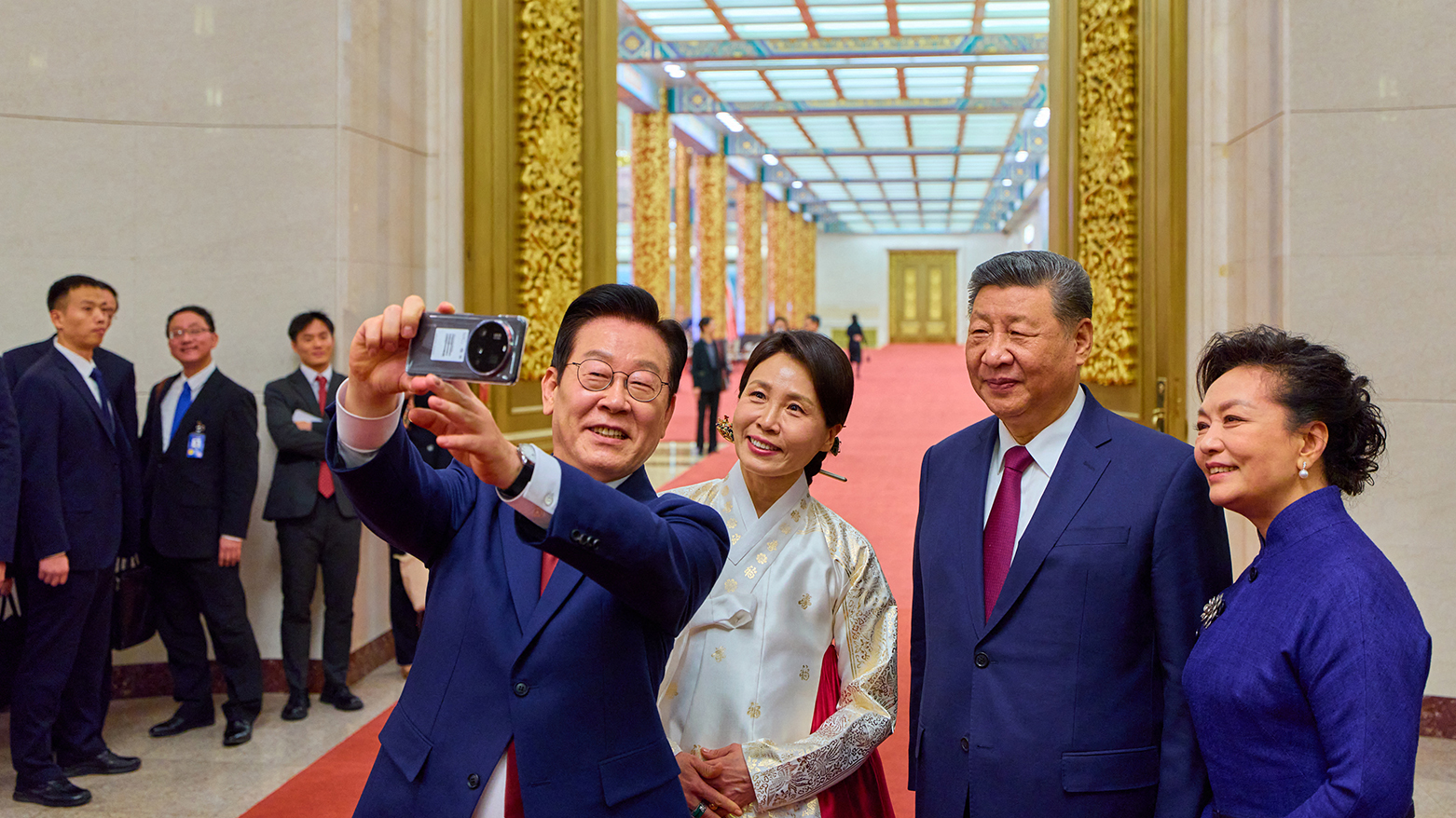
In an unusual display of personal diplomacy intended to project warmth, the two leaders shared a moment of levity regarding a gift Xi had bestowed upon Lee: a Xiaomi smartphone.
During a previous encounter on the sidelines of an APEC summit in South Korea in November, Xi had joked with Lee about the device. When the South Korean president asked if the communications were secure, the Chinese leader had urged him to "check if there is a backdoor," a reference to pre-installed software that could allow third-party monitoring.
On Monday, Lee used that same device to snap a selfie with Xi and their wives, later posting the image to the social media platform X. "Thanks to them, I got the shot of a lifetime," Lee wrote, adding a pledge to "communicate more frequently and collaborate more closely going forward."
Lee’s office also released video footage in which Xi complimented the South Korean leader’s photography skills. The interaction, widely shared on social media, appeared designed to signal a personal rapport between the leaders, though online commentators were quick to note the irony of discussing surveillance technology given the security concerns often raised by Western governments regarding Chinese telecommunications equipment.
Beyond the pleasantries, the summit tackled substantive and contentious issues, particularly regarding the Korean Peninsula.
According to South Korea's Yonhap News Agency, the two leaders shared a consensus on the vital importance of resuming dialogue with North Korea. National Security Adviser Wi Sung-lac told reporters that Lee underscored the necessity of Beijing’s cooperation to bring Pyongyang back to the negotiating table, as the regime has shown little sign of engaging in diplomacy recently.
While Lee was assured of China's willingness to play a "constructive" role, the South Korean president notably avoided direct mentions of "denuclearization" in his opening remarks, focusing instead on "viable alternatives for peace."
This omission aligns with what Yonhap described as a focus on practical cooperation, though the leaders reaffirmed that peace and stability on the peninsula serve the interests of both nations. They agreed to expand communication among defense authorities to build mutual trust.
Economic integration and resistance to protectionism formed another pillar of the talks. Xinhua, China’s official state news agency, reported that Xi emphasized that the two nations share close economic ties with deeply interwoven supply chains.
Xi called on both sides to "oppose protectionism and practice true multilateralism," a statement likely aimed at United States efforts to restrict Chinese access to advanced technologies.
Xi further encouraged South Korea to align its development strategies with China’s domestic goals, specifically the newly formulated 15th Five-Year Plan, which outlines Beijing's economic blueprint for the next half-decade.
The leaders witnessed the signing of 15 cooperation documents covering scientific innovation, the ecological environment, transportation, and trade. Xi stressed that the two countries should achieve more results in emerging fields such as the "silver economy," artificial intelligence, and green industries.
However, friction points remain. Yonhap reported that the summit addressed Seoul’s concerns regarding Chinese steel structures installed in a jointly managed Provisional Maritime Zone (PMZ) in the Yellow Sea.
Since 2018, Beijing has erected these structures, raising questions in Seoul about China’s territorial intentions. The two sides agreed to hold vice-ministerial talks on the issue this year, with South Korean officials expressing "cautious hope" for progress.
Additionally, Lee sought to address the lingering effects of the diplomatic dispute over the 2017 deployment of a U.S. missile defense system in South Korea, which led to unofficial Chinese restrictions on Korean cultural exports.
The two leaders discussed gradually expanding cultural exchanges, with specific mentions of cooperation in films and dramas, an area that has suffered under the unacknowledged ban.
Historical narratives played a significant role in the diplomatic rhetoric.
Both Xi and Lee referenced their nations' shared history of suffering under and fighting against Japanese militarism in the early 20th century. Lee noted that the two neighbors have maintained friendly ties for thousands of years, while Xi, according to Xinhua, called for the two nations to "join hands to safeguard the fruits of the victory in World War II," a framing that subtly emphasizes a shared regional perspective distinct from the trilateral security cooperation pursued by Washington, Tokyo, and Seoul in recent years.
Regarding the sensitive issue of Taiwan, South Korean officials confirmed that Lee reaffirmed Seoul’s respect for the "One China" policy. Lee expressed his hope that the summit would make 2026 the first year for the "full restoration" of bilateral relations, aiming to develop their partnership into an "irreversible trend of the times."
The meeting concluded with a symbolic gesture of cultural goodwill: the signing of a document pledging the return to China of a pair of Qing Dynasty stone lion statues, which had been purchased by a Korean foundation in 1933.
As Lee returns to Seoul, the challenge remains to reconcile these renewed ties with China with the security demands of the U.S. alliance, all while navigating the "complex and turbulent" global environment warned of by Xi.