Maduro Declares Himself “Prisoner of War” as U.S. Backs Vice President to Lead Venezuela
Maduro claims POW status in NY court; Trump courts US oil firms for Venezuela and backs VP Rodríguez as interim leader, sidelining opposition figure Machado.
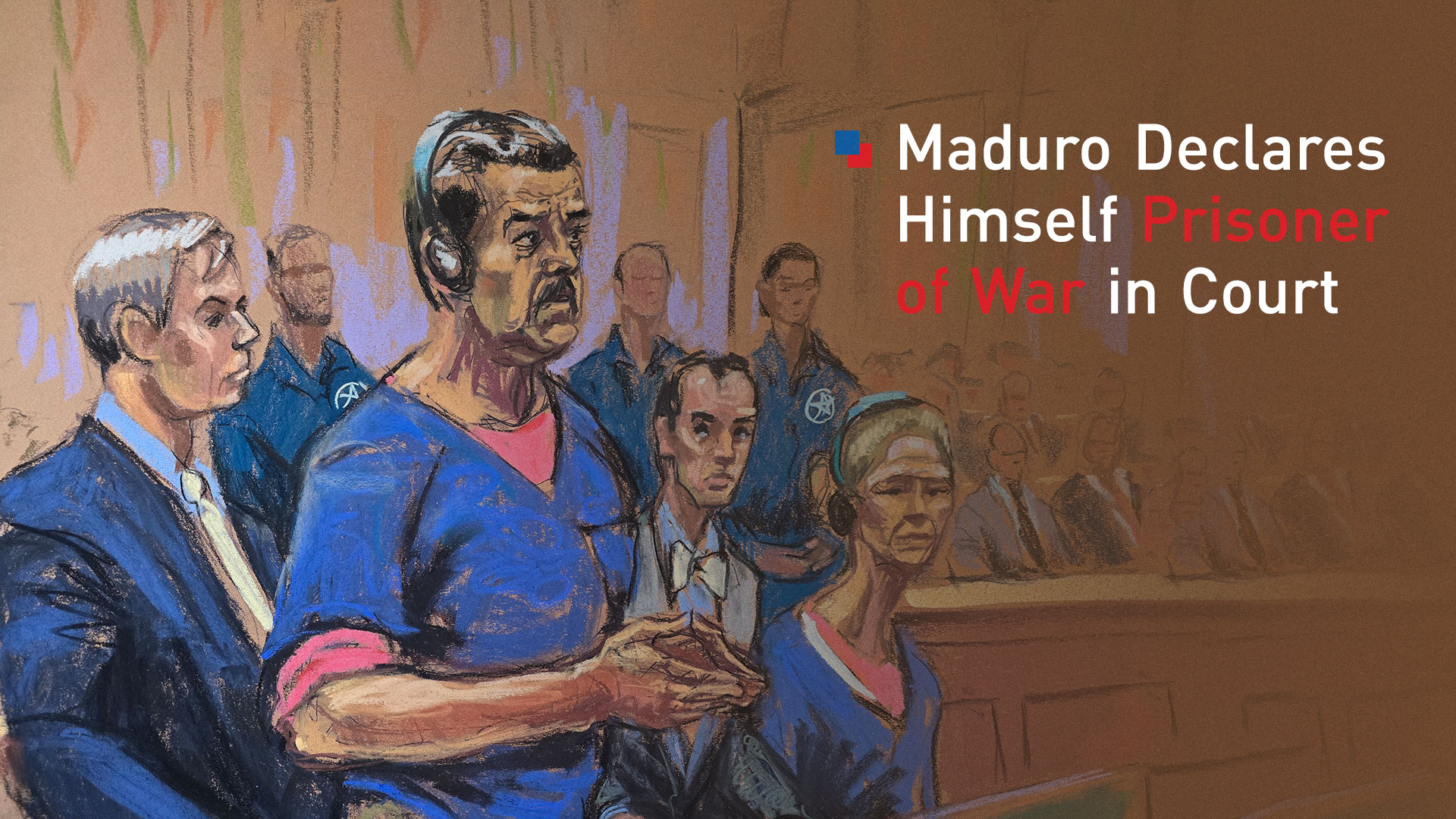
ERBIL (Kurdistan24) — Deposed Venezuelan leader Nicolás Maduro appeared in a federal district court in Lower Manhattan on Monday, pleading not guilty to charges of narco-terrorism and conspiracy to import cocaine while insisting that his status as a head of state captured in a military raid qualifies him as a "prisoner of war" rather than a common criminal defendant. The courtroom declaration came as the Trump administration moved rapidly to implement a comprehensive strategy to revitalize Venezuela’s dilapidated oil sector using American energy companies, a plan President Trump had hinted at to industry executives weeks before the operation.
During his arraignment before Judge Alvin K. Hellerstein, Maduro, 63, sought to challenge the fundamental legitimacy of the U.S. legal proceedings against him.
According to a report by The New York Times, the ousted leader interrupted the proceedings to assert that he is the president of Venezuela and had been "kidnapped" by U.S. forces. By declaring himself a "prisoner of war," Maduro aimed to highlight the contradictions inherent in the Trump administration’s framing of the extraction operation.
While officials like Secretary of State Marco Rubio have defended the mission as a "surgical law enforcement operation" designed to execute a 2020 criminal indictment, the involvement of Army Delta Force commandos, airstrikes on military installations, and the lack of congressional approval suggest a military conflict governed by international laws of war.
Legal experts indicated that Maduro’s strategy faces significant hurdles in the U.S. judicial system.
Daniel C. Richman, a Columbia Law School professor and former federal prosecutor, told The New York Times that while prisoners of war are protected under the Geneva Convention from being tried merely for their status as combatants, they can still face prosecution for specific pre-existing crimes.
Furthermore, the convention dictates that prisoners of war are generally released at the end of a conflict rather than sentenced by a judge. However, in a U.S. federal court, Maduro is being treated as a criminal defendant facing accusations of personal wrongdoing under civilian laws.
Judge Hellerstein dismissed Maduro’s speeches regarding the legality of his capture during the hearing, stating, "There will be time and place to get into all of this."
Maduro and his wife, Cilia Flores, are currently being held at the Metropolitan Detention Center in Brooklyn, a facility notorious for its harsh conditions.
They join approximately 1,300 other inmates in a lockup where legal proceedings can drag on for years. The Times reported that conditions at the facility have been so grave that a judge in 2024 refused to send a convict there while awaiting sentencing.
Oil Executives Were Told to "Get Ready"
As the legal battle commenced in New York, the economic dimensions of the U.S. intervention came into sharper focus.
According to The Wall Street Journal, President Trump hinted at major changes in Venezuela to a small group of American oil executives roughly a month before the capture of Maduro.
In a vague but tantalizing message, the President told them to "get ready," signaling that a shift was imminent without revealing the operational specifics of the raid or seeking their advice on the subsequent stabilization plan.
The centrality of oil to the administration's decision-making was made explicit by Trump at a press conference at Mar-a-Lago on Saturday.
"We are going to be taking a tremendous amount of wealth out of the ground," the President declared. He outlined a vision where U.S. oil companies would "go in, spend billions of dollars, fix the badly broken infrastructure, the oil infrastructure, and start making money for the country."
The White House has confirmed that Energy Secretary Chris Wright and Secretary of State Marco Rubio are leading the effort to engage U.S. energy firms, with correspondence already underway.
The market reacted positively to the prospect of a reopened Venezuelan energy sector. Shares of Chevron, the only major U.S. company still operating in the country, rose about 5 percent on Monday, while ConocoPhillips and Exxon Mobil saw gains of roughly 3 percent and 2 percent, respectively.
However, The Wall Street Journal reported that industry giants remain cautious. Chevron has indicated it has no immediate plans to ramp up spending until the country stabilizes and questions surrounding commercial agreements are resolved.
"Chevron remains focused on the safety and well-being of our employees," a company spokesman stated, noting that the company has detailed plans to expand under certain scenarios but requires certainty regarding the rule of law and the sanctity of contracts.
The Trump administration hopes that boosting production from Venezuela’s estimated 300 billion barrels of oil reserves—the largest in the world—will improve economic conditions, stem the flow of migrants to the U.S., and keep global energy prices low.
However, experts warn that revitalizing the sector will be a slow process. Venezuela’s current output is roughly 900,000 barrels a day, less than 1 percent of global consumption, and infrastructure is in a state of severe disrepair.
Opposition Leader Machado Sidelined
In a political maneuver that has shocked the Venezuelan opposition and international observers, the Trump administration has refused to back María Corina Machado, the Nobel Peace Prize-winning leader who led a successful election campaign against Maduro in 2024.
According to The New York Times, Trump’s decision was influenced by U.S. intelligence assessments suggesting that the opposition would struggle to govern effectively, as well as a deteriorating relationship between Machado and top Trump officials.
"I think it would be very tough for her to be the leader," Trump said over the weekend. "She doesn’t have the support within, or the respect within, the country."
This assessment contradicts widespread perceptions of Machado’s popularity but aligns with the administration’s preference for stability over democratic idealism in its current strategy.
Senior officials, including Rubio, reportedly argued that backing the opposition could further destabilize the country and necessitate a larger U.S. military footprint. A classified C.I.A. intelligence analysis reportedly reflected this view.
Behind the scenes, friction had been building for months. The New York Times revealed that Richard Grenell, Trump’s envoy, had grown frustrated with Machado during meetings earlier in the year. Machado refused an in-person meeting with Grenell in Caracas despite security assurances and later ignored requests for a list of political prisoners to avoid the appearance of favoritism.
Furthermore, her team offered no concrete plans for installing her surrogate candidate, Edmundo González, into office. Machado was also reportedly upset that Grenell refused to forcefully denounce Maduro as illegitimate, a step the envoy felt would undercut diplomatic outreach.
Instead, the administration has thrown its support behind Delcy Rodríguez, Maduro’s vice president, who was sworn in as interim president by Venezuela’s Supreme Court on Saturday. Despite her long association with the socialist government and past U.S. sanctions against her, Trump has indicated she is "willing to do what we think is necessary."
The Associated Press noted that Rodríguez has developed strong ties with Republicans in the oil industry and on Wall Street who were skeptical of regime change, positioning her as a pragmatic, albeit controversial, partner for Washington.
This pragmatism has frustrated opposition figures. Freddy Guevara, a former Venezuelan congressman living in exile, told The New York Times, "The one who’s holding the gun now is the American government." He speculated that the U.S. is betting on "reforms" rather than a "revolution."
International Unease Over Precedent
The unilateral nature of the U.S. operation has triggered alarm across the globe regarding the erosion of international legal norms.
As reported by the Associated Press, the mission to extract a foreign head of state has raised concerns that the doctrine of "might makes right" is displacing the rules-based international order.
French Foreign Minister Jean-Noël Barrot warned that the capture "runs counter to the principle of the non-use of force," cautioning that violations by permanent members of the UN Security Council have serious consequences for global security.
At the United Nations, Russian Ambassador Vasily Nebenzya denounced the operation as a return to the "era of lawlessness," calling on the Security Council to reject U.S. military methods. The ramifications of the strike are being felt far beyond Latin America. In Ukraine, analysts worry that the U.S. disregard for sovereignty could embolden Russia’s aggression.
In East Asia, the move has ignited speculation about China’s potential actions against Taiwan, though Beijing is viewed as unlikely to replicate such a risky maneuver. Meanwhile, Trump’s open speculation about annexing Greenland has drawn a sharp rebuke from the Danish Prime Minister, who reminded the U.S. president that the territory is not for sale.
The Trump administration has defended the legality of its actions by citing a secret Justice Department memo that justifies strikes based on the idea that the U.S. is in a state of armed conflict with drug cartels. The administration has designated Venezuelan groups as "unlawful combatants," a classification that blurs the lines between law enforcement and war.
Diaspora Reactions and Ground Reality
For the millions of Venezuelans in the diaspora, the removal of Maduro has sparked a complex mix of jubilation and deep caution.
As reported by AFP, while news of the capture initially triggered scenes of celebration among exiles in Colombia and Argentina, the reality that the regime’s security apparatus remains intact has tempered hopes for an immediate return.
"There has been no change of regime in Venezuela, there is no transition," said Ligia Bolivar, a Venezuelan sociologist living in Colombia. "In these circumstances nobody is going to run home."
The retention of power by figures such as Interior Minister Diosdado Cabello and Defense Minister Vladimir Padrino Lopez—both of whom remain in their posts under the interim presidency of Rodríguez—has signaled to refugees that the threat of repression persists.
The streets of Caracas remained eerily quiet on Saturday and Sunday, a stark contrast to the jubilation seen in other historical instances of regime change. According to The New York Times, residents expressed fear that the country could descend into chaos as rival government factions and regional guerrilla groups vie for power.
"The first thing on my mind isn’t, ‘We are free and I’m so happy,’" said José, a Venezuelan entrepreneur based in Mexico City. "It is, ‘What will happen tomorrow?’ Maduro is just one part of a much bigger machine."
Neighboring Colombia has responded to the instability by reinforcing its border. President Gustavo Petro, a leftist critic of Trump, ordered the deployment of tanks and armed soldiers to the frontier, warning of a potential humanitarian crisis.
President Trump exacerbated tensions with Bogotá on Sunday, referring to Petro as a "sick man" involved in the drug trade, a charge the Colombian leader denies.
As Maduro awaits his next court appearance in New York, and U.S. oil companies weigh the risks of re-entry, Venezuela remains in a state of suspended animation.
With the U.S. claiming ultimate authority to "run" the country while the previous regime's architecture remains largely in place, the path toward the "new dawn" promised by U.S. diplomats appears fraught with legal, political, and security challenges.