Damascus Government Factions Labels SDF Positions in Aleppo as Legitimate Targets, Orders Civilian Evacuations
The Damascus government factions declared SDF positions in Aleppo's Sheikh Maqsood and Ashrafiyeh "legitimate targets" and ordered civilians to evacuate via two corridors by 3:00 PM Wednesday, following heavy shelling that killed four.
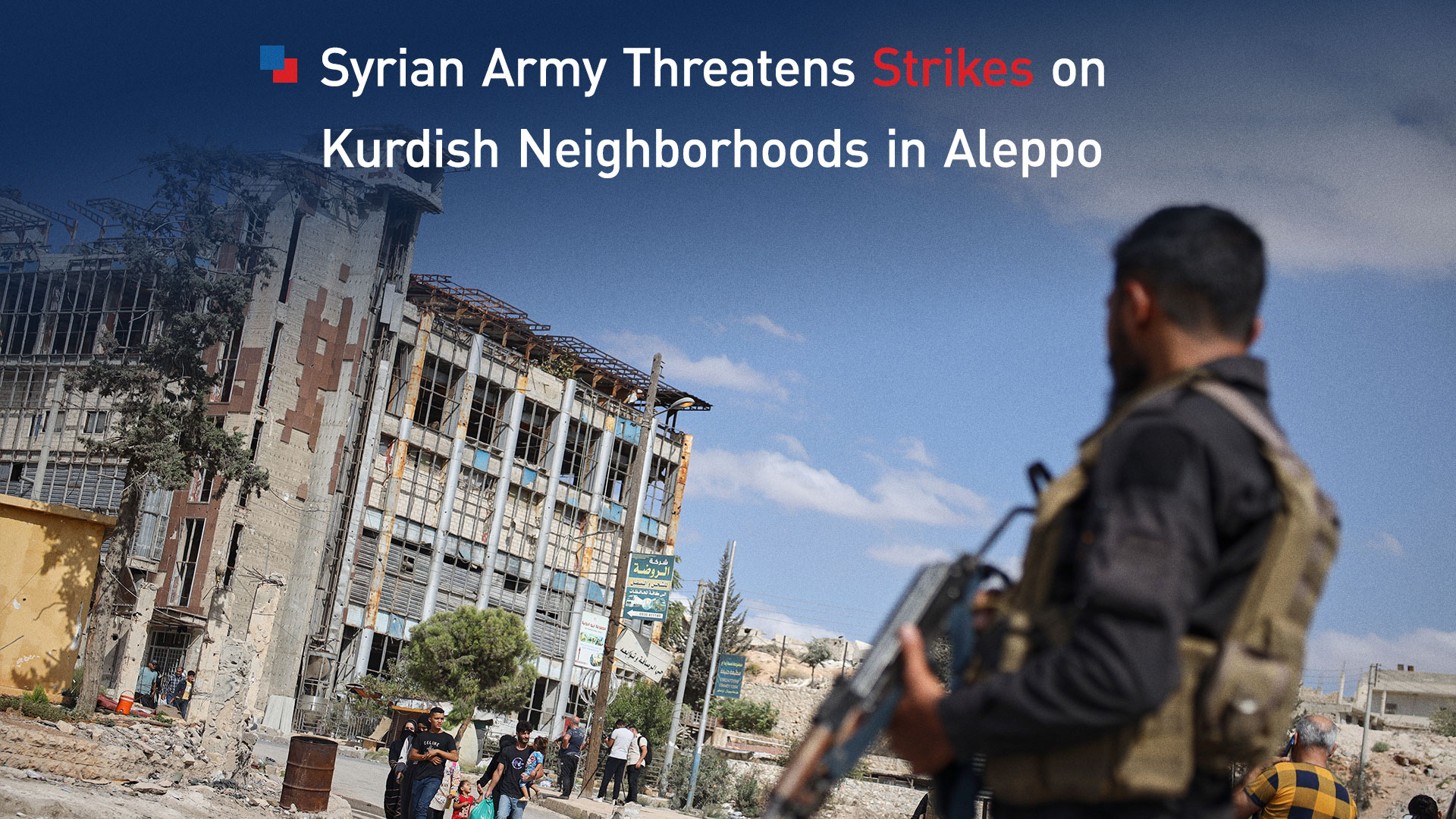
ERBIL (Kurdistan24) — The Syrian Ministry of Defense issued a stark ultimatum on Wednesday, declaring that all positions held by the Syrian Democratic Forces (SDF) in the Sheikh Maqsood and Ashrafiyeh neighborhoods of Aleppo are now considered "legitimate military targets."
The announcement, released by the Operations Body of the Syrian Army, was accompanied by a directive for civilians to evacuate the areas immediately, citing an escalating military confrontation that has already claimed civilian lives and shattered a fragile local truce.
The warning, issued on Wednesday, marks a significant escalation in the hostilities that have gripped northern Aleppo in recent days.
In its statement, the Damascus government factions asserted that the decision to designate SDF positions as targets was a direct response to what it characterized as a "major military operation" launched by the SDF toward government-held neighborhoods in Aleppo.
Consequently, the military command instructed civilian residents in Sheikh Maqsood and Ashrafiyeh to "immediately distance themselves from SDF headquarters and military points in order to protect their lives."
To facilitate the evacuation of the civilian population, estimated by local officials to number in the hundreds of thousands, the Damascus government factions announced the opening of two humanitarian corridors: the Awariz Crossing and Zuhoor Street. However, the statement emphasized a strict deadline, noting that these safe passages would remain open only until 3:00 PM on Wednesday afternoon.
The imposition of such a tight timeframe has raised concerns regarding the feasibility of a mass evacuation from the densely populated districts, which have been subjected to heavy artillery fire over the preceding 24 hours.
The declaration from the Ministry of Defense follows a violent deterioration of security in the area.
According to reports from the Internal Security Forces (Asayish) and the SDF, the neighborhoods of Sheikh Maqsood, Ashrafiyeh, and Bani Zaid were struck by intense shelling initiated by factions affiliated with the Damascus government.
The bombardment, described by residents as one of the most violent in recent weeks, utilized a wide array of heavy weaponry, including tanks, heavy artillery, Grad and Katyusha rocket launchers, mortars, and DShK machine guns.
The toll on the civilian population has been immediate.
The shelling resulted in the deaths of four civilians, identified as Fatima Hamada, 41; Masoud Faiq Abdo, 30; George Khawam, 42; and a child.
Additionally, twenty-six other civilians, including children and the elderly, sustained injuries. The attacks caused widespread destruction to infrastructure, with shells landing on residential structures in areas such as Maghsalat al-Jazira, Farouj Ammar, al-Hassan Mosque, the Grand Sheikh Maqsoud Mosque, Furniture Street in Ashrafiyeh, and the Youth Housing area.
While the Damascus government factions justified its Wednesday directive as a countermeasure to SDF aggression, Kurdish forces offered a conflicting narrative regarding the catalyst for the violence.
The Internal Security Forces stated that the initial escalation began when factions affiliated with the Syrian interim Ministry of Defense and the Damascus government launched an assault using tanks and artillery against residential areas.
The Asayish reported that they acted "within the framework of legitimate self-defense" to repel the assault, thwarting five attempted infiltrations into the neighborhoods.
The SDF specifically pointed to factions known as "al-Amshat," which they described as being affiliated with the Damascus government, accusing them of shelling densely populated areas in the Deir Hafir district and near the Tishrin Dam using "suicide drones" and heavy weapons.
The SDF characterized these actions as a "planned escalation" intended to destabilize the region.
Conversely, Syrian state media outlets have accused Kurdish forces of initiating attacks. The Syrian Arab News Agency (SANA), citing the Ministry of Interior, reported that the SDF targeted army positions near Sheikh Maqsood with drones, killing one member of the Syrian Arab Army.
Furthermore, the Directorate of Information in Aleppo accused the SDF of targeting the area near Sheihan Roundabout, resulting in casualties among Ministry of Defense personnel.
SANA also reported that SDF shelling hit residential buildings in the al-Midan neighborhood, killing three civilians. The SDF acknowledged that a shell had landed in al-Midan but claimed it was a projectile fired by Damascus-affiliated factions that had veered off course while targeting Sheikh Maqsood.
The ultimatum to evacuate comes against the backdrop of what the Syrian Democratic Council (SDC) has described as a tightening siege on the Kurdish-held enclaves.
Mohammad Amin, an official in the Relations Office of the SDC, detailed a severe deterioration in humanitarian conditions leading up to the current hostilities. Mr. Amin noted that more than 600,000 civilians living in the affected neighborhoods have been facing critical shortages of basic necessities.
According to Mr. Amin, the entry of essential goods, including flour, yeast, and fuel, has been blocked by armed factions surrounding the districts. This blockade has forced the closure of many of the thirteen bakeries serving the area and has left residents without heating fuel during the winter months.
Furthermore, electricity has reportedly been cut off completely for more than 28 days, and hospitals are struggling with shortages of oxygen, medicines, and emergency supplies. The closure of schools has left approximately 25,000 students without access to education.
The logistics of the evacuation order issued Wednesday are complicated by these pre-existing restrictions.
Amin previously reported that vehicles were only allowed to pass through the al-Awarid checkpoint—one of the two corridors now designated for evacuation—causing heavy congestion. He also cited daily harassment at checkpoints, including phone inspections and detentions.
The opening of Zuhoor Street alongside Awariz Crossing appears to be a temporary measure to facilitate the army’s deadline, yet the infrastructure’s capacity to handle a mass exodus within hours remains unclear.
The exchange of fire has caused significant physical damage to the civilian infrastructure of the districts. Internal Security Forces reported that the bombardment struck key public spaces, including Markets and mosques.
The strikes on Furniture Street, Fifteenth Street, Twentieth Street, and Martyrs Square suggest a broad targeting of the urban center rather than isolated military points. Dozens of homes and buildings have sustained severe damage, further displacing residents who now face the choice of remaining in a declared combat zone or fleeing through the army-controlled corridors.
As the 3:00 PM deadline approached, the situation on the ground remained volatile.
While a fragile calm had briefly settled over the neighborhoods following the initial heavy exchanges, shelling resumed shortly thereafter with renewed intensity. The Damascus government factions' statement emphasizes that following the expiration of the deadline, any remaining SDF positions will be treated as hostile targets, signaling a potential shift from skirmishes to a full-scale offensive.
The SDF has stated that it holds the attacking forces accountable for the escalation and any resulting damage, describing the bombardment of residential neighborhoods as a "blatant violation of international humanitarian law." Meanwhile, the Syrian government maintains that its actions are a necessary response to violations of agreements and attacks on its personnel.
With heavy weapons deployed by both sides and the diplomatic language hardening into ultimatums, the hundreds of thousands of civilians in Sheikh Maqsood and Ashrafiyeh face an imminent threat of expanded warfare.