Trump Says U.S. Must Control Greenland to Block Russian and Chinese Influence
Trump vowed to acquire Greenland "whether they like it or not," citing Russian and Chinese threats. He dismissed Danish sovereignty and threatened to act "the hard way," risking a NATO rupture.
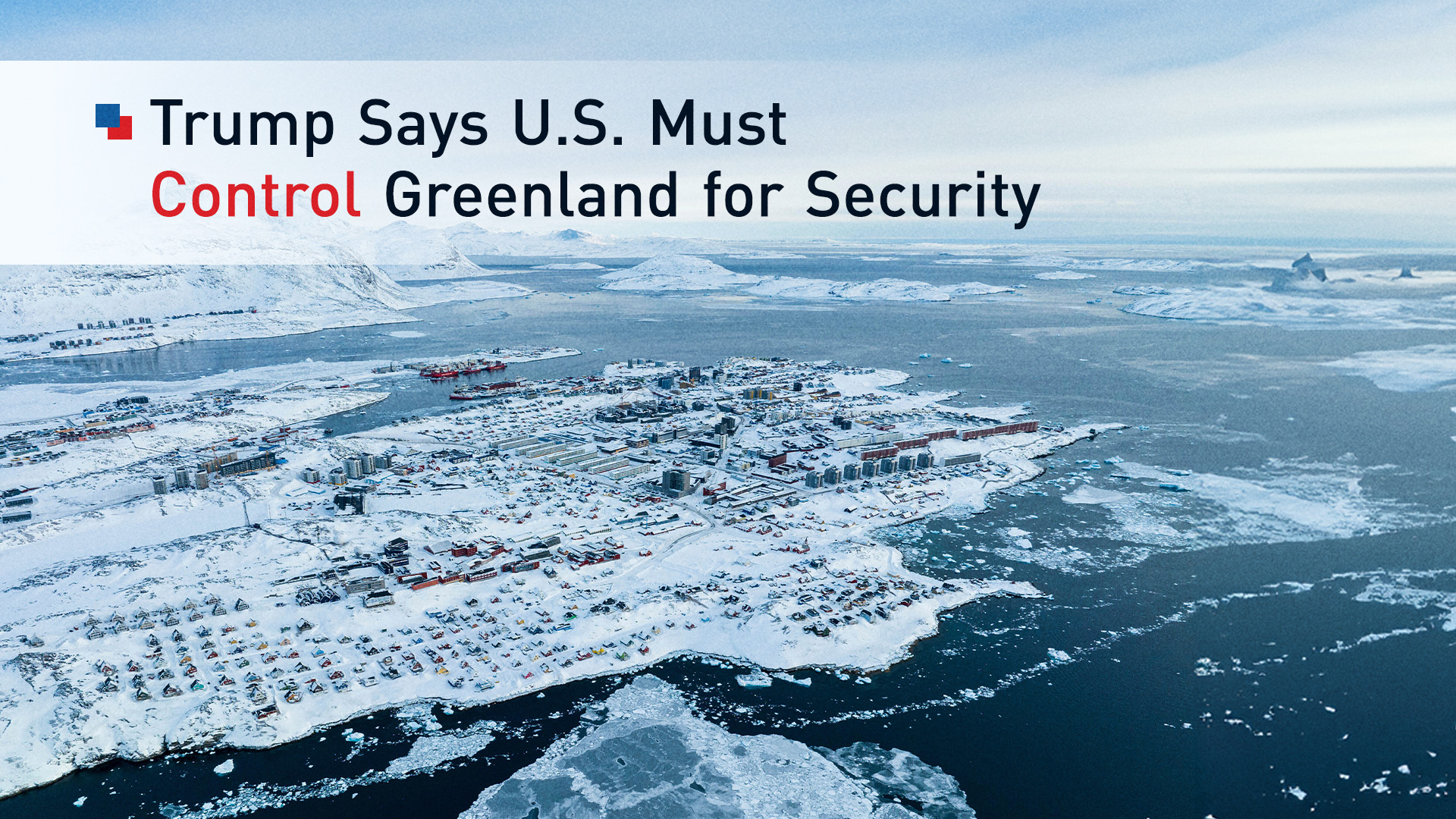
ERBIL (Kurdistan24) — The U.S. President Donald Trump intensified his campaign to acquire Greenland on Friday, warning oil executives at the White House that the United States would take control of the Danish territory "whether they like it or not" to prevent Russia and China from gaining a foothold in the Arctic.
The comments, which dismissed Denmark’s centuries-old sovereignty over the island, marked a sharp escalation in an already tense diplomatic standoff with European allies.
"We are going to do something on Greenland, whether they like it or not," President Trump said during a meeting with nearly two dozen energy executives. "Because if we don't do it, Russia or China will take over Greenland, and we're not going to have Russia or China as a neighbor."
The President’s remarks, reported by Fox News, underscored a foreign policy driven by what The New York Times described as an "imperialist vision" in which U.S. dominance over neighboring regions is deemed essential to national security.
President Trump, who recently ordered the capture of Venezuelan President Nicolás Maduro, linked his ambitions in the Caribbean and the Arctic, framing both as necessary measures against rival powers.
Strategic Justification and "The Hard Way"
During the Friday meeting, which focused on potential U.S. investments in Venezuela’s oil sector, Trump repeatedly invoked the threat of Chinese and Russian encroachment to justify his stance. "If we don't take Greenland, you can have Russia or China as your next-door neighbor. That's not going to happen," he said.
He issued a stark warning to Copenhagen: "I would like to make a deal the easy way, but if we don't do it the easy way we're going to do it the hard way."
According to Politico, administration officials have not ruled out the use of military force, a prospect that has alarmed European diplomats and could threaten the cohesion of NATO.
When pressed on the fact that the U.S. already maintains a military presence on the island, Trump argued that leases and treaties are insufficient.
"When we own it, we defend it," he said. "Ownership is very important. Because that’s what I feel is psychologically needed for success… ownership gives you things and elements that you can’t get from just signing a document."
Trump also questioned the legitimacy of Denmark’s claim to the territory.
"The fact that they had a boat land there 500 years ago doesn't mean that they own the land," he told the executives. "I'm sure we had lots of boats go there also."
Historically, the United States formally recognized Danish sovereignty over Greenland in a 1916 treaty that facilitated the U.S. purchase of the Virgin Islands.
Claims of Russian and Chinese Presence
The President bolstered his argument by claiming a significant hostile naval presence around the island.
"If you take a look outside of Greenland right now, there are Russian destroyers, there are Chinese destroyers and bigger," Trump said Sunday from Air Force One. "Greenland is covered with Russian and Chinese ships all over the place."
However, The New York Times reported that these assertions are false. While Russia and China are active in the Arctic Circle, Greenland is not "ringed" by their warships.
China published its first Arctic policy white paper in 2018, labeling itself a "near-Arctic state," and Greenland’s location along the shortest routes between North America and Eurasia makes it strategically vital for missile detection and trade.
A Return to the "Bullying" Playbook
According to Politico, Trump’s strategy relies on a belief that "bullying and threats" are effective tools for compelling allies to act. A senior White House official told the outlet that the President’s previous success in forcing NATO members to increase defense spending validated this approach.
"He got all these countries to pay their fair share into NATO security, and he did it by fear and sheer force of will," the official said. "He’s been proven right about that aspect, and he’s going to be proven right about this."
Vice President JD Vance echoed this sentiment, advising European leaders to "take the president seriously." Vance warned, "If they’re not, the United States is going to have to do something about it. What that is, I’ll leave that to the president."
The administration’s aggressive posture follows the successful operation in Venezuela, where U.S. forces seized Maduro on narco-terrorism charges. Politico noted that this action has served as a potent signal to other nations. "Everyone now knows that America is not playing around, especially now," the senior White House official said.
European Pushback and NATO Concerns
European leaders have reacted with alarm, viewing the potential annexation of Greenland as an existential threat to the principles of sovereignty and territorial integrity.
A joint statement from the leaders of the UK, France, Germany, Italy, Poland, Spain, and Denmark emphasized that "Greenland belongs to its people" and that decisions concerning the territory are for Denmark and Greenland alone to make.
"Arctic security must be achieved collectively, in conjunction with NATO allies... by upholding the principles of the U.N. Charter," the statement read.
EU foreign policy chief Kaja Kallas told reporters in Cairo that the messages regarding Greenland are "extremely concerning" and that discussions are underway about a potential European response.
The dispute strikes at the heart of the NATO alliance. Article 5 of the NATO treaty considers an attack on one member an attack on all.
The New York Times noted that a U.S. move to take Greenland by force would "rip apart" this central agreement. In an interview with the Times, Trump acknowledged that rupturing the alliance "may be a choice."
Diplomatic Maneuvering
Despite the harsh rhetoric, some diplomatic channels remain open. Secretary of State Marco Rubio is expected to meet with his Danish counterpart in Washington next Wednesday.
Politico reported that Rubio privately told lawmakers that Trump prefers to purchase the island rather than launch an immediate military operation.
Denmark has sought to navigate the crisis by engaging with U.S. lawmakers and hiring lobbyists.
Danish Ambassador Jesper Møller Sørensen expressed openness to discussing measures to enhance U.S. security while respecting Danish sovereignty. However, the Trump administration has reportedly rebuffed offers to simply station more troops or open additional bases, insisting on "ownership."
Some European officials fear the Greenland issue could become part of a "grand bargain" involving Ukraine, though a White House official dismissed this as unlikely.
Nevertheless, the official emphasized that the administration’s approach is transactional. "It’s just like a business deal," the official said. "We go along and then we reassess every step of the way."