Kurdish Sculptor Unveils Peace-Themed Statue Atop Private Museum in Bokan
Sculptor Rebin Haidari has installed a two-and-a-half-meter peace statue atop his private museum in Bokan, reflecting his human-centered practice and decades-long career in sculpture.
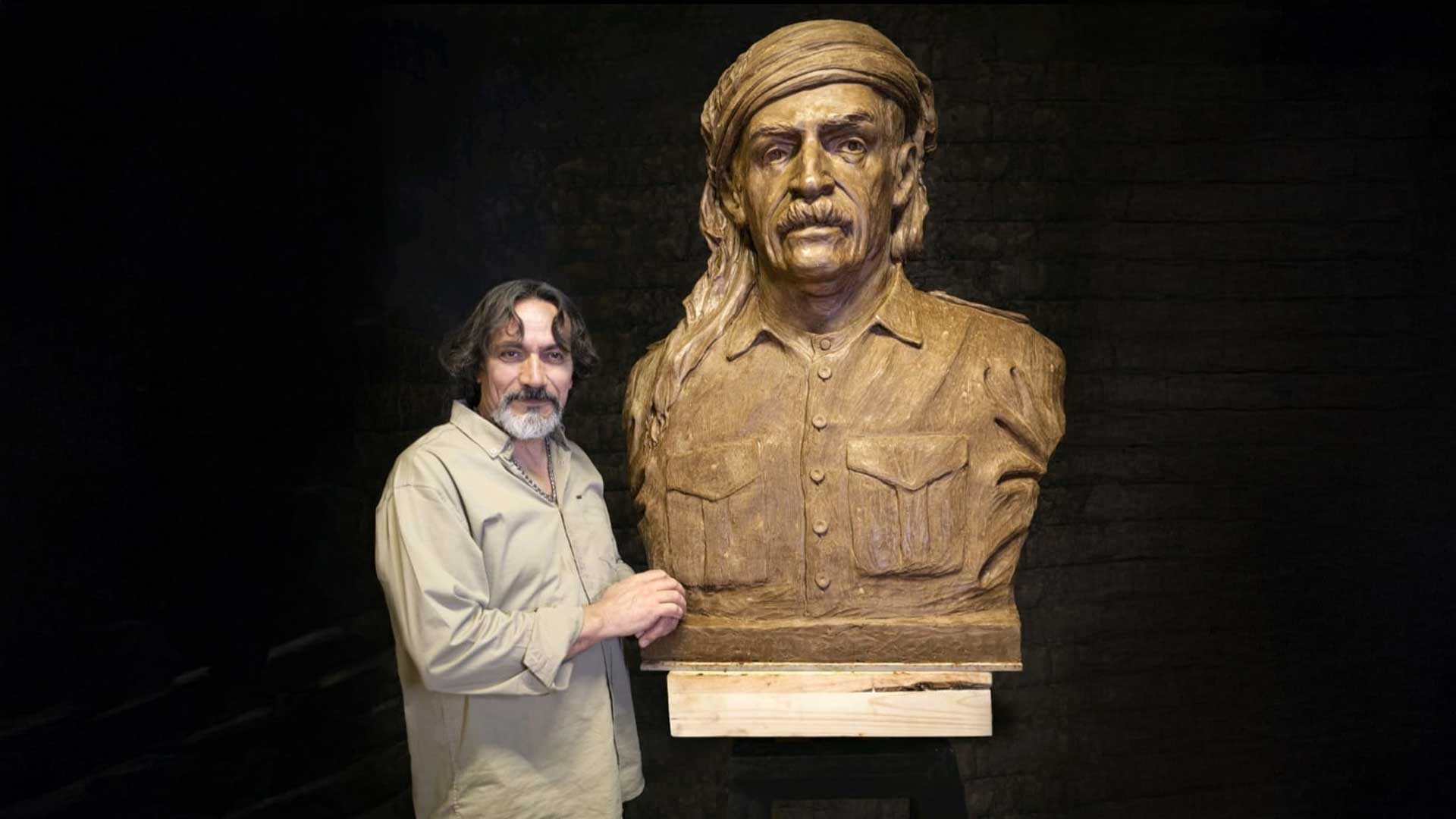
ERBIL (Kurdistan24) - Kurdish Sculptor Rebin Haidari has placed a new statue addressing the theme of peace atop the crown of his private museum in the city of Bokan, a work he describes as central to his artistic concerns and personal outlook, according to an exclusive interview with Kurdistan24 in which he discussed his career, materials, and the ideas shaping his sculptures.
The statue, installed at his museum in Bokan, is a fiber work measuring two and a half meters in height. Haidari said the piece reflects his belief in peace as an enduring aspiration, even as he acknowledged that it remains elusive in human societies.
He described the work not only as a sculptural object but as an embodiment of hope, emphasizing its significance within the broader context of his practice.
Haidari’s comments situate the peace statue within a body of work that, he said, consistently centers on the human condition.
In the interview, he explained that his sculptures generally address humans as social beings whose lives are shaped by societies that have also generated hardship and turmoil. He described this tension as a recurring subject that motivates his work and sustains his engagement with sculpture as a means of expression.
Born in 1968 in Eastern Kurdistan, Haidari is a resident of Bokan, where he has established both a private academy and a museum.
He said his interest in art began in early childhood, initially expressed through drawing. According to Haidari, art was not a passing interest during those years but an internal drive to observe and comprehend the surrounding world.
A significant shift in his artistic direction occurred after his migration to Sweden in 1993. Haidari said that during this period, his focus moved decisively from drawing toward sculpture.
In Sweden, he became active as a sculptor and participated in numerous projects and exhibitions, experiences he described as formative for the development of his artistic thinking and technical approach. He characterized this stage as one of refinement, during which his ideas and working methods became more clearly defined.
In 2000, Haidari moved to the United States, where he pursued advanced studies in sculpture.
He obtained a master’s degree in sculpture from the Pennsylvania Academy of the Fine Arts (PAFA) in Philadelphia. He said that this academic experience contributed further to the evolution of his practice. Three years later, in 2003, he returned to Sweden, resuming his work and artistic activities there.
Haidari’s trajectory then led him back to Eastern Kurdistan in 2008.
Upon his return, he established his own private academy and museum in Bokan. He said that since then, he has remained continuously engaged in artistic work and related activities at that location. The museum, which now features the peace statue on its crown, serves as both a workspace and a site for presenting his sculptures.
In discussing his artistic methods, Haidari emphasized the diversity of materials he employs. He said that his work largely falls within the fields of stone carving and sculpture, which he distinguished in terms of process and scope.
Stone carving, he explained, involves working directly on stone, while sculpture encompasses the creation of figures using a range of materials. Among those he cited are stone, bronze, plaster or gypsum, iron, wood, fiberglass, and other substances.
Haidari described each material as possessing its own language, a quality that shapes how a sculpture communicates with its audience. He said that his choice of material is not incidental but integral to the way meaning is conveyed through form.
This emphasis on materiality aligns with his broader view of sculpture as a language capable of addressing complex themes.
Central to that language, Haidari said, is the human figure. He reiterated that the primary content of his sculptures is humanity itself, particularly the place and status of humans within society.
He described societies as structures that have created lives marked by difficulty, resulting in individuals being caught within circumstances of their own making. This dynamic, he said, remains a subject of sustained interest that continually encourages him to explore it through sculpture.
For Haidari, sculpture functions as a means of discussing both problems and beauty.
He compared it to other art forms in its capacity to articulate challenges while also presenting aesthetic qualities. He said that artistic language reflects how an artist thinks, sees, and feels the world, framing sculpture as a return to the artist’s internal perspective.
In his remarks, Haidari also outlined his understanding of the artist’s role. He said that an artist possesses particular viewpoints that differ from those of others and that such perspectives can influence societal progress.
According to Haidari, effective artistic communication requires not only clarity of intent but also mastery of technique. He emphasized the importance of expertise in both conceptual discourse and practical execution, stating that these elements enable a direct connection with viewers and allow messages to be conveyed clearly.
Haidari’s exhibition history reflects his long-standing engagement with international art contexts. He said that since the years following 1997, he has held numerous solo and group exhibitions.
These exhibitions, according to Haidari, have taken place in various countries across Europe, America, Australia, and Iran. In addition to gallery settings, his sculptures have been installed in public and state spaces in several countries, including Sweden, Denmark, Germany, Finland, the United States, Australia, Iran, and regions of Eastern and Southern Kurdistan.
The placement of his works in public locations forms part of his broader practice, extending his engagement beyond private or institutional exhibition spaces. Haidari did not elaborate on specific sites or works but noted the geographical range of these installations as indicative of his professional activity over several decades.
In addressing subject matter, Haidari spoke about his depiction of the human body, both female and male. He said that for him, there is no fundamental difference between the two as artistic subjects, describing each as possessing its own distinct beauty.
His selection of a female or male figure, he explained, depends on the subject he seeks to address. In some cases, he uses one or the other, while in others he combines both to fully convey meaning.
This approach underscores his focus on the human form as a vehicle for broader themes rather than as an end in itself. By varying the representation of gendered bodies, Haidari said he aims to articulate ideas more completely, aligning form with content.
The peace statue at his museum represents a continuation of these concerns. Haidari described peace as a topic that remains unfamiliar and unrealized for humanity, yet one in which he maintains a strong belief as an ideal. He characterized it as a “beautiful dream and wish,” suggesting that the sculpture embodies aspiration rather than resolution.
Constructed from fiber and rising two and a half meters, the statue occupies a prominent physical position atop the museum, a placement that reflects its personal importance to the artist. Haidari said the work is dear to him not merely as a sculptural achievement but as a manifestation of hope within his artistic environment.
The museum itself, as part of Haidari’s activities in Bokan, functions as a space where his works and ideas converge.
Established after his return to Eastern Kurdistan, it reflects his decision to base his practice locally while maintaining connections to his international experience. Haidari’s ongoing activity there suggests a sustained commitment to sculpture as both a creative and communicative practice.
Throughout the interview, Haidari framed his career as a sequence of developmental stages shaped by migration, study, and return. From his early interest in drawing to his later focus on sculpture, and from his years in Sweden and the United States to his establishment of an academy and museum in Bokan, he presented his path as one of continuous engagement with art.
The peace statue, as he described it, stands within this trajectory as a recent articulation of themes that have long informed his work. By situating it at the crown of his museum, Haidari has integrated the piece into the physical and conceptual center of his practice, linking his reflections on humanity, society, and aspiration to a specific place and form.