Halabja Governor Leads Rally Condemning Violence in Aleppo, Urges International Intervention
Halabja Governor Nuxsha Nasih led a rally condemning attacks on Aleppo’s Kurds, urging global intervention. The protest follows a ceasefire and evacuation deal after days of heavy combat.
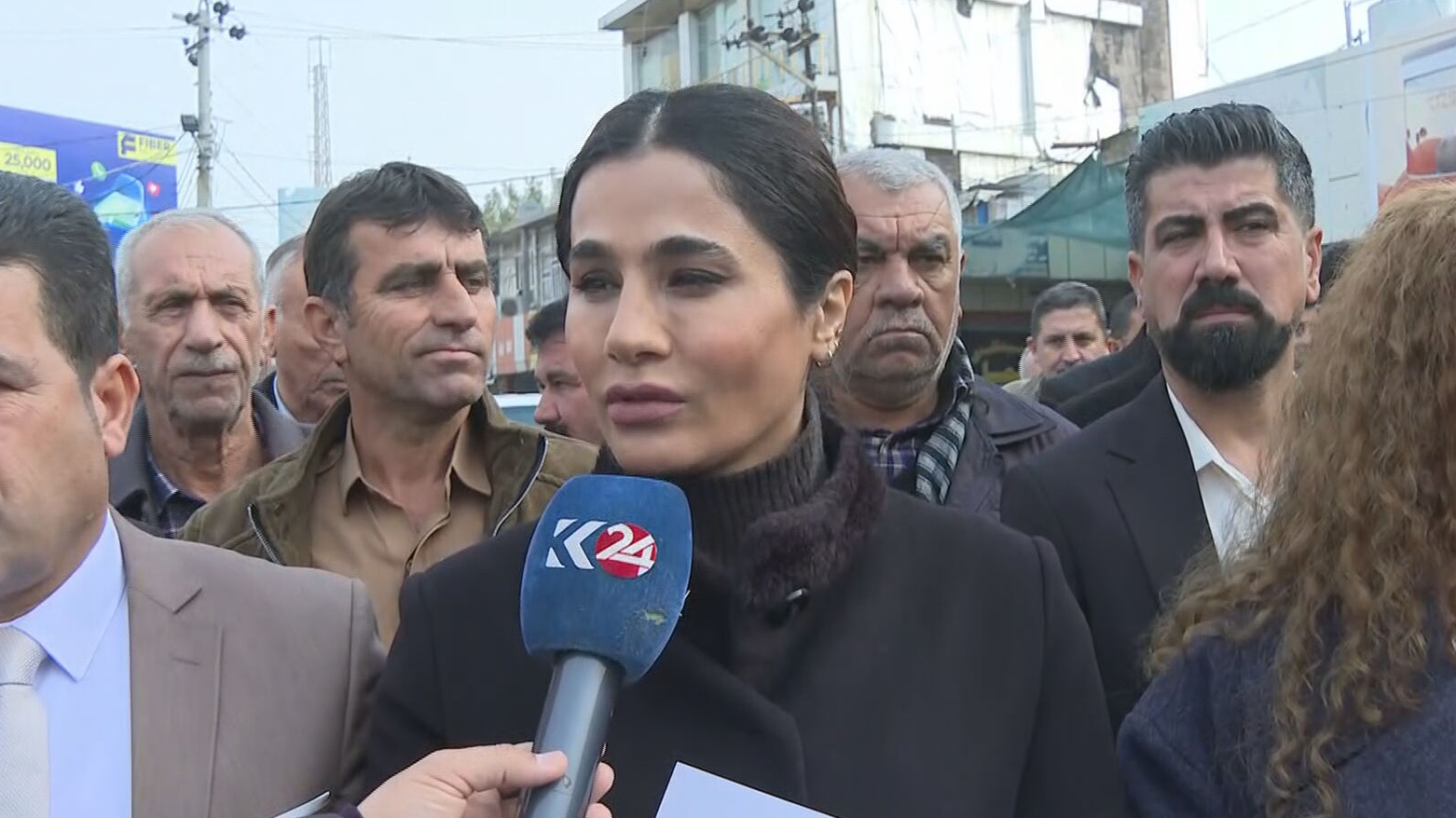
ERBIL (Kurdistan24) – A significant public assembly convened in the Halabja Governorate on Monday to protest the recent military offensive targeting Kurdish populations in the Syrian city of Aleppo. Local officials and residents gathered to express solidarity with the Sheikh Maqsud and Ashrafiyeh neighborhoods following days of intense urban combat that has resulted in mass displacement and allegations of systematic targeting of civilians.
Nuxsha Nasih, the Governor of Halabja, led the rally on Monday, issuing a forceful condemnation of the violence and calling on the international community to intervene immediately.
The gathering in the Kurdistan Region of Iraq was organized as a direct reaction to the assaults carried out over the past week by government-affiliated forces in Syria.
Addressing the crowd and the media, Governor Nasih articulated a message of cross-border unity, emphasizing the deep social and political ties binding the Kurdish populations across the region.
"Our message is a message of unity and solidarity of all four parts of Kurdistan," Governor Nasih told Kurdistan24 during the event. "We tell our sisters and brothers in both the Ashrafiyeh and Sheikh Maqsud neighborhoods that we are with you and we support you."
The Governor’s statement went beyond rhetoric, suggesting a willingness among the local populace to provide direct assistance. She characterized the Kurdish posture as historically defensive, asserting that Kurds "have never attacked anyone else's land."
However, she warned that the community remains prepared to confront violence. "We are ready, whether in a civil manner or in any other way, to go there to protect them," she said, underscoring the severity with which the leadership in Halabja views the crisis in neighboring Syria.
The rally in Halabja comes in response to a volatile security situation in Aleppo that has deteriorated rapidly since early January.
The Internal Security Forces operating in Sheikh Maqsud and Ashrafiyeh issued a statement on Sunday accusing paramilitary units affiliated with the Syrian government of launching a systematic military offensive.
Security officials alleged that the operation, which reportedly began on Jan. 6, 2026, was aimed at the "extermination" of the local population and the permanent alteration of the districts' demographic structure.
According to the allegations cited by the security forces, the offensive involved thousands of fighters described as "mercenaries affiliated with the Syrian government."
These units were reportedly supported by a substantial array of heavy military hardware, including drones, tanks, artillery, and armored vehicles. The security forces asserted that the objective of these incursions extended beyond establishing territorial control, aiming instead to violate the dignity of residents and dismantle the long-standing Kurdish majority in these areas.
The humanitarian fallout from the conflict was a central theme of the Halabja rally. Reports emerging from the week-long conflict in Aleppo indicate that at least 60 civilians were killed and nearly 100 others were wounded. The violence has also precipitated a massive displacement event.
Aleppo Governor Azam al-Gharib reported that approximately 155,000 people had fled their homes due to the violence.
Corroborating the scale of the crisis, the Barzani Charity Foundation documented the displacement of more than 27,000 families, noting that the majority have sought refuge in the Afrin district and its surrounding villages, where they face harsh winter conditions and shortages of shelter.
Participants in the Halabja rally expressed deep concern over specific reports of infrastructure targeting. The Internal Security Forces in Aleppo detailed repeated attacks on the Khalid Fajr Hospital, identifying it as the sole medical facility in the neighborhood capable of treating patients.
The statement alleged that government-affiliated forces struck the hospital "dozens of times" with heavy weapons and drones, an action the security forces described as an attempt to commit a "massacre" against the wounded and medical staff.
The bombardment reportedly rendered the facility out of service, exacerbating the humanitarian emergency.
"Unfortunately, what happened in Sheikh Maqsud and Ashrafiyeh was a heartbreaking disaster, so I reiterate my support for the Kurds of Aleppo," one demonstrator told reporters at the rally.
The protester emphasized the need for external pressure to prevent further escalation. "We must act to make the world intervene, so that no occupying force dares to attack the Kurds again."
The protests in Halabja coincided with a tentative pause in the fighting on the ground. Earlier on Sunday, Mazloum Abdi, the General Commander of the Syrian Democratic Forces (SDF), confirmed that an agreement had been reached through international mediation to implement a ceasefire.
The agreement facilitates the evacuation of Kurdish fighters, wounded individuals, and besieged civilians from the contested neighborhoods to areas administered by the Autonomous Administration of North and East Syria.
The diplomatic maneuvering behind the ceasefire involved direct engagement by the United States. On Saturday, U.S. Ambassador to Türkiye and Special Envoy for Syria Tom Barrack met with Syrian President Ahmed al-Sharaa in Damascus.
Reports following the meeting indicated that Barrack conveyed warnings from President Donald Trump and Secretary of State Marco Rubio, cautioning that continued violence in Aleppo could jeopardize Syria's political transition following the fall of the Assad government.
Barrack reportedly urged a return to the terms of the "March 2025 integration agreement" between Damascus and the SDF.
Despite the ceasefire, the situation remains fraught with uncertainty. While Syrian state media reported that buses were transporting surrendering Kurdish fighters toward northern Syria, reports surfaced of Syrian security forces separating young men from crowds of evacuating civilians, raising fears of detention.
In Halabja, Governor Nasih emphasized that a temporary halt to hostilities is insufficient. "Work must be done to stop this situation, but we hope that the cessation is not temporary, but rather a fundamental solution so that Kurdish blood is not spilled once again," she stated.
The withdrawal of Kurdish forces from Sheikh Maqsud and Ashrafiyeh marks a decisive shift in Aleppo’s balance of power, ending years of autonomous administration in those districts.
As the evacuation proceeds, the rally in Halabja highlights the reverberations of the conflict across the region, with local leaders demanding long-term guarantees for the safety of the displaced population.