Elham Ahmad Calls for Guarantees and International Action Amid Escalation in Aleppo
She called on the international community to exert pressure on the Syrian government to halt ongoing military attacks, particularly by the Syrian Arab Army, emphasizing that the DAANES has consistently demonstrated readiness for dialogue.
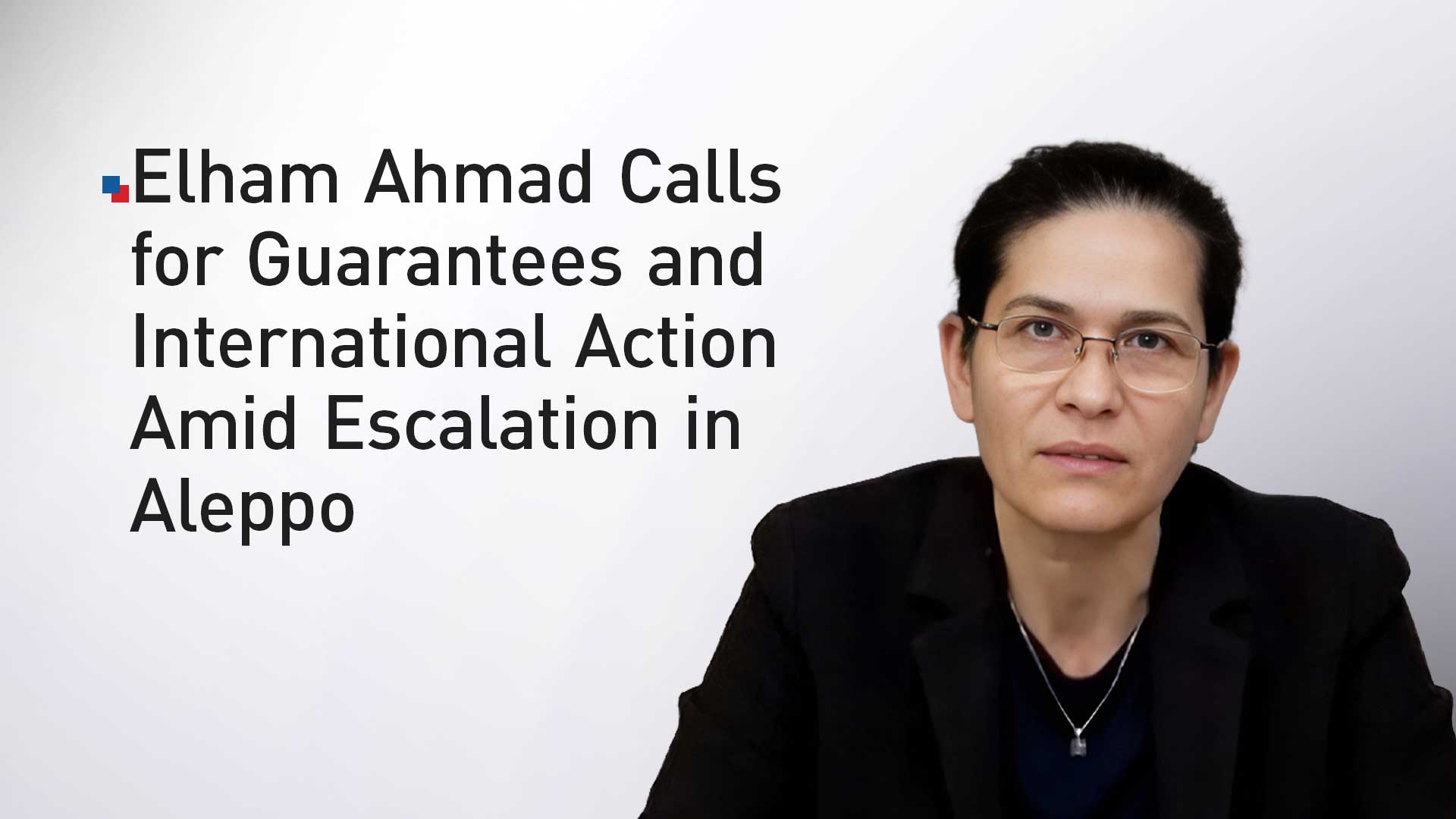
ERBIL (Kurdistan24) – Elham Ahmad, Co-chair of the Department of Foreign Relations for the Democratic Autonomous Administration of North and East Syria (DAANES), said on Tuesday that lasting stability in Syria requires concrete guarantees for civilian life, a genuine political solution, and a serious commitment by the Damascus authorities to resolve the country’s long-standing crises.
Speaking at a press conference, Ahmad stressed the importance of peaceful coexistence among all communities and nationalities in Syria, warning that rhetorical support for the Kurds is insufficient unless it is translated into tangible actions.
“Expressing solidarity is not enough,” Ahmad said. “There must be practical steps and real guarantees on the ground.”
She called on the international community to exert pressure on the Syrian government to halt ongoing military attacks, particularly by the Syrian Arab Army, emphasizing that the DAANES has consistently demonstrated readiness for dialogue. However, she added that negotiations cannot proceed while military operations continue.
Ahmad accused Damascus of misleading public discourse, saying official statements are not matched by actions. “What the Damascus government says in the media is misleading, as it does not fulfill any of its promises,” she said, criticizing what she described as the silence of Western countries in the face of Syrian Arab Army attacks. “This silence is unacceptable.”
She also urged U.S. President Donald Trump to take the initiative in promoting peace in the region, arguing that calls for reconciliation lose their meaning after large-scale loss of life. “After the killing of hundreds of Kurdish citizens, any call for peace becomes meaningless,” Ahmad said, adding that the Kurdish issue cannot be resolved through violence.
Ahmad’s remarks come amid a sharp escalation of violence in Aleppo’s Kurdish-majority neighborhoods in recent days, which has raised serious concerns among residents and international observers.
On January 6, the neighborhoods of Sheikh Maqsud and Ashrafiyeh were subjected to intense military assaults and a sweeping siege. The clashes primarily involved the Syrian Arab Army and its affiliated factions against Kurdish-led internal security forces, known as the Asayish.
The offensive began with heavy bombardment using tanks, artillery, Grad rockets, and suicide drones. The Syrian Arab Army declared the neighborhoods a “closed military zone” and imposed an indefinite curfew, severely restricting civilian movement.
Pro-government media and monitoring groups later reported that Syrian Arab Army forces had entered the area. A ceasefire was announced at 3:00 p.m. local time to facilitate the evacuation of Kurdish fighters.
According to available information, approximately 60 Asayish fighters surrendered and were transferred to Western Kurdistan (northeastern Syria). The violence triggered mass displacement, with estimates suggesting that between 142,000 and 165,000 residents fled the affected neighborhoods.
The developments have intensified calls from Kurdish officials and rights groups for international intervention to protect civilians and revive a political process aimed at ending the conflict in Syria.