Kurdistan24 Exclusive: US Lawmakers Voice Strong Support for Kurds, urge protection and stability amid Syria crisis
US lawmakers from both parties told Kurdistan24 that Kurds remain key US allies, stressing the need to protect Kurdish communities in Syria, support minority rights, and pursue stability and unity to prevent renewed extremism.
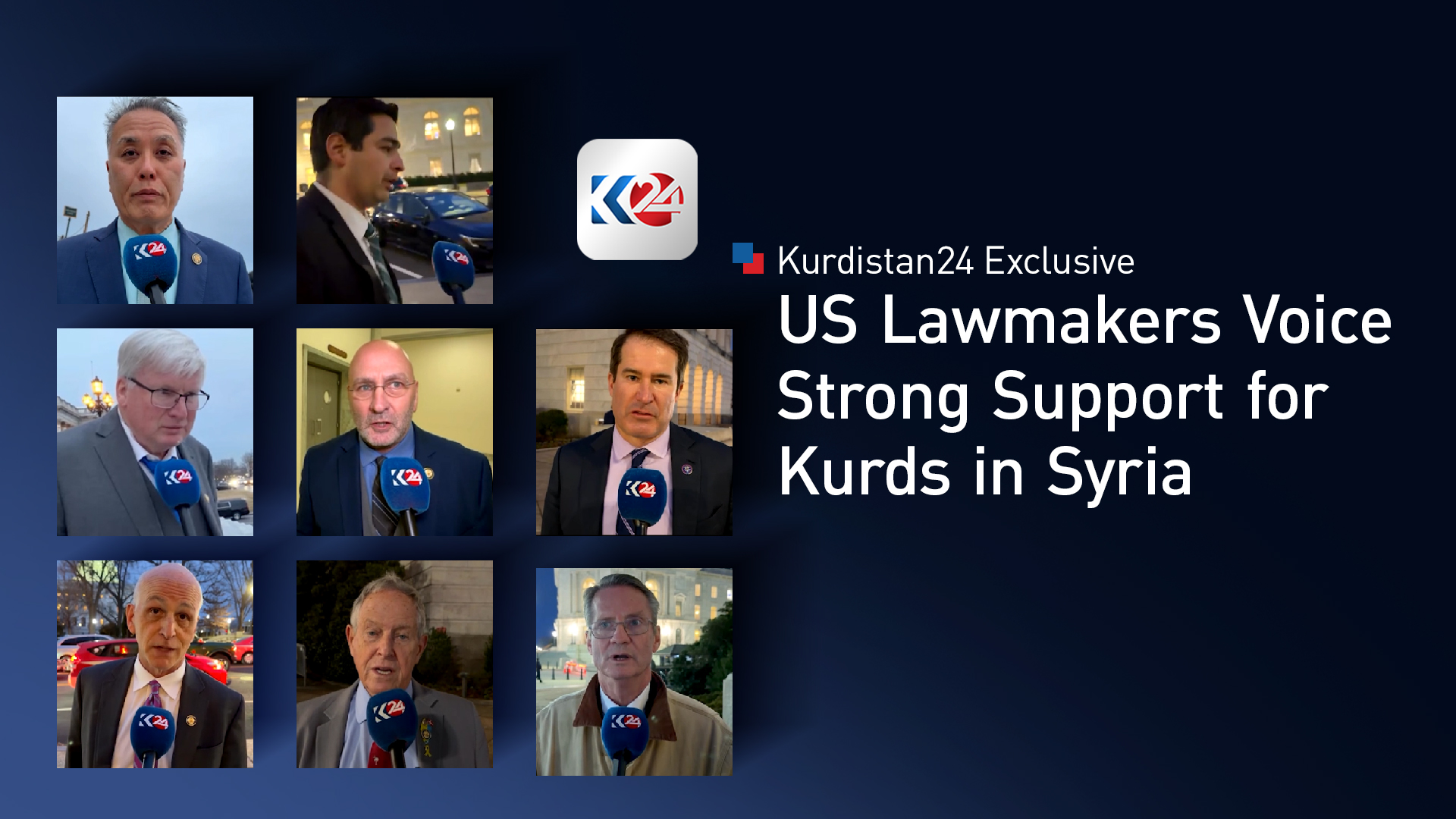
ERBIL (Kurdistan24) - From Capitol Hill, a bipartisan group of US lawmakers delivered a clear message on the unfolding situation in Syria: “the Kurdish people remain vital allies of the United States, and their security, rights, and role in any future Syrian settlement must be safeguarded amid rising instability.”
In a series of interviews conducted by Rahim Rashidi, Head of the Kurdistan24 office in Washington, DC, several members of the US Congress addressed the situation of Kurds in Syria, emphasizing the need for stability, unity, and the protection of minorities.
Congressman Joe Wilson underscored the importance of avoiding fragmentation in Syria, warning that division could create opportunities for extremist groups. “It’s important that there be a peaceful resolution and unification of Syria to the benefit of the people of all of Syria so that there’s not a division and statelets created,” he said. Wilson cautioned that divisions “create an opening for ISIS,” while pointing to the Kurdistan Region of Iraq as a successful model. “There still can be a level of independence but at the same time part of a unified Syria so that it can be secure to provide for peace and prosperity,” he added.
Responding to a question about President Masoud Barzani’s calls for peace and stability, Wilson expressed appreciation for Barzani’s role, noting his engagement with Ahmed al-Sharaa and US Special Envoy Tom Barrack. “President Barzani working with al-Sharaa, working indeed with Tom Barrack… Tom Barrack as a person of great capability, of Lebanese-American heritage, he wants the best for the region,” Wilson said. He again highlighted the Kurdistan Region of Iraq as “the really star example of success,” linking regional stability to peace and prosperity.
Wilson also described his meeting with Mark Savaya, the US Special Envoy to Iraq, as positive. “We know the envoys are really dear friends of President Donald Trump, and President Trump wants peace, he wants prosperity, he wants stability for the people of the region,” he said, adding that he was confident these goals could be achieved.
Congressman Adam Smith stressed the responsibility of the United States toward Kurdish communities in Syria. “I think it’s very important that the United States protect the Kurdish minority in Syria,” he said, adding that while Kurds should be part of the Syrian government, “their independence should be respected, they should be protected.” Smith argued that more must be done by Washington to ensure that protection.
Expanding his remarks to the broader Kurdish issue, Smith said, “All of the Kurdish people need to make sure that they are protected,” noting that they face threats “from a variety of different forces.” He described the Kurds as “the best partner that we’ve had in the Middle East in a long time” and emphasized the need for continued US commitment.
Congressman Glenn Grothman offered a concise assessment, stating, “It is important we look out for the people who are being persecuted because they are a minority.”
Congressman Clay Higgins framed US policy toward Syria within broader principles of international relations. He said American engagement must be based on “a totality of circumstance of regional conflict and our history with that individual nation.” While declining to comment on specific developments in Syria, Higgins stressed that US interactions would be guided by “peace and economic stability, freedom of transport and commerce and economic prosperity and individual rights, liberties and freedoms.” He added, “If you’re aligned with what I just said, you’ll be all right with America. If you’re not, you could be you could have a problem.”
Congressman Gabe Evans highlighted the Kurdish role in combating extremism, drawing on his own military experience. “The Kurds were a critical ally in the fight against ISIS and terrorism,” he said, noting his twelve years in the US Army and deployments to the region. “We just have to make sure that we are finding those ways to continue to support our allies abroad.” Addressing Kurds directly, Evans added, “We appreciate all of the efforts in the fight against extremism, and we’re going to try to find ways to continue to work together.”
Congressman Mark Takano recalled visiting the Kurdistan Region and stressed the importance of Kurdish autonomy. “I’ve visited Kurdistan. I’ve been in Erbil. I know how important they are as allies,” he said, expressing hope that issues could be resolved while “keeping the Kurdistan’s autonomy intact.” While he declined to comment in detail on Syria, Takano reiterated that “the Kurds as a people have been a strong ally of the United States,” adding that Americans have “important reason to back our Kurdish allies.”
Congressman Seth Moulton echoed that sentiment succinctly, stating, “Of course, we should always stand up for our allies. And that’s something that’s important to the United States of America.”
Congressman Tim Burchett focused on the broader issue of violence and minority protection in Syria. “Syrians are at attack at the leadership. I think it’s wrong,” he said, arguing that the United States should consider using its economic power against those harming civilians. When asked about minorities, including Kurds and Druze, Burchett responded, “I would think so. I think so. They were loyal to us. I just don’t see how we could turn our backs on ’em.”
In early January 2026, Aleppo witnessed one of the most significant military escalations in years, as the Syrian Arab Army (SAA), launched a large-scale offensive against Kurdish-led Internal Security Forces (Asayish) in the Sheikh Maqsud and Ashrafiyeh neighborhoods. The operation marked a decisive shift in control, bringing an end to years of Kurdish autonomous administration in those parts of the city.
The assault involved heavy military assets, including tanks, artillery, and suicide drones. By Jan. 13, the Syrian army formally declared the two neighborhoods closed military zones and announced it had established full control. The campaign did not remain confined to Aleppo. Syrian forces expanded their operations eastward toward Deir Hafir and Maskanah, demanding that the Syrian Democratic Forces (SDF) withdraw to the eastern bank of the Euphrates River. Clashes were also reported in Deir ez-Zor, signaling a broader geographical expansion of the conflict.
The 5 days-long urban fighting produced a severe humanitarian crisis. Reports indicated at least 216 deaths among both sides, while more than 260 Kurdish civilians, including women and children, were reported missing. Displacement reached critical levels, with estimates ranging between 142,000 and 155,000 residents forced to flee. Many sought refuge in the Afrin district amid harsh winter conditions.
Kurdish security authorities accused the Syrian government of pursuing a systematic campaign aimed at exterminating the population and altering the area’s demographic structure. They specifically cited repeated shelling of Khalid Fajr Hospital, the only medical facility serving the neighborhoods, which was rendered inoperable during the fighting.
As the violence intensified, international diplomatic efforts accelerated in an attempt to prevent a wider regional escalation. US Special Envoy Tom Barrack played a central role, meeting Syrian President Ahmed al-Sharaa in Damascus to convey warnings from the Trump administration that continued military action could jeopardize Syria’s political transition. Barrack pushed for a return to the March 10, 2025 Integration Agreement, which outlines the incorporation of the SDF into Syria’s national institutions.
SDF General Commander Mazloum Abdi later confirmed that international mediation resulted in a partial ceasefire and an evacuation arrangement. Under the deal, Kurdish fighters and besieged civilians were transported out of Aleppo toward northern Syria. The European Union and US Central Command (CENTCOM) Commander Adm. Brad Cooper issued statements urging maximum restraint and the protection of critical infrastructure, linking Syria’s internal stability to broader regional peace.
The crisis also exposed deep political and social fault lines. Türkiye’s Foreign Minister Hakan Fidan warned the SDF, describing them as an obstacle to peace and demanding an end to what he termed separatism, while Ankara continued coordination with international partners over its national security concerns. Within Syria, Elham Ahmad of the Democratic Autonomous Administration of North and East Syria criticized what she described as Western silence during the assault and accused Damascus of failing to honor its public commitments to a peaceful political settlement.
Diplomatic efforts to mitigate the crisis involved high-level engagements between regional and international leaders seeking to prevent a wider regional war. On January 9, Syrian Interim President Ahmed al-Sharaa initiated a telephone call with President Barzani to affirm that Kurds are an indigenous and fundamental component of Syria, pledging the state’s full commitment to their political and civil rights without discrimination.
Simultaneously, U.S. Special Envoy Tom Barrack coordinated with both leaders and met with President al-Sharaa in Damascus to advocate for de-escalation and the revival of the March 2025 integration agreement, which aims to incorporate Kurdish forces into national institutions.
Despite these diplomatic assurances, the military advance continued until international mediation eventually secured a partial ceasefire and an evacuation deal that bused Kurdish fighters and besieged civilians out of the contested neighborhoods toward northern Syria.
As of Jan. 13, 2026, active combat in Aleppo city had largely subsided following the withdrawal of Kurdish forces. However, the situation remained volatile. Syrian forces began consolidating control over the formerly autonomous neighborhoods, while search teams continued efforts to recover bodies and account for missing civilians. At the same time, regional leaders intensified appeals for restraint to prevent the conflict from igniting broader communal tensions between Kurdish and Arab communities.
Taken together, the lawmakers’ remarks reflect a rare bipartisan consensus in Washington: the Kurds are seen as steadfast allies, and many in Congress believe the United States carries a continued responsibility to support their security, rights, and future amid Syria’s ongoing uncertainty.
Head of the Kurdistan 24 office in Washington, D.C. Rahim Rashidi (Mr. Kurd) contributed to this report.