US Vice President Urges Al-Sharaa to Settle Dispute With Kurds, WSJ Says
The Wall Street Journal reports US officials fear a Syrian military operation against the SDF near Aleppo could expand eastward, threaten US forces, and destabilize counter-ISIS efforts across Syria.
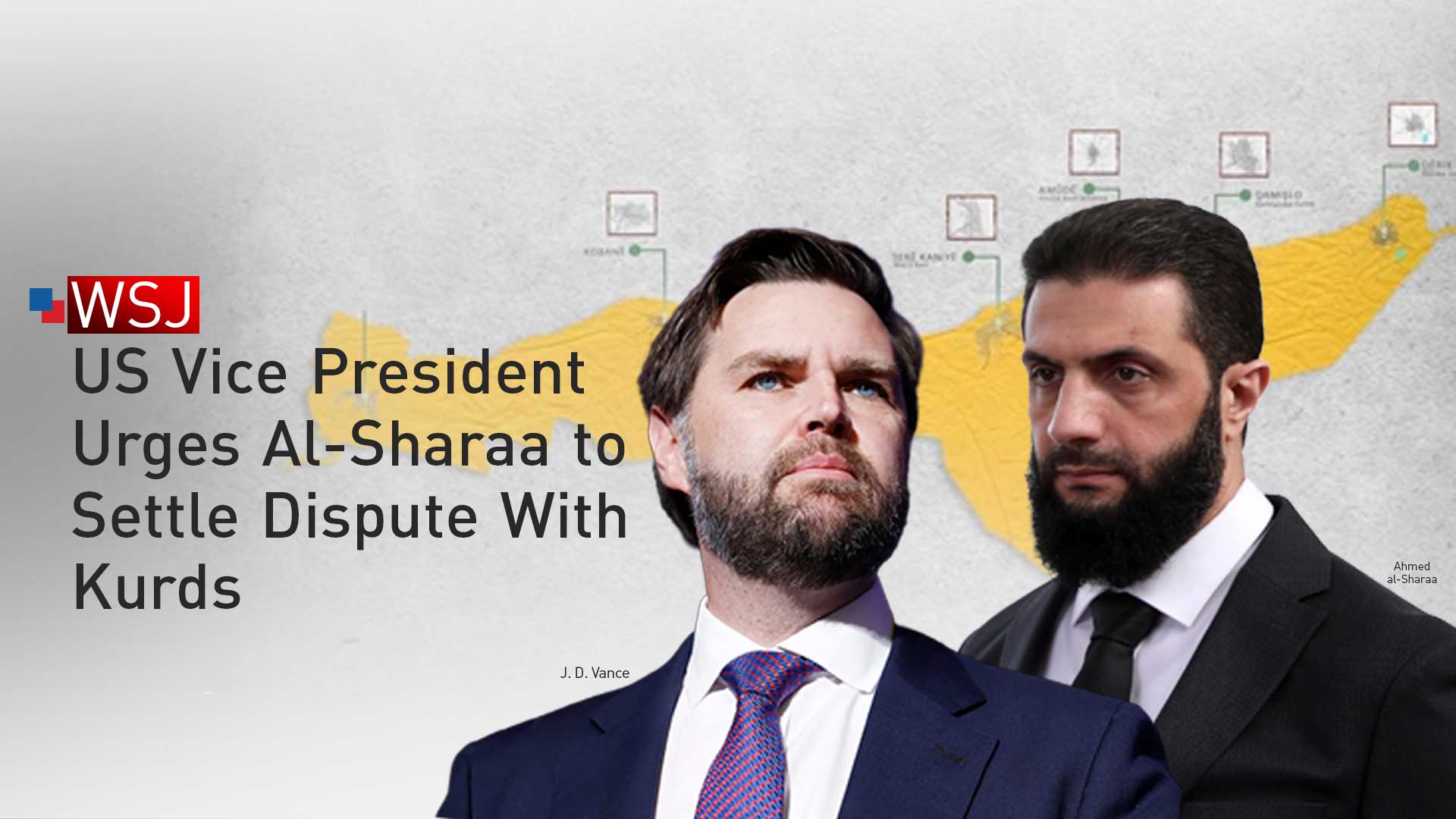
ERBIL (Kurdistan24) - US officials are increasingly alarmed that a Syrian military operation against Kurdish forces near Aleppo, may evolve into a far broader campaign, according to a detailed report by The Wall Street Journal, raising fears of renewed instability, expanded fighting, and serious risks to US interests in Syria.
According to The Wall Street Journal, the Syrian army’s operations command announced on Friday night that government forces were striking units allied with the Kurdish-led Syrian Democratic Forces in the town of Deir Hafer, east of Aleppo. The statement followed several days in which Damascus had surged military forces into the area.
The report said the SDF announced shortly after midnight local time that it was withdrawing its forces from Deir Hafer, describing the move as a show of good faith after calls from foreign powers mediating the dispute.
Citing two US officials, The Wall Street Journal reported that US intelligence agencies have assessed Syrian President Ahmed al-Sharaa is planning a multipronged operation, backed by the Turkish military, targeting the SDF in eastern Aleppo province and potentially extending across the Euphrates River. US officials warned such an expansion could push the fighting into northeastern Syria, where most US forces are deployed.
President Trump’s special envoy for Syria, Ambassador Tom Barrack, and Adm. Brad Cooper, the head of U.S. Central Command, have been engaging daily with both sides to head off a larger offensive, one of the officials said. Vice President JD Vance spoke to Sharaa to urge him to resolve differences with the Kurds, according to a person familiar with the conversation.
U.S. officials have threatened to reimplement Caesar Act sanctions against the Syrian government if Damascus goes ahead with the broader attack, the official said.
“The United States remains in close contact with all parties in Syria, working around the clock to lower the temperature, prevent escalation, and return to integration talks between the Syrian government and the SDF,” Barrack said on social media Friday.
Sen. Lindsey Graham (R, S.C.) posted on social media on Thursday that he is “growing increasingly concerned” that Damascus was partnering with Turkey to attack the Syrian Kurds, and added that the Kurdish fighters control 9,000 Islamic State prisoners across the country.
“I support a fair chance for the new Syrian government, however if there’s an escalation of attacks against the Kurds by Syrian forces supported by Turkey, this will create a whole new dynamic,” Graham said. “If anyone believes that I or any of my colleagues would be comfortable—at this stage—for the ISIS prisoners to be guarded by the Syrian army or Turkey instead of the Kurds, you are sadly mistaken. Choose wisely.”
In an indication of the seriousness of the situation, The Wall Street Journal reported that US military forces arrived in Deir Hafer on Friday to meet with Syrian partners following days of deadly clashes. Capt. Tim Hawkins, a spokesman for US Central Command, was quoted as saying US forces would “temporarily assess what is happening on the ground, engage Syrian partners, and help stabilize the situation.”
“A Syria at peace with itself is critical to preserving peace and stability across the region,” Hawkins said, according to the newspaper.
The report said Damascus’ forces had begun bombing Deir Hafer earlier in the week and urged civilians to evacuate the area. It noted the displacement of people fleeing from Kurdish-controlled areas in the Syrian countryside.
The Wall Street Journal reported that the semiautonomous Kurdish region of northeastern Syria (Western Kurdistan) remains a major obstacle to President al-Sharaa’s efforts to consolidate control following the collapse of the Assad regime in 2024.
According to the newspaper, President al-Sharaa and the SDF’s leader signed an agreement in March to merge the SDF into the Syrian military. However, the report said the agreement lacked details, and negotiations toward a final arrangement have stalled in recent months.
The newspaper said US lawmakers and military officials are particularly concerned that if fighting spreads into Western Kurdistan, Kurdish forces guarding hundreds of ISIS prisoners across the region could abandon their posts, potentially leading to mass escapes.
US intelligence officials cited by The Wall Street Journal were reported to be debating the scope of the potential operation. Some believe President al-Sharaa intends to limit fighting to Aleppo province, while others assess he is considering a broader campaign involving troop movements from western Syria toward the Euphrates River and south from the Turkish border. Military intelligence officials believe President al-Sharaa has already approved the larger operation, according to the report.
The newspaper added that other Western officials monitoring developments believe the offensive will remain confined to areas around Deir Hafer, south of the Euphrates River, but warned that fighting could spill over to other parts of the front line.
As reported by The Wall Street Journal, US officials say Washington is working intensively to prevent a wider Syrian-Turkish-backed offensive that could destabilize Syria, threaten US forces, and undermine efforts to contain ISIS at a critical moment in the country’s fragile transition.