Iraqi Premier Cites Strategic Foresight in Managing Syria Security Crisis and ISIS Detainee Transfers
Iraqi PM Sudani and U.S. Admiral Cooper discussed Syrian security and ISIS prison threats Friday. Iraq is receiving 7,000 detainees weekly, while Sudani urges European nations to repatriate their citizens.
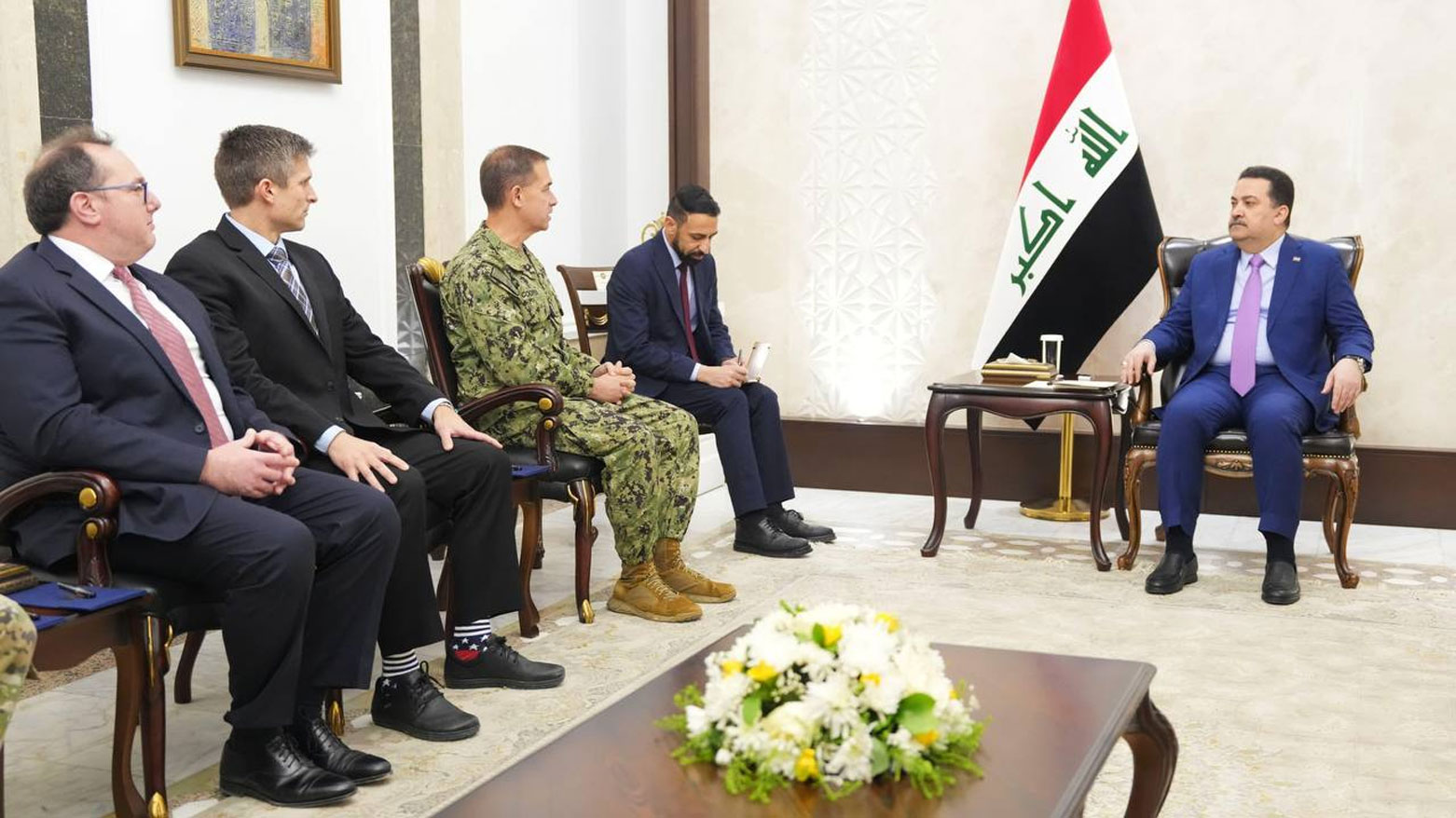
ERBIL (Kurdistan24) - Prime Minister Mohammed Shia al-Sudani asserted on Friday that the Iraqi government’s early anticipation of regional instability allowed the state to secure its borders and manage a massive influx of detainees, following high-level discussions with U.S. military leadership regarding the deteriorating security situation in neighboring Syria.
During a meeting in Baghdad with Admiral Brad Cooper, the Commander of the U.S. Central Command, Iraqi PM al-Sudani emphasized that the Iraqi leadership possessed "early foresight" regarding the potential for regional developments to unfold in a destabilizing manner.
According to a release from the Prime Minister’s Media Office, received by the Iraqi News Agency (INA), this strategic outlook prompted the federal government to establish proactive protection plans for the national frontier, utilizing fortification methods implemented for the first time in the country’s history.
The meeting between the Prime Minister and the U.S. commander focused heavily on the volatility in Syria, specifically targeting the security of facilities housing members of the Islamic State (ISIS).
The INA report noted that both officials expressed concern regarding the areas surrounding these prisons, which currently face "continuous threats of being stormed" by extremist elements seeking to release the detainees. Such a development, the statement warned, constitutes a "serious threat" to the stability of both Iraq and the wider Middle East.
To counter these risks, al-Sudani and Admiral Cooper underscored the necessity of sustained communication between Iraqi security and military commands and the International Coalition forces.
The Prime Minister’s office stated that the coordination would involve dividing tasks according to specific timelines and providing the necessary logistical, administrative, and technical groundwork to ensure the mission is executed in a secure manner.
As reported by INA, al-Sudani praised Admiral Cooper’s role in finalizing the requirements for the conclusion of the International Coalition's mission in Iraq, including the significant handover of the Ain al-Asad Airbase to Iraqi forces.
The Iraqi Prime Minister characterized these steps as evidence of the evolving partnership between Baghdad and the coalition, which originally formed to confront the ISIS territorial caliphate.
In his remarks, Admiral Cooper commended Iraq’s contribution to the International Coalition and expressed gratitude on behalf of the international community for Baghdad's "effective security step" of receiving ISIS detainees.
The Admiral confirmed the U.S. military’s readiness to provide continued logistical and technical support, assuring the Prime Minister that cooperation between the two parties would persist at the "highest levels."
Expanding Custodial Burden and Diplomatic Pressure
The strategic dialogue in Baghdad occurs against the backdrop of a massive logistical operation to transfer thousands of ISIS fighters from Syrian territory to Iraqi jurisdiction.
According to background reports from Kurdistan24, this process has reached an unprecedented scale, with Iraq’s Interior Ministry confirming that approximately 7,000 ISIS prisoners are being transferred into the country weekly.
The demographic composition of these transferees has become a central point of contention for the Iraqi government.
Data provided by Interior Ministry spokesperson Miqdad Miri indicates that of the 7,000 weekly arrivals, roughly 5,000 are foreign nationals, while 2,000 are Iraqi citizens.
This disparity has led al-Sudani to increase diplomatic pressure on Western governments to repatriate their own citizens rather than leaving the legal and custodial burden to Baghdad.
In a telephone conversation with French President Emmanuel Macron on Friday, the Iraqi PM insisted that European nations must fulfill their international obligations.
The Prime Minister told President Macron that European Union member states should assume responsibility by "receiving those individuals who hold their nationalities" and conducting the necessary prosecutions within their own jurisdictions.
This appeal followed a report by Agence France-Presse (AFP) indicating that the Iraqi premier views the current arrangement as unsustainable without international reciprocity.
Domestically, the Iraqi judiciary has already begun to formalize its handling of the crisis.
On Thursday, judicial authorities announced the launch of legal proceedings against the ISIS detainees transferred from Syria.
By activating the legal system, Baghdad intends to demonstrate its commitment to accountability while simultaneously signaling that it will not indefinitely house foreign combatants without a clear path toward repatriation by their home countries.
Border Fortification and Provincial Distribution
The Interior Ministry has outlined a comprehensive security architecture designed to prevent any breaches during the transfer of these high-value detainees.
To secure the border with Syria, Iraqi authorities have established three distinct defensive lines. These perimeters are overseen respectively by the border guards, the Iraqi army, and the Popular Mobilization Forces (PMF).
This layered approach is intended to ensure that neither insurgent cells nor escaping detainees can navigate the frontier undetected.
Once inside Iraq, the prisoners are being distributed among high-security facilities in multiple provinces to mitigate the risks associated with large-scale detention.
The Interior Ministry confirmed that the detainees are currently being housed in prisons located in Nasiriyah, Hillah, and Nineveh. These measures, according to the ministry, reflect Iraq’s broader commitment to regional security and counterterrorism.
The ongoing coordination also involves civilian components.
Al-Sudani noted that Iraq’s "early foresight" included the repatriation of a large number of Iraqi families from regional camps, a move aimed at preventing the long-term radicalization of vulnerable populations.
In parallel with the military discussions, the Iraqi government has maintained close ties with Washington’s diplomatic channels.
On Thursday, al-Sudani received U.S. Special Envoy for Syria Tom Barrack. During that meeting, the envoy conveyed the gratitude of U.S. President Donald Trump for Iraq's stabilizing role in the region.
The discussions with Barrack reportedly touched on economic cooperation and sustainable development, which both sides view as critical for ensuring that the security gains made in the fight against ISIS are not lost to future economic instability.
While the International Coalition mission moves toward its formal conclusion, the joint statements from Baghdad and U.S. Central Command suggest that the operational realities of the ISIS threat will require continued technical and logistical integration for the foreseeable future.