DEM Party MP Accuses Damascus of Ethnic Campaign as Kobani Siege Deepens Humanitarian Crisis
Gulistan Kiliç characterized the offensive in Rojava as a massacre supported by international silence; "With the support of Ankara and Washington, Syria intends to massacre Kurds, and their efforts are aimed at the destruction of Kurds in Rojava," Kiliç stated.
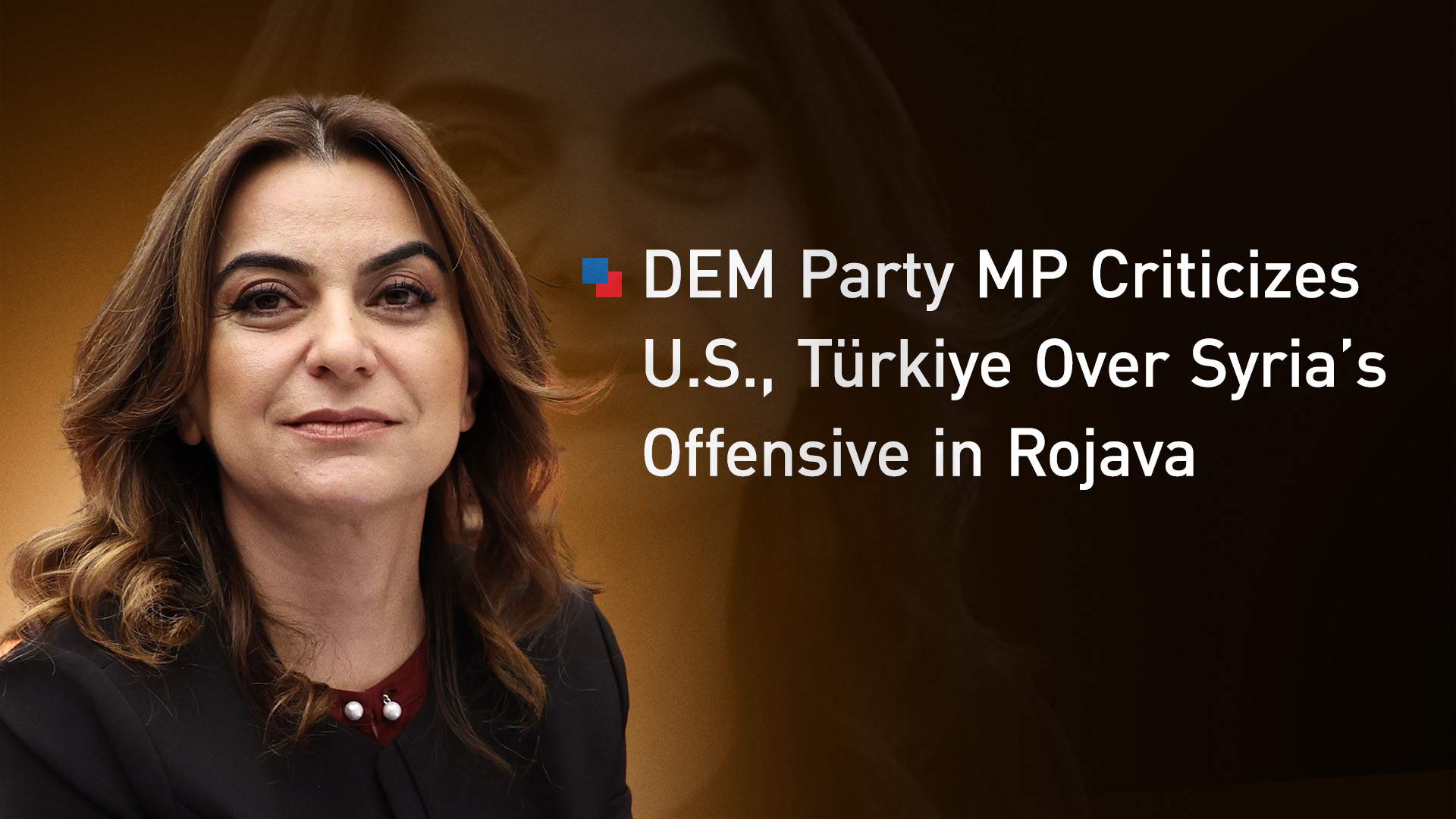
ERBIL (Kurdistan24) – Gulistan Kiliç, the head of the parliamentary group for the Peoples’ Equality and Democracy Party (DEM Party), issued a sharp condemnation on Saturday regarding the escalating military offensive in Western Kurdistan, asserting that Syrian government-affiliated forces are executing a systematic massacre of the Kurdish population. Speaking during an appearance on the "Basi Roj" program on Kurdistan24 on Jan. 24, 2026, Kiliç characterized the current hostilities as a fulfillment of extremist objectives that the Islamic State (ISIS) had failed to achieve during its previous territorial campaigns, while further alleging that the international community, specifically Washington and Ankara, have facilitated the advance of the Syrian Arab Army.
Kiliç’s remarks arrive at a pivotal moment in the Syrian conflict, as the city of Kobani remains under an encompassing military blockade and reports of civilian fatalities, including children, continue to emerge from the region.
The lawmaker argued that the war currently unfolding across Kurdish-populated areas is a direct extension of the violence that erupted on Jan. 6 in the Sheikh Maqsud and Ashrafiyeh neighborhoods of Aleppo.
She contended that an "ISIS-like and extremist mindset" has taken hold of the governing structures in Syria, which she claims is actively inciting various ethnicities to engage in combat against the Kurds. According to Kiliç, these developments represent a move toward a full-scale ethnic war and the consolidation of a new dictatorial regime in Damascus.
The head of the DEM Party parliamentary group directed specific criticism toward the United States and Türkiye, noting their status as members of the North Atlantic Treaty Organization (NATO).
She asserted that both powers possess the necessary leverage to compel the Syrian government to lift its blockade on Kurdish districts, yet they have refrained from providing a positive response to calls for an immediate cessation of hostilities.
"With the support of Ankara and Washington, Syria intends to massacre Kurds, and their efforts are aimed at the destruction of Kurds in Rojava," Kiliç stated. She emphasized that the voice of the region has been brought to both Türkiye and Europe without securing a tangible commitment to protect Kurdish lives.
Humanitarian Collapse in Kobani
The geopolitical alarms raised by Kiliç are corroborated by a rapidly deteriorating humanitarian landscape within the city of Kobani.
As of Saturday, the military siege of the city entered its seventh day, leading to what the Democratic Autonomous Administration of North and East Syria (DAANES) has described as a "slow death" for the urban center.
Avin Qamishlo, the Co-chair of the Media Office for the DAANES, told Kurdistan24 on Saturday that the crisis had claimed the life of another child due to a critical shortage of medical oxygen. The death occurred at a local hospital where health facilities are reportedly no longer able to meet basic patient needs as essential resources are exhausted.
Under the current siege, the city’s approximately 150,000 residents have been subjected to a total cutoff of water, electricity, and internet services. The blockade has paralyzed the daily functions of vital institutions, with hospitals now relying entirely on emergency generators.
Dr. Haqi Ali Demir, a specialist in anesthesia and intensive care in Kobani, warned that patients dependent on ventilators are at immediate risk as fuel supplies for these generators run low.
A group of Kurdish political organizations in Kobani issued a joint statement characterizing the siege as a form of "collective punishment" and a crime against humanity under international law, noting that children are currently without milk and families lack basic foodstuffs such as flour.
Environmental factors have significantly worsened the mortality rate within the encircled city.
The Kurdish Red Crescent reported on Saturday that five children, including an infant, have died in Kobani specifically due to exposure to extreme cold. The fatalities are linked to a significant drop in temperatures and a total absence of heating fuel.
These conditions coincide with a historic winter storm that has brought the heaviest snowfall to the region in more than 50 years. Meteorological reports indicate that the city and its surrounding villages are facing an unprecedented climate disaster while simultaneously being denied access to external relief.
Obstruction of Regional and International Aid
The isolation of Kobani stands in stark contrast to the humanitarian efforts currently being mounted in other parts of northeastern Syria.
The Barzani Charity Foundation (BCF), operating under the direction of President Masoud Barzani and the supervision of Prime Minister Masrour Barzani, has managed to deliver 102 trucks of aid to Rojava, consisting of more than 850 tons of food and essential supplies.
Karzan Nuri, a member of the BCF Administrative Board, confirmed that the foundation has also triples its fuel distribution to 300,000 liters to assist families in cities such as Qamishlo and Amuda.
However, these supplies have been unable to penetrate the military lines around Kobani. While the BCF has provided medical treatment to 685 individuals in other districts, the siege remains absolute.
The United Nations has echoed these concerns, with Deputy Spokesperson Farhan Haq stating on Friday that all primary and secondary access routes to Kobani remain closed.
Haq indicated that while the UN has successfully delivered aid to Hasakah and Raqqa, it has been forced to request specific "facilitation" from authorities in Aleppo to reach the trapped population in Kobani. The lack of a humanitarian corridor has effectively neutralized regional relief initiatives for the city's most vulnerable inhabitants.
Diaspora Mobilization and Diplomatic Standoff
The crisis has triggered a wave of mass protests across Europe, reflecting the "great fear" described by Kiliç regarding the future of the Kurdish people. In Paris, official police statistics indicated that approximately 7,500 people gathered on Saturday to support Rojava.
Protesters raised banners and chanted slogans such as "Kobani will not fall" and "Defend Rojava," expressing their opposition to the offensive by the Syrian Arab Army and affiliated armed groups.
Demet Sahin, a lawyer participating in the Paris march, told Agence France-Presse (AFP) that despite international rhetoric about supporting the Kurds, there is a visible absence of "practical measures" to alleviate the siege.
The French government, home to the second-largest Kurdish diaspora in Europe, issued a statement on Thursday asserting it had not abandoned the Kurds and praising their role in defeating ISIS.
However, these diplomatic assurances have not calmed the expatriate community. Tensions on the sidelines of these protests have led to 24 arrests and injuries to 21 police officers in recent days, resulting in a ban on demonstrations in the city of Marseille.
Against this backdrop of public unrest and humanitarian suffering, a fragile ceasefire agreement was announced late Saturday. The Syrian Democratic Forces (SDF) and the Syrian Ministry of Defense confirmed that a fifteen-day extension of the standing ceasefire had been reached through international mediation.
Damascus indicated that the truce is intended to facilitate the transfer of approximately 7,000 ISIS detainees from SDF-run prisons to Iraqi territory, an operation supported by the United States. On Wednesday, a convoy of 150 ISIS fighters, including European militants, was reportedly moved to Iraq as part of this process.
The Strategy of Integration and Internal Discipline
Despite the ceasefire, the political and ethical divisions between the combatants remain stark. The SDF recently released a dossier documenting what it claims are war crimes committed by government forces during the 17-day campaign, including reports of arbitrary detention and the targeting of medical facilities.
Simultaneously, the SDF Media Center moved to address its own internal discipline, announcing on Saturday the dismissal and referral to military court of a fighter who was photographed alongside the bodies of opposing gunmen.
The command described the incident as an "individual and isolated act" and reaffirmed its commitment to international humanitarian standards.
Kiliç addressed the broader political implications of this conflict, linking the situation in Rojava to the peace process within Türkiye.
She argued that every bullet fired in Syria is aimed at all "four parts of Kurdistan," and questioned how a domestic peace process in Türkiye could be discussed while Kurds are being targeted across the border.
Regarding the message of imprisoned PKK leader Abdullah Öcalan, Kiliç clarified that his communication does not advocate for the SDF to surrender or lay down arms to the Syrian government, but rather emphasizes a democratic resolution to the Kurdish issue.
She concluded her remarks by highlighting the "very important and significant" role of the Kurdistan Regional Government in mediating the crisis. Kiliç praised the diplomatic efforts conducted in Erbil with the participation of President Barzani, expressing hope that these high-level meetings would facilitate a resolution and deliver the Kurds from their current peril in Rojava.
As the fifteen-day ceasefire begins, the focus of the Kurdish leadership and the international community remains on whether the military blockade of Kobani will be lifted to prevent a further increase in the civilian death toll.