Iraqi FM Ties Regional Stability to ISIS Repatriation Costs and Resolving Presidential Deadlock
Iraqi FM Fuad Hussein stated that Parliament will elect the President after KDP-PUK failed to agree on a joint candidate, while demanding the U.S. and E.U. pay for the repatriation of Iraqi ISIS fighters.
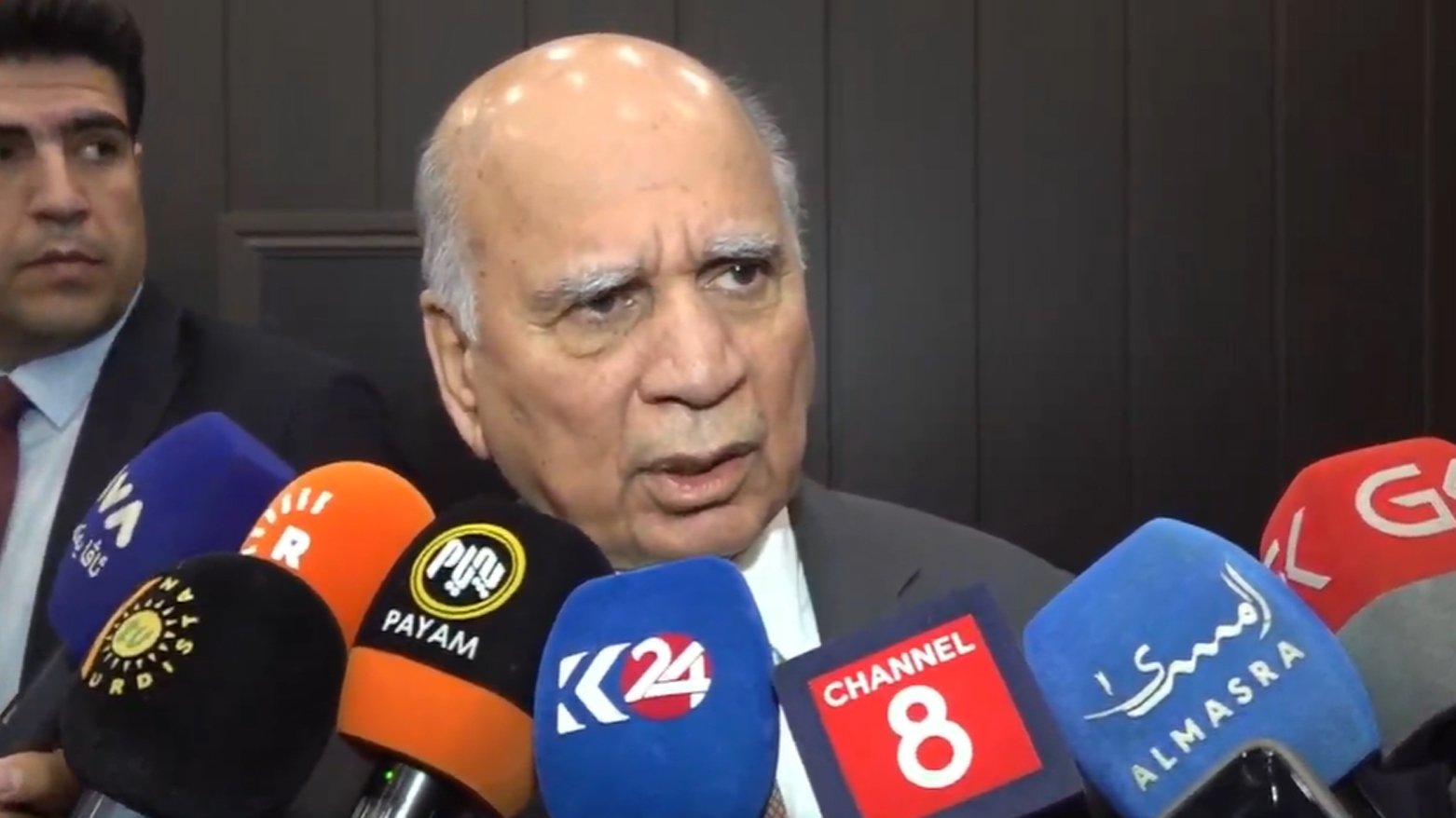
ERBIL (Kurdistan24) - Iraq’s Deputy Prime Minister and Minister of Foreign Affairs, Fuad Hussein, announced Sunday that Baghdad has reached a formal understanding with Syrian authorities to repatriate Iraqi nationals currently held in ISIS detention facilities in northeast Syria. During a comprehensive press conference, Minister Hussein categorized the prisoner file as a strategic imperative for Iraq’s national security while explicitly calling on the United States and the European Union to assume the logistical and financial responsibilities for the massive transfer operation.
The Foreign Minister’s remarks, delivered on Jan. 25, 2026, underscored the complexity of managing the legacy of the Islamic State (ISIS) amid shifting control of territory in Syria. Hussein revealed that while Iraq is prepared to receive its citizens, the government maintains significant reservations regarding the mechanics of the process.
He noted that the Iraqi government has requested that international partners, specifically the U.S. and the E.U., bear the costs of transportation and the broader financial requirements of the repatriation.
Central to the government’s concern is the profile of the detainees. Hussein described many of those slated for transfer as "dangerous leaders" whose continued detention must be managed under the strictest security protocols to prevent escape attempts.
The Minister stated that the agreement with the Syrian side is strictly limited to fighters who hold Iraqi citizenship, a policy intended to mitigate the custodial burden on the state while ensuring that those wanted by Iraqi courts face domestic justice.
Logistical Scale and International Coordination
The announcement by Hussein follows a period of intensified activity regarding the relocation of ISIS militants.
According to information provided by the Iraqi Ministry of Interior to Kurdistan24, a second convoy of prisoners is scheduled to arrive in Iraq from Syria within the coming days. Miqdad Miri, the spokesperson for the Ministry of Interior, previously confirmed that approximately 150 fighters have already been handed over to Iraq.
The broader objective, as defined by the United States Central Command (CENTCOM), is the eventual transfer of approximately 7,000 ISIS prisoners from Syrian territory to Iraqi jurisdiction.
This operation is being conducted under the joint supervision of the Iraqi Interior Ministry and CENTCOM. Miri stated that the International Coalition has expressed readiness to assist Baghdad in the protection and transportation of the detainees, who are being distributed among various high-security prisons across the country rather than a single centralized facility.
The necessity of the transfer has been framed by the Iraqi government as a "preemptive step to protect national security."
Basim Alawadi, the government spokesperson, noted that the move is designed to address the increasing instability in northeastern Syria, where the risk of prison breaks from facilities previously controlled by the Syrian Democratic Forces (SDF) has escalated significantly.
Border Fortification and Internal Security Friction
To support the influx of high-value detainees and prevent cross-border infiltration, Hussein provided assurances that Iraq has implemented "intensive preparations" along its frontier with Syria.
Senior Iraqi security officials have detailed a triple-layered defensive architecture consisting of lines overseen by the Border Guard, the Iraqi Army, and the Popular Mobilization Forces (PMF). This physical barrier is supplemented by thermal surveillance cameras, drones, concrete walls, and trenches.
Despite these assurances, the repatriation policy has generated friction within Iraq’s security apparatus. Abu Turab al-Tamimi, a senior commander in the PMF and the Badr Organization, characterized the return of ISIS prisoners as a "major mistake" and a "wrongful act" for which the government must bear responsibility.
In response to these internal tensions, the government has maintained that the Supreme Judicial Council has already begun the necessary procedures to process the detainees under national law.
Sabah al-Numan, the spokesperson for the Commander-in-Chief of the Iraqi Armed Forces, stated that most of the transferred individuals are already wanted by Iraqi courts. He emphasized that the trial process will adhere to the country’s effective laws, ensuring that the militants receive "just punishment."
This stance was echoed by former Chief of Staff Babakir Zebari, who argued that the dangerous nature of the fighters requires them to be tried and sentenced to death to prevent any possibility of a future resurgence.
Regional Shifts and the Fate of Juveniles
The security landscape in Syria has been further complicated by the Syrian government’s recent efforts to reassert authority over areas previously held by the SDF.
This shift in control has directly impacted detention facilities such as al-Aqtan Prison in Raqqa. On Saturday, Syrian security forces announced the release of 126 ISIS-linked detainees from al-Aqtan on the basis that they were minors under the age of 18 at the time of their capture.
Syrian officials stated that the release followed a review conducted via a newly launched digital platform, "Your Voice Is Heard," which found that the individuals did not pose an immediate security threat.
This development highlights the divergent approaches to the detainee crisis as Damascus takes over facilities from the Kurdish-led SDF, which had for years overseen the detention of thousands of ISIS members and their families.
The SDF has recently warned of the volatility surrounding these sites, particularly following attacks on the Shaddadi prison that resulted in several escapes. This instability provides the immediate context for Minister Hussein’s demand that the U.S. and E.U. help control these facilities and prevent militants from returning to the battlefield.
The Deadlock Over the Iraqi Presidency
Beyond the security portfolio, Foreign Minister Hussein addressed the protracted political impasse regarding the election of Iraq’s next President. He confirmed that the two primary Kurdish parties—the Kurdistan Democratic Party (KDP) and the Patriotic Union of Kurdistan (PUK)—have yet to reach a final agreement on a joint candidate for the post.
"The final list of candidates includes 18 people, and ultimately the Iraqi Parliament will decide which of these candidates will be elected to the post," Hussein said. The lack of a unified Kurdish front has complicated the government formation process, as the presidency is traditionally reserved for the Kurdish component under Iraq’s post-2003 political custom.
The failure of the KDP and PUK to align on a single nominee means that the decision will likely be settled on the floor of the parliament, where broader alliances within the legislative body will determine the outcome.
Hussein expressed concern over the continued lack of consensus, suggesting that the delay in electing a president hinders the overall political transition and the formation of a stable cabinet.
Diplomatic Maneuvering with Western Powers
The Foreign Minister’s press conference aligns with broader efforts by Iraq's Prime Minister Mohammed Shia al-Sudani to distribute the burden of the ISIS legacy.
On Friday, al-Sudani held a telephone conversation with French President Emmanuel Macron, during which he insisted that European Union member states must repatriate and prosecute their own nationals currently held in the region.
The Iraqi government has pointed out that a significant portion of the ISIS detainee population consists of foreign nationals, with approximately 5,000 foreign fighters expected to be part of the larger transfer plan, alongside 2,000 Iraqi citizens.
By demanding that the U.S. and E.U. cover the financial costs of the transfer, as Hussein did on Sunday, Baghdad is signaling that its willingness to provide a secure environment for these prisoners is conditional upon international cooperation.
The visit of U.S. Special Envoy for Syria Tom Barrack to Baghdad on Thursday further emphasized this dynamic.
Barrack conveyed President Donald Trump’s gratitude for Iraq’s role in regional stability. However, Minister Hussein’s comments suggest that gratitude must be accompanied by tangible financial and logistical support if the repatriation of "dangerous leaders" is to continue without compromising Iraq's own fiscal stability.
As Iraq navigates these twin crises—the logistical challenge of the ISIS prisoner transfer and the political hurdle of the presidential election—the government is positioning itself as a central but overburdened arbiter of regional security.
The upcoming arrival of the second convoy of ISIS fighters will serve as a practical test of the "intensive preparations" cited by the Foreign Minister and the resilience of the nation’s triple-layered border defenses.
This article was updated on Sunday, Jan. 25, 2026, at 02:12pm.