SDF Says Pro-Damascus Armed Groups Launched Attacks South of Kobani
The anniversary of Kobani’s liberation arrives amid a new military siege and a failing ceasefire, with SDF forces repelling government-affiliated attacks as 100,000 civilians face a humanitarian catastrophe.
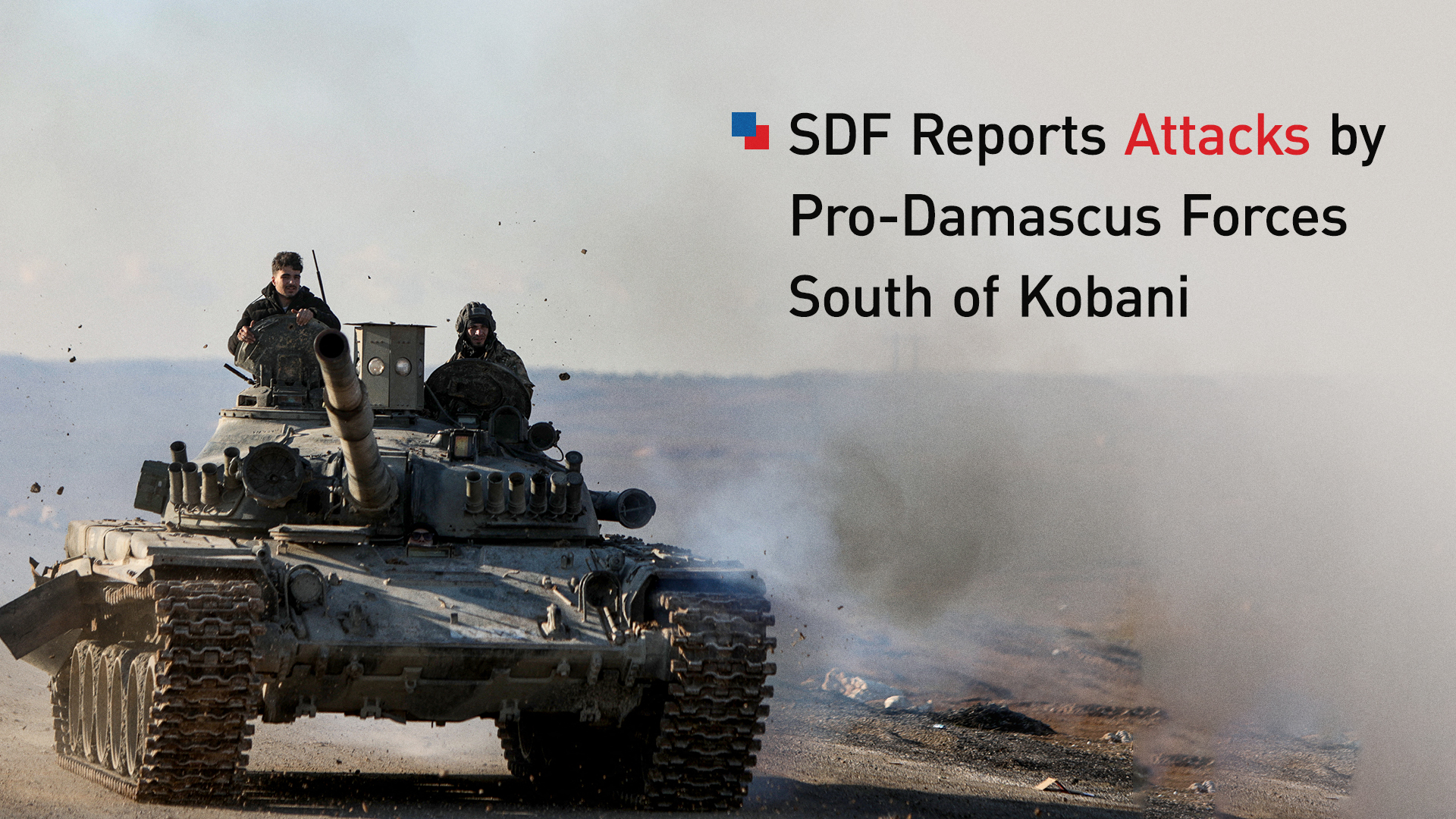
ERBIL (Kurdistan24) - Armed groups affiliated with the Syrian government resumed intensive military operations on the outskirts of Kobani early Monday, according to reports from the Syrian Democratic Forces, signaling a collapse of the two-day-old ceasefire agreement on the same day the city marked the eleventh anniversary of its liberation from the Islamic State.
The offensive, which Kurdish officials described as a "clear and blatant violation" of recent diplomatic understandings, has exacerbated a deepening humanitarian crisis within the encircled city, where more than 100,000 displaced persons are currently sheltering under a strict siege amid severe winter conditions.
The Media Center of the Syrian Democratic Forces (SDF) confirmed in a formal statement that the attacks began at dawn on January 26, 2026, launched from several fronts against the villages of Kharab Ashk and Jalabiya, located southeast of Kobani.
The SDF reported that the assault included heavy artillery shelling of residential neighborhoods and that fierce clashes ensued as Kurdish-led forces moved to repel the advance.
Military monitors observed that the attacking groups, which are aligned with the Damascus administration led by Ahmed al-Shara, have continued to move reinforcements, including tanks and armored vehicles, toward the contact lines.
The SDF also noted intensive drone activity over the area, characterizing the persistence of the military escalation as evidence of the central government’s failure to adhere to its diplomatic commitments.
The resumption of hostilities occurred as the SDF General Command issued a commemorative statement for the anniversary of Kobani’s 2015 liberation from the Islamic State, known as ISIS.
In its reflection, the command described the original victory as a "decisive turning point" and a defense of global human values that ended the extremist group's territorial project. However, the command warned that the current attempts to destabilize northern and eastern Syria through new offensive operations constitute a direct threat to international security.
The SDF called on the international community to assume its legal and moral responsibilities to protect the security gains achieved during the war against terrorism.
Inside the besieged city, the atmosphere is described by residents as one of "psychological terror." Dr. Bakhtiar Mudarris, speaking to Kurdistan24 from the city center, reported that the humanitarian situation has reached a critical threshold.
He stated that the influx of displaced persons from surrounding villages has left schools and public buildings overcrowded, while essential services remain non-existent.
"There is no electricity, no fuel, and no food," Dr. Mudarris said, adding that medical supplies in local hospitals are nearing total depletion. He warned that if the military blockade is not lifted immediately, the city will face a large-scale humanitarian catastrophe.
The inadequacy of international aid has become a primary concern for local officials. Dr. Mudarris noted that a recent United Nations aid convoy was only sufficient to assist approximately 2,000 individuals, a fraction of the estimated 100,000 people currently trapped in the city center.
This shortfall has led to an increased reliance on the Barzani Charity Foundation (BCF), with local residents looking toward the organization as the primary hope for relief.
Despite the dire circumstances, Dr. Mudarris emphasized that the Kurdish population does not seek secession from the Syrian state. "We only want this war to stop and to live in peace," he said, appealing to all Syrian components, particularly the Arab population, to pursue coexistence over the "language of war."
The current instability follows the collapse of the Bashar al-Assad regime on December 8, 2024, and the rise of a transitional administration in Damascus.
While a U.S.-supported agreement was signed on January 18, 2026, to unify efforts against ISIS remnants and establish a ceasefire, the region has been plagued by repeated violations and military friction throughout the past month. The volatility has drawn sharp criticism from international observers and lawmakers.
In London, Feryal Clark, the Labour Member of Parliament for Enfield North, urged the British government to take "immediate and decisive action" regarding the escalating violence.
In a letter to Foreign Secretary Yvette Cooper, Clark highlighted that more than 150,000 people have been displaced during the January escalation. She expressed concern over reports that some extremist elements have been released from detention, reviving fears of an ISIS-era threat under the current political vacuum.
Clark called for the UK to pursue international accountability measures, including targeted sanctions against those responsible for harming civilians and minorities.
Similar concerns were echoed in Washington, where former U.S. Secretary of State and CIA Director Mike Pompeo warned that abandoning Kurdish allies in Syria would represent a "moral and strategic disaster."
Pompeo endorsed calls for bipartisan action in the U.S. Senate to protect the SDF and other minority communities, including Christians and Yazidis, from government-affiliated factions.
Nadine Maenza, a Global Fellow at the Wilson Center and president of the International Religious Freedom (IRF) Secretariat, also demanded the continuation of the ceasefire, insisting that regime forces must remain outside of Kurdish-majority areas to ensure humanitarian access.
The United Nations High Commissioner for Refugees (UNHCR) has similarly stressed the urgency of the situation. High Commissioner Barham Salih, speaking at the World Economic Forum in Davos, delivered a message to global leaders emphasizing that life-saving aid must be paired with the preservation of human dignity.
The UNHCR warned that without a comprehensive and sustained diplomatic intervention, the cycle of displacement in Syria would continue to undermine regional stability.
The latest ceasefire extension, announced on Saturday, was intended to last fifteen days to facilitate a U.S.-led operation to transfer approximately 7,000 ISIS detainees from SDF-run prisons to facilities in Iraq.
The Syrian Defense Ministry had stated that the extension would support the movement of these high-value prisoners, 150 of whom were transferred earlier this week, followed by a second batch of up to 1,000 on Saturday. However, the resumption of attacks on Kobani on Monday morning suggests that the truce is being treated as a secondary priority to territorial acquisition by government-aligned forces.
Kurdish sources indicate that ongoing negotiations mediated by U.S. envoy Tom Barrack have included proposals for Damascus to manage border crossings in exchange for allocating a share of oil and customs revenues to Kurdish-administered areas.
While Presidential Decree No. 13, issued by the al-Shara administration, was seen as a positive step toward constitutional recognition of Kurdish identity and rights, Kurdish political councils argue that these promises have not translated into safety on the ground.
The recapture of key oil fields by the Syrian Arab Army earlier this month and the release of 126 minors from a Raqqa detention facility have further complicated the trust between the negotiating parties.
The SDF statement on Monday emphasized their legitimate right to self-defense in the face of the renewed offensive. The command held the Damascus government "fully responsible" for the humanitarian and security consequences of the latest escalation.
They issued an urgent appeal to the guarantor parties of the January 18 agreement to act decisively to end the policy of military confrontation.
As fighting continues in the villages of Kharab Ashk and Jalabiya, the 11th anniversary of Kobani's victory over ISIS has been overshadowed by the immediate threat of a new conflict.
The convergence of a severe winter, a lack of medical oxygen, and the advance of government-affiliated armored units has left the city’s 150,000 inhabitants in a state of extreme vulnerability.
Local authorities maintain that the international community’s silence in the face of documented violations amounts to complicity, stressing that the window for a negotiated political solution is rapidly closing as frontline clashes intensify.
This article was updated on Monday, Jan. 26, 2026, at 12:05pm.