Kobani Council Head: Siege Pushing Kurdish City Toward Disaster Amid Severe Shortages
KNCS official Adnan Bozan warns Kobani faces a severe humanitarian crisis, citing shortages of medicine, food, water, electricity, and heating as children fall ill under an ongoing siege.
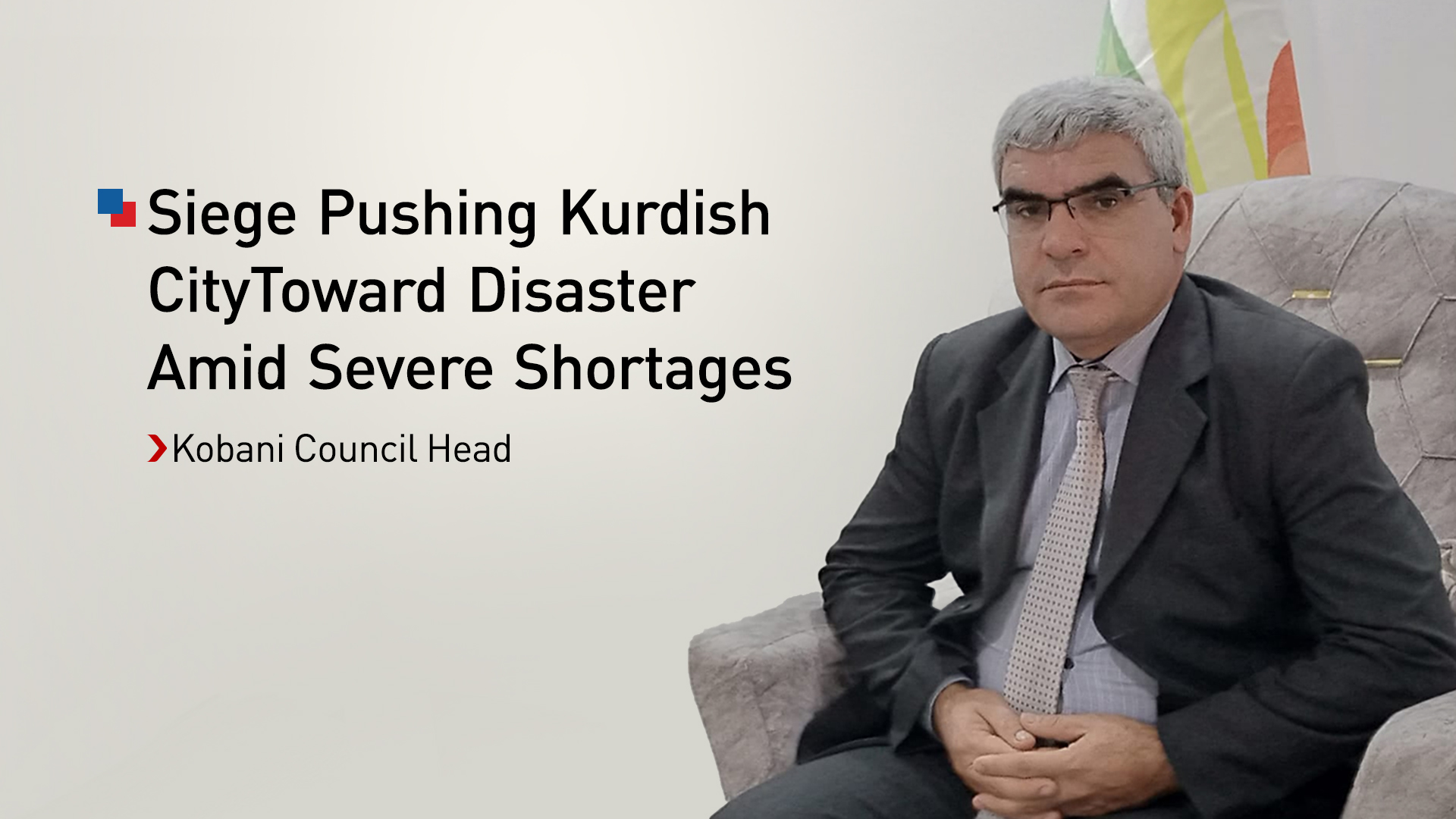
ERBIL (Kurdistan24) - Darkness, cold, and empty shelves now define daily life in Kobani, where children are falling ill, hospitals are overwhelmed, and families struggle to secure even the most basic necessities, according to a senior Kurdish official speaking to Kurdistan24.
In an interview with Kurdistan24, Adnan Bozan, Head of the Kobani Local Council of the Kurdish National Council in Syria (KNCS), warned that the continued siege of the city is pushing civilians, particularly children, toward a humanitarian disaster as winter conditions intensify and humanitarian access remains blocked.
Bozan described the health situation in Kobani as “extremely dangerous,” especially for children, citing the absence of basic necessities amid harsh winter weather.
“With the lack of heating, food, medicines, and infant formula, it is natural that seasonal illnesses such as gastrointestinal infections and skin diseases are spreading, in addition to early signs of malnutrition,” he said. “There are real fears that if the siege continues, we could be facing a humanitarian catastrophe.”
He confirmed that pharmacies and warehouses have begun running out of essential medicines, particularly those required for chronic diseases. Infant formula, he said, is “almost completely unavailable” in local markets, creating an urgent and critical need.
According to Bozan, hospitals and medical centers are operating with severely limited capacity. He said doctors at several facilities have confirmed that many patients require surgical operations, but these procedures are being postponed due to an acute shortage of medical supplies and equipment.
Bozan said the local council has issued official appeals and conducted dozens of media interviews calling for the opening of humanitarian corridors and the entry of international organizations into Kobani before conditions deteriorate further. He said the council continues its efforts and ongoing communications with relevant parties.
Turning to living conditions and food security, Bozan said there are genuine fears that flour supplies for bakeries could soon be exhausted, particularly due to fuel shortages, raising the prospect of a severe bread crisis.
He noted that a limited number of United Nations trucks have reached Kobani from Aleppo, carrying some medical and relief supplies as well as small quantities of fuel. However, he stressed that the aid delivered so far does not meet the scale of needs in the city.
Regarding assistance from the Barzani Charity Foundation, Bozan said the Kurdish National Council remains in constant contact with the organization, which is making significant efforts to deliver aid to Kobani through the United Nations. “But unfortunately, until now, this has not happened,” he said.
He called on the interim government to allow international organizations, “especially the Barzani Charity Foundation, which is a purely humanitarian organization with no political affiliation,” to deliver aid to the besieged population of Kobani, particularly displaced people from surrounding villages fleeing ongoing fighting.
Bozan said that while individuals from Kobani living abroad are attempting to send small amounts of aid, the large number of displaced people far exceeds available resources. “The real solution lies in allowing international organizations to enter directly and regularly,” he said.
He added that household food stocks are unlikely to last much longer due to the suffocating siege and the disappearance of basic goods from markets. Prices, he said, have risen sharply, while most economic activity has come to a halt.
“A large segment of the population depends on daily wages,” Bozan said, explaining that under current conditions, purchasing basic necessities has become nearly impossible.
Addressing basic services, Bozan said electricity has been cut off from Kobani for more than ten days, leaving the city in complete darkness. He noted that power briefly returned at around five in the evening but lasted no more than five minutes before being cut again, affecting both the city and surrounding rural areas.
Internet services, he said, have been completely disconnected for more than a week, severely hindering communication with the outside world and even within the city itself. As for concerns about monitoring, Bozan said there are currently no communications at all, making such fears irrelevant.
Water supplies have also been disrupted due to the electricity outage, which has stopped water pumps from operating. Residents are now forced to buy water from tankers, with the price of a household tank holding five barrels reaching 125,000 Syrian pounds, approximately eleven dollars, due to fuel shortages.
Bozan said there have been no humanitarian corridors for more than ten days, emphasizing that not “a single can of infant formula, a kilogram of vegetables, or a liter of diesel” has entered Kobani or its countryside during that time.
He described the city as being under a suffocating siege from all four directions, with the Turkish border closed to the north, areas controlled by Syrian National Army factions to the west and east, and ongoing fighting between the Syrian army and the Syrian Democratic Forces to the south.
With heating fuel nearly nonexistent, Bozan said residents are resorting to lighting fires with whatever wood they can find or using old stoves that had not been used for decades. “Heating materials are almost completely unavailable,” he said.
Looking ahead, Bozan said the Kurdish National Council is exerting all possible efforts to pressure the interim government to allow international organizations access and to open commercial routes to meet the city’s needs.
In a message to residents, he said: “We address our steadfast people in Kobani and affirm that we in the Kurdish National Council will spare no effort to secure the basic requirements of life for the city. We are in continuous contact with all relevant and influential parties to open humanitarian corridors and lift the siege.”
Bozan’s warnings come as the United Nations Office for the Coordination of Humanitarian Affairs said more than 170,000 people have been displaced across several parts of Syria since Jan. 6, warning that humanitarian needs are rapidly increasing.
In a statement posted on X, OCHA said displacement sites are overcrowded and struggling to cope with the growing number of people in need, while humanitarian organizations are providing emergency assistance, including food, blankets, and winter clothing, as families face harsh conditions.
The United Nations has also welcomed the start of humanitarian aid deliveries to the city of Kobani, describing the move as a critical step toward easing civilian suffering in Western Kurdistan.
As winter deepens and access remains restricted, Kobani’s children and families face worsening hardship, with local officials warning that without immediate and sustained humanitarian access, the city risks sliding into a full-scale humanitarian disaster.