German Lawmaker Says President Barzani Played Key Role in Stabilizing Western Kurdistan
Berivan Aymaz, deputy speaker of the North Rhine-Westphalia (NRW) state parliament in Germany, said President Barzani played a key role in easing tensions in Rojava, stressed Kurdish unity, and called for sustained German political, economic, and cultural engagement with the Kurdistan Region.
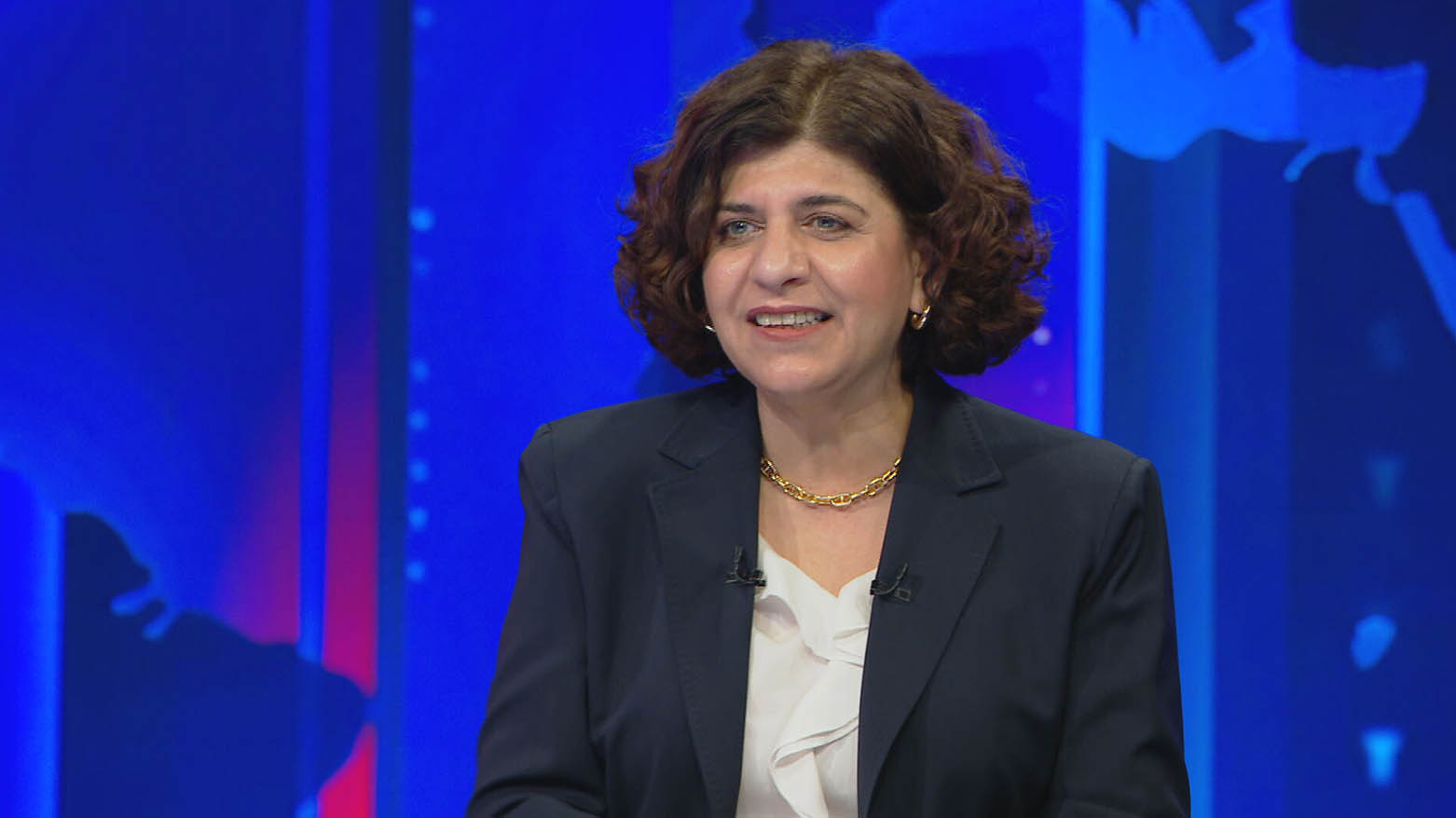
ERBIL (Kurdistan24) - Berivan Aymaz, deputy speaker of the North Rhine-Westphalia (NRW) state parliament in Germany, said President Masoud Barzani played a decisive role in calming tensions and establishing peace in Western Kurdistan (Rojava), while stressing that the Kurdistan Region’s political position and internal Kurdish unity remain essential to regional stability.
Aymaz made the remarks during an appearance on Kurdistan24’s “Basi Roj” (Topic of the Day) program, where she discussed the objectives of a visiting delegation of German parliamentarians to the Kurdistan Region, Germany’s relationship with the Kurdistan Region, and developments in Rojava. Her comments came as Kurdish communities in Germany held large demonstrations in support of Rojava and amid renewed debate about Kurdish unity and security arrangements in northern Syria.
Speaking from Erbil, Aymaz described her visit as both official and personal. She said she was visiting as a representative of a German regional parliament and, for the first time in that capacity, as a German Kurd with a migration background. She thanked Erbil Governor Omed Khoshnaw and others for what she described as a warm reception of the German delegation, calling the visit significant given ongoing developments in Rojava and the security situation there.
Aymaz said ties between NRW and the Kurdistan Region are longstanding and multifaceted, rooted in the presence of large Kurdish communities in Germany, particularly in cities such as Bonn and Cologne. She noted that Kurds in those cities were politically active even decades ago and said those people-to-people connections later expanded into economic and political relations. She also pointed to Germany’s support for Yazidi refugees as part of that relationship. According to Aymaz, the goal of the visit was to strengthen and sustain these links for the future.
Asked about the importance of strong relations between Germany and the Kurdistan Region, Aymaz said Iraqi Kurdistan plays a key role in the Middle East.
She cited what she described as significant development in the Kurdistan Region over recent decades and emphasized that different religious and ethnic groups coexist there peacefully. She contrasted this with conditions elsewhere in the region and said this experience added to the Kurdistan Region’s value as a stabilizing actor.
Within that context, Aymaz highlighted President Barzani’s role, saying he had exercised considerable influence in promoting peace and stability, not only within the Kurdistan Region but also among neighboring areas.
She said President Barzani had played what she described as a historic and major role in calming the situation and establishing peace in Rojava, a point she returned to repeatedly throughout the interview.
The discussion also addressed German assistance to the Kurdistan Region, which Aymaz acknowledged had largely taken the form of military support during the war against the Islamic State (ISIS).
She said the Kurds in the Kurdistan Region and in Rojava had been partners and allies in that fight and argued that relations should not be limited to periods of crisis. Instead, she said cooperation should evolve into long-term political, economic, and cultural engagement.
Aymaz pointed to several areas where she believed such engagement could expand, including business activity, cultural exchange, and institutional cooperation. She cited the potential establishment of a Goethe Institute in Erbil as an example of cultural ties and said parliamentary exchanges were important for strengthening democratic institutions.
She also suggested cooperation at the municipal level, noting that cities in NRW have sister-city relationships that could be developed with Erbil and other cities in the Kurdistan Region.
Regarding the delegation’s schedule, Aymaz said meetings were planned with President Masoud Barzani, Kurdistan Region's President Nechirvan Barzani, and Prime Minister Masrour Barzani. She thanked Shifa Barzani for organizing the meetings and said it was important for the delegation to speak with figures who play prominent roles in the region.
Aymaz said the delegation wanted to hear assessments of the regional situation, discuss what support might be needed, and exchange views on ongoing dialogues in Europe related to developments in different parts of Kurdistan.
Aymaz was also asked about what she described as Germany’s relatively limited or slow public response to events in Rojava in recent weeks. She said Germany had not initially played a large role, but added that Kurdish activism in Europe had been strong.
According to Aymaz, Kurds in Germany organized protests, demonstrated in front of parliament, and conveyed their demands directly to German lawmakers, leading many politicians to break their silence and take action.
Responding to concerns expressed by Kurds who feel abandoned by Western allies, Aymaz said she understood the sense of pain and disappointment, particularly after the sacrifices made during the fight against ISIS.
She said she had spoken with many Kurds during protests and emphasized that the demonstrations reflected widespread emotional distress. She said women, children, and entire families participated, and that Kurds in Germany collectively felt that sense of neglect and hopelessness.
On Germany’s broader role, Aymaz said the country holds a central position within the European Union and seeks to promote human rights and minority rights. She added that stability in the region matters to Germany, noting the geographic proximity and the presence of large Kurdish communities within Germany itself.
When asked about the size and status of the Kurdish population in Germany, Aymaz said precise numbers are difficult to determine because ethnicity is not recorded in passports.
She estimated that between one and one and a half million Kurds live in Germany and described them as an integral part of German society. She cited her own position as deputy speaker of a state parliament as an example and said Kurds are active in fields including culture, art, music, and politics.
Aymaz also referred to projects in NRW that support Kurdish culture and history, including Kurdish associations and institutions that receive annual government funding. She described these as permanent initiatives aimed at preserving language, culture, and historical research.
Discussing Kurdish diaspora activism, Aymaz said demonstrations held in Bonn and other cities had attracted thousands and increased media and government attention to Kurdish demands. She said the gatherings were significant not only politically but socially, as they brought together Kurdish youth, women, and children across political differences to rally around shared calls for freedom and justice.
She added that events in Rojava and Kobane had resonated strongly with her German parliamentary colleagues, many of whom, she said, expressed solidarity publicly and discussed Kurdish history and the role of Kurdish women in resisting ISIS.
Returning to the Kurdistan Region’s role, Aymaz said Iraqi Kurdistan has provided substantial humanitarian assistance to Rojava and has sought political solutions. She said President Barzani worked to activate and unify Kurdish parties in pursuit of dialogue and stability.
In closing, Aymaz addressed fighters and civilians in Rojava, saying that as a parliamentarian she and others in the German parliament had expressed support for the slogan “Jin, Jiyan, Azadi.” She said Kurds, and especially Kurdish women, played a major role in protecting European security during the fight against ISIS and argued that Europe has a humanitarian responsibility not to abandon those who fought for its security.
Her remarks aligned with recent statements by Parwin Yusuf, co-chair of the Democratic Union Party (PYD), who told Kurdistan24 that only Kurdish unity can guarantee rights and security in northern Syria.
Yusuf said an agreement was in place to prevent the Syrian army from entering Kurdish areas, emphasized self-defense as the main guarantee against renewed conflict, and warned against fragmentation within the Kurdish political landscape.
Together, the comments underscored a shared emphasis on unity, dialogue, and the role of the Kurdistan Region and its leadership in shaping outcomes in Rojava.