Iraq’s FM Says Shiite Bloc to Meet President Barzani as Deadlock Over Presidency Persists
Iraq’s foreign minister said no deal has been reached on the presidency, with Shiite leaders set to meet President Barzani as parliament again fails to elect a president.
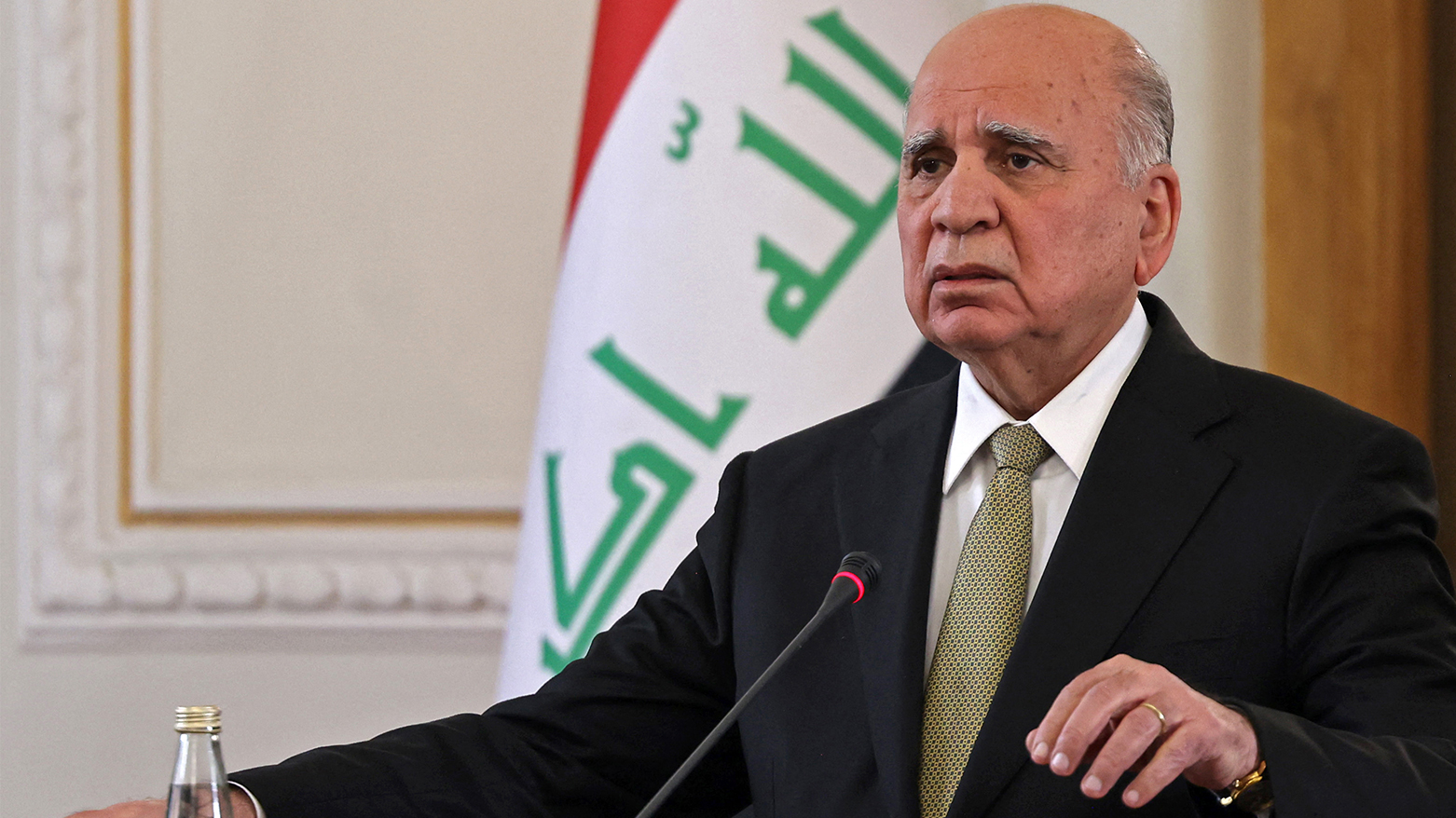
ERBIL (Kurdistan24) - Iraq’s Foreign Minister Fuad Hussein said on Sunday that a delegation from the Shiite-led Coordination Framework (SCF) is scheduled to meet President Masoud Barzani on Monday, as political negotiations continue amid a prolonged deadlock over the election of Iraq’s president and the formation of a new federal government. Speaking to Kurdistan24 on Feb. 1, 2026, Hussein said no agreement has yet been reached on the presidency, underscoring that talks remain ongoing despite mounting pressure from missed constitutional timelines and repeated postponements of parliamentary sessions.
Hussein confirmed that the Coordination Framework delegation’s meeting with President Barzani is part of ongoing efforts to bridge differences among Iraq’s main political blocs. He emphasized that discussions regarding the presidency have not resulted in a final agreement so far, reflecting the complexity of negotiations between Kurdish parties and Shiite forces over Iraq’s top constitutional posts.
Under the political agreement that has governed Iraq since 2003, the post of president is allocated to the Kurds. Kurdish political parties, including the Kurdistan Democratic Party (KDP), the Patriotic Union of Kurdistan (PUK), and the Kurdistan Islamic Union (KIU), have each put forward candidates for the largely ceremonial but symbolically significant position.
While 81 individuals initially submitted applications for the presidency, the Iraqi parliament later narrowed the list to 19 candidates, before one withdrew.
The Presidency of the Iraqi Parliament published the final list of candidates on Friday, January 23. Nawzad Hadi, one of the two candidates originally nominated by the KDP, subsequently withdrew from the race, leaving 18 candidates officially in contention. These include Dr. Abdullah Mohammed Ali Alyawayi, Fuad Mohammed Hussein Baki, Nizar Mohammed Said Mohammed, Shuan Hawiz Fareeq Namiq, Ahmed Abdullah Tawfiq Ahmed, Hussein Taha Hassan Mohammed Sinjari, Najmaddin Abdulkarim Hamakarim Nasrallah, Aso Fereidun Ali, Saman Ali Ismail Shali, Sabah Salih Said, Iqbal Abdullah Amin Haliwi, Sardar Abdullah Mahmoud, Muthanna Amin Nadir, Khalid Siddiq Aziz Mohammed, Azad Majid Hassan, Rafe' Abdullah Hamid Musa, Salem Hawas Ali Saedi, and Latif Mohammed Jamal Rashid.
Hussein’s remarks came as Iraq’s parliament again failed to convene a session to elect the president, deepening concerns over a constitutional vacuum. Earlier on Sunday, Shakhawan Abdullah, head of the KDP bloc in the Iraqi Parliament, said that an agreement had been reached among parliamentary leaders to grant the Coordination Framework additional time to complete its consultations.
Abdullah told Kurdistan24 that the latest parliamentary session was postponed due to the absence of a legal quorum. He stressed that the issue was not limited to Kurdish parties, saying that other political forces could have ensured quorum if they had chosen to do so. According to Abdullah, broader political difficulties persist, including unresolved disagreements over the appointment of the prime minister.
He said that during a meeting held earlier in the day between the heads of parliamentary blocs and the Speaker of Parliament, an agreement was reached to allow the Coordination Framework delegation currently visiting the Kurdistan Region to return and present its views. As a result, the parliamentary session has been postponed until the end of the week or the beginning of next week, he said.
The lack of quorum has fueled frustration among some lawmakers. Mahmoud Falih Sayid, a member of the Iraqi Council of Representatives from the Khadamat Alliance, warned that failure to elect a president could lead to calls for dissolving parliament. Speaking to Iraqi media on February 1, Sayid said that Iraq had entered what he described as a constitutional vacuum because January 29 marked the final deadline for electing the president.
Sayid said constitutional timelines had been ignored and the constitution violated. He noted that only 75 lawmakers attended the session scheduled for Sunday, while most members remained outside the chamber, preventing the session from reaching quorum. He said that if quorum is not met during a third session convened to elect the president, he and several other lawmakers would call for the dissolution of parliament.
Amid these tensions, the Parliamentary Presidency convened what it described as an extensive and important meeting on Sunday with representatives of all parliamentary parties and blocs. According to a statement from the Parliamentary Media Department, the meeting focused on practical steps to resolve the presidency and determine a final date for the voting session.
During the meeting, the Speaker of Parliament stressed the need to accelerate legal procedures and urged all parties to adhere to constitutional timelines so that the political process could move forward without further delay or obstruction.
Participants discussed the importance of reaching agreement on a voting date, noting that such consensus would not only fill a senior constitutional post but also lay the groundwork for completing other constitutional requirements and restoring political and administrative stability.
The Parliamentary Media Department said it is expected that political forces will agree on a near date for a special session to elect the president, with the aim of overcoming the current political deadlock.
Separately, Banas Dosky, a member of parliament from the KDP, said his party is prepared for a parliamentary session at any time and that its official presidential candidate is already present in the parliament building.
Speaking to Kurdistan24, Dosky said the KDP’s nominee, Fuad Hussein, was ready for the session that had been scheduled earlier on Sunday but postponed for a second time.
Dosky attributed the repeated delays largely to the stance of Shiite parties, saying that they are not rushing the process of government formation.
According to Dosky, the Shiite political forces, influenced by current political conditions and international statements, prefer to take additional time before finalizing a prime ministerial candidate and forming a cabinet.
He said that after the election of the president, constitutional procedures require the head of the largest parliamentary alliance—the Coordination Framework—to immediately nominate a prime minister to begin the process of forming a new government.
Dosky said that at this stage, all political actors appear reluctant to rush decisions, arguing that deliberation is intended to ensure outcomes that serve Iraq’s interests.
The comments came as the Coordination Framework, the largest Shiite alliance in parliament, continues to play a central role in negotiations over both the presidency and the premiership. The bloc has sent a senior-level delegation to Erbil as part of what it has described as accelerated efforts to complete Iraq’s constitutional entitlements.
According to a previous Kurdistan24 report, the Coordination Framework delegation’s visit to Erbil aims to establish what officials described as a final roadmap for resolving both the presidency and the premiership.
The delegation was expected to include Prime Minister Mohammed Shia al-Sudani, Deputy Speaker of Parliament Mohsen al-Mandalawi, and Badr Organization leader Hadi al-Ameri, who were scheduled to meet senior Kurdish leaders.
Abdulrahman al-Jazairi, a member of the State of Law Coalition, said the talks in Erbil were intended to reach political understandings that could unblock the current impasse.
According to Kurdistan24’s correspondent in Baghdad, the Coordination Framework has been seeking assurances from Kurdish parties to support its preferred prime ministerial candidate in exchange for facilitating consensus on a Kurdish nominee for the presidency.
The Erbil visit coincided with a parliamentary session initially scheduled for Sunday morning to elect a president, a session that was viewed as critical to meeting constitutional requirements and advancing government formation. That vote had already been postponed once at the request of the Patriotic Union of Kurdistan, highlighting ongoing Kurdish divisions despite the convention that reserves the presidency for a Kurdish figure.
Shakhawan Abdullah, speaking earlier on Sunday at a press conference, reiterated that discussions over the presidency were ongoing and rejected any suggestion that the KDP was responsible for delaying the session. He said the KDP bloc was present in parliament and that its official candidate was ready.
Abdullah said that while the Kurdish side had nominated a candidate for the presidency, the question of the prime minister remained an internal matter for Shiite parties within the Coordination Framework. He added that the parliament’s agenda includes not only the election of the president but also the selection of a prime minister and several other important issues.
Asked whether the Coordination Framework was close to agreeing on a prime ministerial nominee, Abdullah expressed skepticism, saying he did not believe the bloc was currently able to settle that issue.
The uncertainty surrounding the premiership has been further complicated by the Coordination Framework’s recent reaffirmation of its support for former prime minister Nouri Kamil al-Maliki as its candidate. In a statement issued after its 261st regular meeting, the bloc said the selection of the next prime minister was an internal Iraqi constitutional matter and rejected what it described as external interference.
The bloc emphasized its commitment to constitutional mechanisms and national interests, while calling on all political actors to respect deadlines and work toward consensual solutions. The endorsement of Maliki has remained a contentious issue, contributing to broader political tensions as Iraq struggles to complete the formation of its governing institutions.
As of Sunday, no agreement had been announced on either the presidency or the premiership. Hussein’s confirmation of an upcoming meeting between the Coordination Framework delegation and President Barzani underscores the continued centrality of Kurdish-Shiite negotiations in determining the outcome of Iraq’s stalled political process.
This article was updated on Sunday, Feb. 1, 2026, at 03:11pm.