PM Barzani: Baghdad Must Treat Kurdistan Region Salaries Like Rest of Iraq
Speaking in an interview with Kurdistan24 presenter Ammar Najmaddin on the sidelines of the World Governments Summit in Dubai, Prime Minister Barzani said relations with the UAE leadership have continued to strengthen over time, particularly in the economic and political spheres.
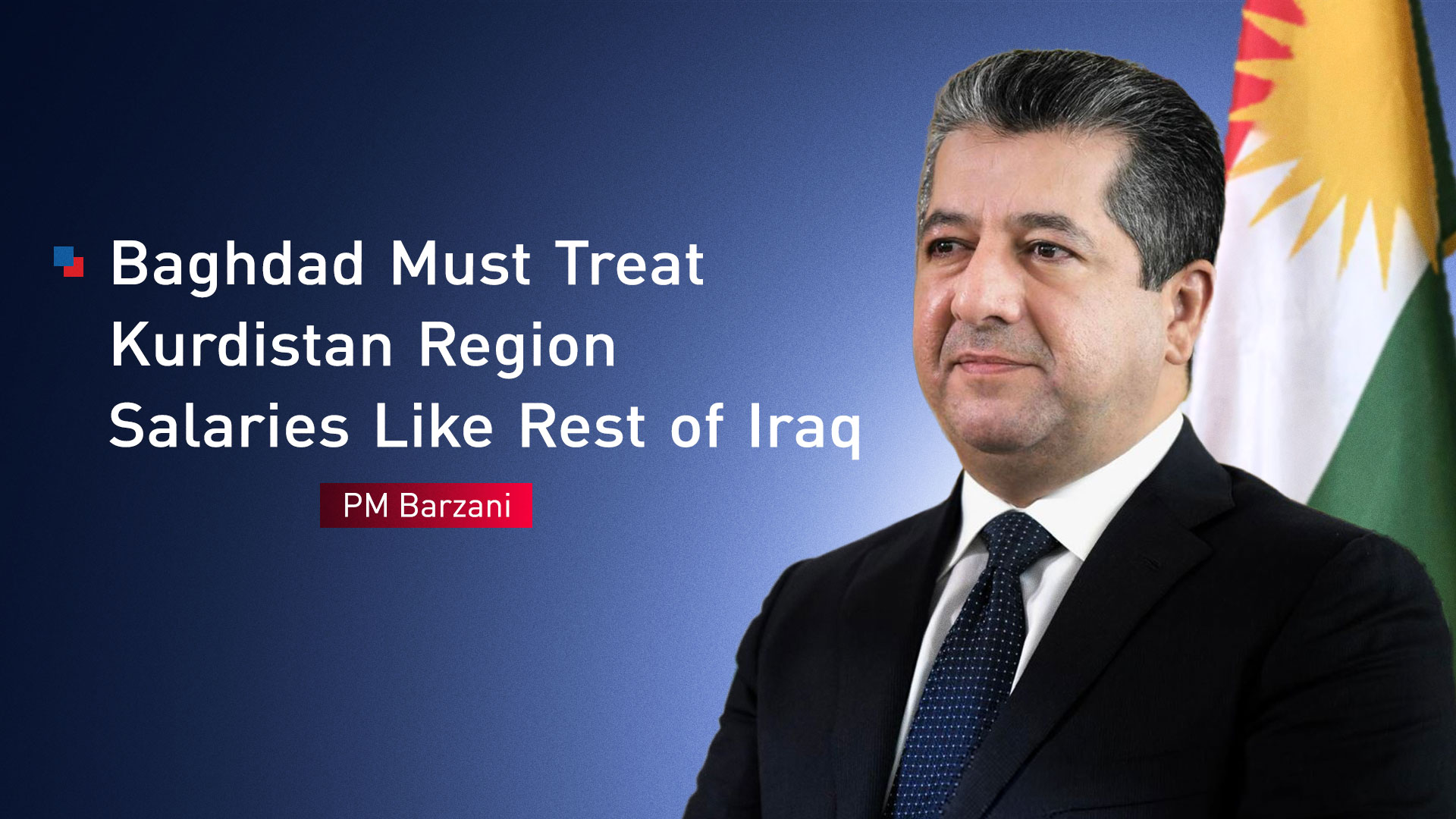
ERBIL (Kurdistan24) – Kurdistan Region Prime Minister Masrour Barzani on Wednesday underscored the strong and growing relationship between the Kurdistan Region and the United Arab Emirates, describing the ties as longstanding and built on mutual trust.
Speaking in an interview with Kurdistan24 presenter Ammar Najmaddin on the sidelines of the World Governments Summit in Dubai, Prime Minister Barzani said relations with the UAE leadership have continued to strengthen over time, particularly in the economic and political spheres.
Barzani noted that the Kurdistan Region maintains close and respectful relations with the UAE president and prime minister, adding that cooperation between the two sides is rooted in shared interests and a common vision for regional stability.
“Our relationship with the UAE is not new. It is based on trust and mutual respect, and it has grown stronger day by day,” Barzani said.
He highlighted expanding economic ties, pointing to the presence of several Emirati companies operating in the Kurdistan Region, as well as Kurdish entrepreneurs and businesspeople investing in the UAE. According to the prime minister, this growing trade and investment exchange has played a key role in strengthening bilateral economic relations.
On the political front, Barzani emphasized that the Kurdistan Region and the UAE share similar views on regional challenges, noting that regular consultations and exchanges of ideas help both sides address ongoing crises and prevent instability.
“We consult with one another to find the best ways to protect our region from chaos and crises and to better serve our people,” he said.
Prime Minister Barzani expressed confidence that this shared approach has further reinforced relations between Erbil and Abu Dhabi, paving the way for continued cooperation across multiple sectors.
Addressing domestic issues, Barzani also spoke about the ongoing deadlock in forming the new Kurdistan Regional Government, emphasizing that the process must be guided by the will of the people.
“The formation of the government is based on respecting the wishes of the Kurdish people and voters,” he said. “Once political parties acknowledge this principle, forming a government becomes straightforward.”
Barzani noted that political parties have already agreed on the general agenda for the next cabinet and said there are no anticipated obstacles regarding the government’s program. However, he stressed that personal interests or competition over positions should not take precedence over the country’s broader interests.
“We cannot prioritize personal gain or specific posts over the supreme interests of our nation,” he said, adding that discussions over the management of certain ministerial funds are aimed at improving services for citizens.
The prime minister acknowledged that while calls for a unified government have been frequent, commitment from all sides has been inconsistent. He expressed hope that services currently available in some provinces—where there is adherence to the government’s agenda—can be extended across the entire Kurdistan Region.
“Once we share a unified vision focused on serving all citizens equally, forming a government will be much easier,” Barzani said.
Asked whether an agreement has been reached regarding the Iraqi presidency, Barzani said that, to his knowledge, no deal has yet been finalized.
“As far as I know, there has been no agreement so far,” he said, adding that he was unaware of any developments in recent hours.
Barzani also criticized the idea that a political party which did not win an election could claim exclusive rights to nominate a presidential candidate.
“If they had won, they would be entitled to it,” he said. “But they did not, and the majority of the Kurdish people do not support this option.”
He explained that a proposed mechanism would allow the majority of members of parliament—either in the Kurdistan Region Parliament or among Kurdish representatives in the Iraqi parliament—to jointly vote on a consensus presidential candidate representing all Kurds.
The prime minister expressed confidence that once political forces align around a shared vision focused on public service and democratic legitimacy, progress on both government formation and broader political issues would become easier.
Turning to the ongoing salary issue and financial entitlements in the Kurdistan Region, Barzani said he was surprised by the prolonged delay, stressing that the matter is both legal and political but has been unnecessarily politicized.
“Kurdish citizens must be treated equally with all other Iraqi citizens,” he said. “You cannot treat the Kurdistan Region separately unless salaries are paid to all Iraqis equally.”
Barzani said the federal government often cites financial difficulties, but warned that such justifications should not result in discrimination against the Kurdistan Region. He revealed that during Iraqi Prime Minister Mohammed Shia al-Sudani’s recent visit to Erbil, the two discussed the salary issue, and Sudani expressed hope that it would not turn into a major problem and would be resolved.
The prime minister emphasized that the Kurdistan Region has fulfilled all its obligations, noting that most public sector salaries in the region are funded locally.
“The oil sold in the Kurdistan Region and the 120 billion Iraqi dinars in non-oil revenues handed over to the federal government cover between 60 and 70 percent of salaries,” Barzani said.
He added that the remaining 200 billion dinars should be returned to the region from its own revenues, arguing that it would not be difficult for Baghdad to send salaries if it adheres to the constitution and its legal obligations.
Barzani expressed hope that once salaries begin to be distributed across Iraq, funds for Kurdistan Region public employees will also be released, easing public concern and restoring confidence.
To be updated...