Thousands Attend Funeral of Seif al-Islam Gaddafi in Libya After Fatal Gun Attack
Thousands attended Seif al-Islam Gaddafi’s funeral in Bani Walid days after he was shot dead at his home, as Libyan authorities continue to investigate the killing.
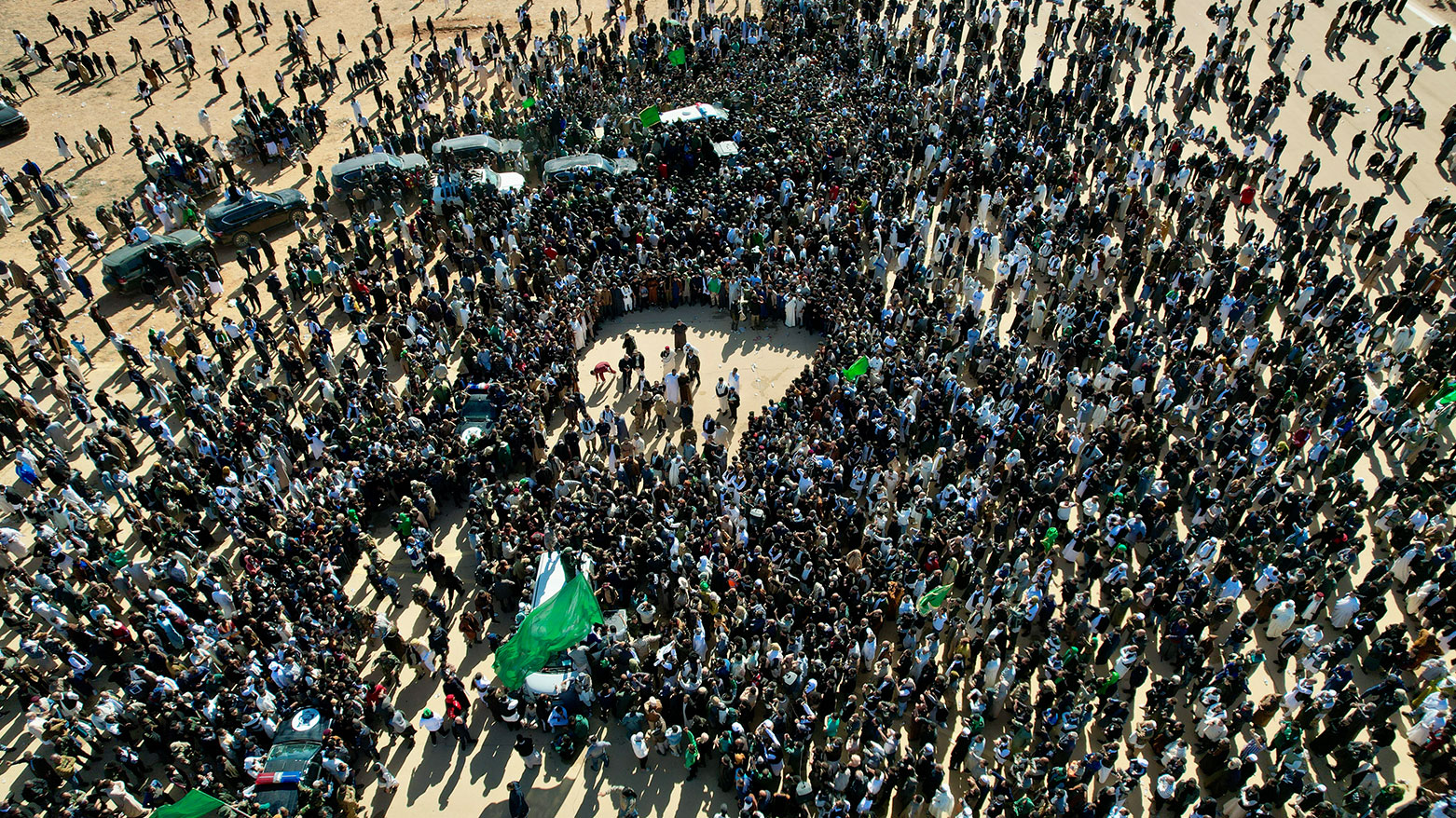
ERBIL (Kurdistan24) - Thousands of Libyans gathered on Friday in northwestern Libya for the funeral of Seif al-Islam Gaddafi, the son of the country’s late leader Moammar Gaddafi, days after he was shot and killed in an attack at his home, according to an Associated Press report.
The funeral took place in the town of Bani Walid, about 145 kilometers southeast of the capital, Tripoli, where large crowds converged to mourn Seif al-Islam, who was widely known by his first name. Mourners carried his coffin through the town and held large photographs of both Seif al-Islam and his father, the AP reported.
The crowd also waved plain green flags, which served as Libya’s official flag from 1977 to 2011 under Moammar Gaddafi’s rule. Moammar Gaddafi governed Libya for more than four decades before being toppled during a NATO-backed uprising in 2011 and later killed in his hometown of Sirte as the conflict escalated into a civil war.
As the funeral procession began and the number of mourners grew, a small group of supporters took Seif al-Islam’s coffin away from the larger crowd. According to the AP, they later performed funeral prayers and carried out his burial.
Ali Saleh, a resident of Sirte, told The Associated Press that Seif al-Islam was viewed by some as a “symbol of reconciliation.” He described the killing as a “horrible crime in the history of mankind,” reflecting the sentiments expressed by some mourners during the funeral.
Seif al-Islam Gaddafi, 53, was killed on Tuesday inside his home in the western Libyan town of Zintan, about 135 kilometers southwest of Tripoli, prosecutors said, according to the AP. Authorities stated that an initial investigation found he was shot to death, though they did not provide further details about the circumstances or those responsible.
His political team later released a statement saying that “four masked men” stormed his house, disabled security cameras, and killed him in what the statement described as a “cowardly and treacherous assassination,” the AP reported. No group has claimed responsibility for the attack, and officials have not publicly identified suspects or motives.
A previous Kurdistan24 report, citing confirmation from Seif al-Islam’s French lawyer, Marcel Ceccaldi, said the killing took place at about 2:00 p.m. local time and involved a four-man commando that forcibly entered the residence. That report also noted that authorities had yet to clarify who was behind the attack.
Seif al-Islam was captured by fighters in Zintan late in 2011 while attempting to flee to neighboring Niger during the uprising against his father. He was released in June 2017 after one of Libya’s rival governments granted him amnesty, according to the AP.
In a Facebook post published on Friday, Seif al-Islam’s brother, Mohamed Gaddafi, who lives in exile outside Libya, expressed grief over his death.
“The pain of loss weighs heavily on my heart, and it intensifies because I can’t bid him farewell from within my homeland — a pain that words can’t ease,” he wrote, according to the AP. He added that his consolation lay in the belief that “the loyal sons of the nation are fulfilling their duty and will give him a farewell befitting his stature.”
Since the 2011 uprising that toppled Moammar Gaddafi, Libya has remained deeply divided and unstable.
The oil-rich North African country split between rival administrations in the east and west, each backed by various armed groups and foreign governments, according to the AP. This prolonged fragmentation has repeatedly disrupted efforts to restore unified governance and hold national elections.
Seif al-Islam was the second-born son of Moammar Gaddafi and was long viewed as his father’s political heir. Before 2011, he was often presented as the reformist face of the regime and played a prominent role in outreach to Western governments, seeking to improve Libya’s international standing, the AP reported.
That image changed during the uprising, when Seif al-Islam delivered inflammatory public statements encouraging violence against anti-Gaddafi protesters.
As a result, the United Nations imposed sanctions on him, including a travel ban and an asset freeze. The International Criminal Court later charged him with crimes against humanity in connection with events during the 2011 uprising, according to the AP.
In July 2021, Seif al-Islam told The New York Times that he was considering a return to Libya’s political scene after a decade largely out of public view. He criticized Libya’s post-2011 leadership, saying, “There’s no life here. Go to the gas station — there’s no diesel,” the AP reported, citing the interview.
Later that year, in November 2021, Seif al-Islam announced his candidacy in Libya’s planned presidential election, a move that sparked controversy and opposition from anti-Gaddafi political forces across the country.
Libya’s High National Elections Committee disqualified him, but the election itself was never held due to disputes between rival administrations and armed groups, according to the AP.
The earlier Kurdistan24 report noted that Seif al-Islam’s candidacy polarized Libya, drawing support from those nostalgic for stability under the former regime while provoking strong opposition from revolutionary factions and victims of his father’s rule. It also cited statements from his adviser and lawyer describing concerns about his security in the days before the attack.
Authorities have continued to investigate the killing, but as of Friday had released few details publicly. The lack of clarity surrounding the attack has added to existing uncertainty in Libya’s already fragile political and security environment.
The large turnout at Friday’s funeral highlighted the enduring divisions within Libyan society more than a decade after the fall of Moammar Gaddafi. While many Libyans continue to reject the former regime, others have expressed support for figures associated with it, viewing them as potential sources of stability amid years of conflict and political deadlock.
Seif al-Islam’s death removes a controversial but influential figure from Libya’s political landscape. His killing comes as the country remains split between competing power centers and as efforts to organize national elections have repeatedly stalled.
For now, officials have emphasized that investigations into the attack are ongoing. The funeral in Bani Walid marked a public farewell for Seif al-Islam, even as questions remain unanswered about who carried out the killing and why, according to the AP and earlier Kurdistan24 reporting.