Iran's FM Warns Against ‘Doctrine of Impunity’ in Speech Focused on Israel at Doha Forum
Iran’s foreign minister warned in Doha that Israeli impunity undermines international law and regional stability, as Tehran and Washington concluded Oman talks and agreed to continue diplomatic engagement.
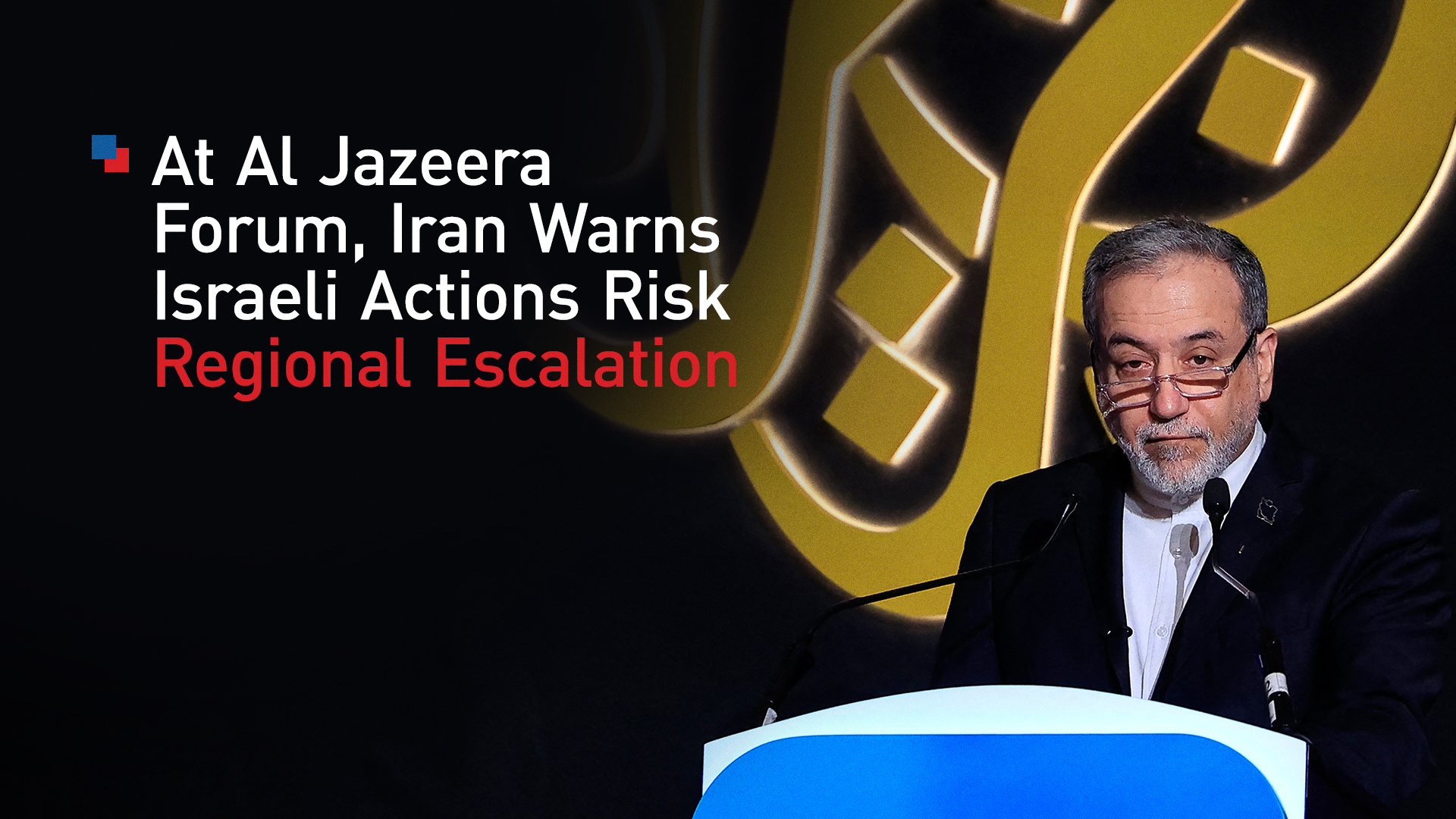
ERBIL (Kurdistan24) - Iran’s Foreign Minister Seyed Abbas Araghchi warned that allowing Israel to operate without accountability would undermine regional and global stability, saying that what he described as a “doctrine of impunity” would not bring peace but instead lead to wider conflict, according to a speech he delivered at the Al Jazeera Forum 2026 in Doha and published in full by Iran’s official news agency, IRNA.
Speaking as a special guest at the opening panel of the forum, Araghchi said that Palestine had become the central test of international law and global governance, arguing that developments in Gaza and the broader Palestinian territories reflected a broader erosion of legal and moral standards.
“Let no one make a miscalculation: no region will remain stable by allowing one actor to operate above the law,” he said, according to IRNA. “The doctrine of impunity does not bring peace; rather, it leads to broader conflict.”
IRNA reported that Araghchi traveled to Qatar following the conclusion of a new round of indirect negotiations between Iran and the United States in Oman, placing his remarks within days of renewed diplomatic engagement between Tehran and Washington.
The agency said the foreign minister’s address focused on Palestine and Israel, which he described as the defining issue shaping the future of regional order.
In the opening portion of his speech, Araghchi said Palestine was not simply one issue among many but the “defining issue of justice in West Asia and beyond,” according to the text released by IRNA. He said it represented a measure of whether international law retained meaning and whether global institutions existed to protect weaker populations or instead served powerful states.
He told the forum that Gaza and Palestine should no longer be viewed solely as a humanitarian crisis, but rather as the center of what he characterized as a broader and more dangerous project. According to the speech, Araghchi said the situation had evolved beyond the framework of occupation and had become an expansionist effort carried out under the banner of security.
“What we are witnessing today in Gaza is not simply a war,” Araghchi said, according to IRNA’s text. He rejected the description of events as a conflict between equal parties or as unintended consequences of security measures, describing them instead as “the deliberate and widespread destruction of civilian life,” which he labeled “genocide.”
Araghchi said the human cost of Israeli actions in Gaza had affected people across religious and national lines, extending beyond the Islamic world. According to the speech, he said the events had resonated with “Christians, Jews, and followers of all faiths” who rejected the targeting of civilians and civilian infrastructure.
He argued that Palestine had become a mirror reflecting not only Palestinian suffering but also what he described as the failure of those with the power to prevent the crisis. According to IRNA, he said some actors had justified, enabled, or normalized the situation instead of preventing it.
Araghchi said the conduct of Israel and the absence of accountability had produced three major consequences, which he described as global, regional, and structural. On the global level, he said the situation had undermined the international legal order, warning that the world was moving toward a condition in which international law no longer governed relations between states.
According to the speech text, he said a dangerous precedent was being established in which a state with sufficient political backing could carry out actions such as bombing civilians, besieging populations, targeting infrastructure, and conducting assassinations across borders while still claiming legitimacy. He said this was not solely a Palestinian issue but a global one, reflecting a shift from law to force.
On the regional level, Araghchi said Israel’s actions had had a direct destabilizing impact on the security of neighboring countries.
According to IRNA, he said Israel openly violated borders, infringed on sovereignty, carried out assassinations, and expanded its influence across different arenas, doing so with what he described as an expectation of immunity from international accountability.
He warned that if the situation in Gaza were resolved through destruction and forced displacement, similar patterns could be extended elsewhere. According to the speech, he said that acceptance of such outcomes would pave the way for further annexation, describing this trajectory as part of what he called the “Greater Israel project.”
Araghchi said the central question facing the region was whether it would accept a future in which borders were temporary, sovereignty conditional, and security defined by power rather than law or diplomacy. He said these developments posed a threat not only to Palestinians but to the regional order as a whole.
The third consequence, which he described as structural and the most dangerous, involved what he said was a permanent imbalance in military and strategic power.
According to IRNA, Araghchi said Israel’s expansionist project required neighboring states to be weakened militarily, technologically, economically, and socially in order to preserve Israeli superiority.
Within this framework, he said Israel was able to expand its military arsenal without restriction, including weapons of mass destruction that he said remained outside any inspection regime. At the same time, he said other countries faced pressure to disarm or reduce their defensive capabilities and were sanctioned or punished for scientific and technological progress.
“This is not arms control. It is not non-proliferation. It is not security,” Araghchi said, according to the speech. He described the situation as the imposition of permanent inequality, in which Israel was expected to maintain military and intelligence superiority while others remained vulnerable.
He said these dynamics underscored why Palestine should be viewed not only as a humanitarian issue but as a strategic one with implications for the future of the region and the rules governing international relations.
Turning to what he described as necessary responses, Araghchi said expressions of concern and statements of condemnation were insufficient. According to IRNA, he called for a coordinated strategy involving legal, diplomatic, economic, and security measures rooted in international law and collective responsibility.
He said the international community should support legal mechanisms without hesitation and ensure that violations carried consequences. He called for comprehensive and targeted sanctions against Israel, including an immediate arms embargo, suspension of military and intelligence cooperation, restrictions against officials, and a trade ban, according to the speech text.
He reiterated his central warning that no region would remain stable if one actor were allowed to operate above the law, repeating that the doctrine of impunity would lead to broader conflict rather than peace.
Araghchi also outlined what he described as a credible political horizon based on international law.
According to IRNA, he said this should include an end to occupation, recognition of the right of return and compensation, and the formation of an independent and united Palestinian state with Al-Quds al-Sharif as its capital.
He said the humanitarian crisis must be treated as an urgent international responsibility and warned against normalizing collective punishment. He also said regional countries should act in coordination to protect sovereignty and deter aggression, stressing that security could not be built on the insecurity of others.
In the concluding portion of his address, Araghchi called for coordinated action by the Islamic world, the Arab world, and countries of the Global South.
According to the speech, he urged organizations such as the Organization of Islamic Cooperation and the Arab League to move beyond symbolic gestures toward coordinated legal, diplomatic, economic, and strategic measures.
He said such efforts were not aimed at confrontation but at preventing what he described as the redesign of the region through force. He closed by repeating that peace and stability depended on justice for Palestine, accountability for crimes, and a regional order based on sovereignty, equality, and cooperation.
IRNA reported that Araghchi’s appearance at the Doha forum came shortly after indirect talks between Iran and the United States concluded in Muscat, Oman. According to previous reports cited as background, both sides described those talks as positive and agreed to continue negotiations, with Oman acting as mediator.
U.S. President Donald Trump said the discussions were “very good” and that further meetings were expected, according to AFP. Iranian officials, including Araghchi, said the talks were conducted in a “very good atmosphere” and focused on Iran’s nuclear program, according to AFP and Iranian state media.
Following the Muscat talks, Araghchi said there was an understanding between Tehran and Washington to continue the diplomatic process, though consultations with their respective governments were required, according to statements reported by Iranian media.
Iranian Foreign Ministry spokesperson Esmail Baghaei also said both sides agreed to return to their capitals to consult on the next round.
Oman’s Foreign Minister Badr Hamad al-Busaidi said the talks were serious and useful in clarifying the positions of both sides, according to statements cited in the background reports. Iraq’s Foreign Ministry publicly welcomed the talks, describing them as a positive step toward reducing regional tensions and praising Oman’s mediating role.
At the same time, the United States announced new sanctions targeting what it described as an Iranian “shadow fleet” used to transport oil, sanctioning vessels, individuals, and entities accused of helping Iran evade restrictions.
IRNA did not directly link Araghchi’s Doha speech to the substance of the Muscat negotiations, but noted that his travel to Qatar followed their conclusion. The speech itself focused on Israel, Palestine, and what he described as the broader implications of impunity for international law and regional stability.
The remarks underscored Iran’s public diplomatic messaging at a moment of renewed, though fragile, engagement with Washington, as indirect talks continue under Omani mediation and regional actors closely watch developments.
This article was updated on Saturday, Feb. 7, 2026, at 11:14am.