U.S. Alleges China Conducted Secret Nuclear Test as Arms-Control Pact Expires
U.S. alleges a 2020 Chinese nuclear test, cites Russian support, and signals resumption of nuclear testing amid arms-control lapses.
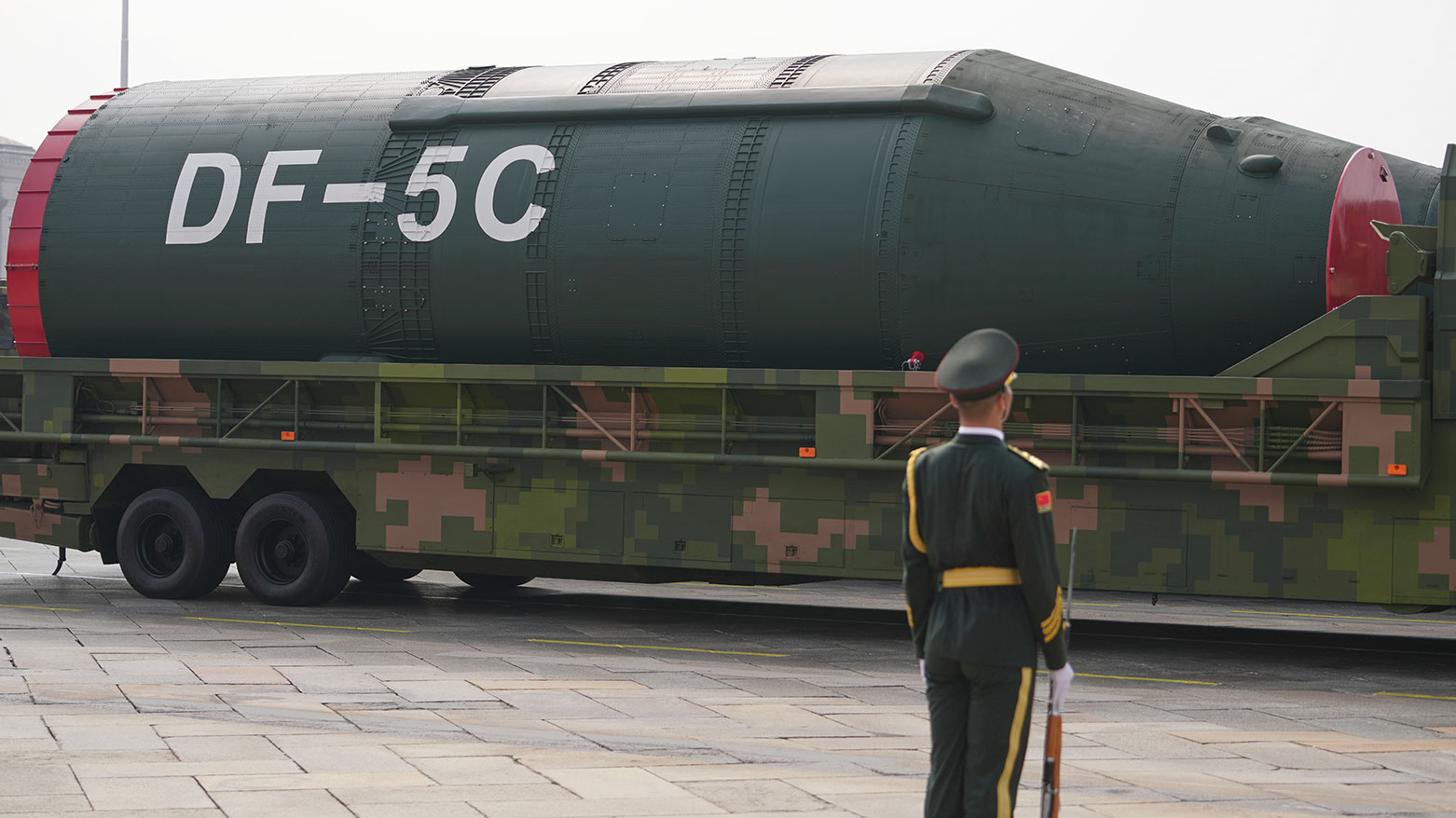
ERBIL (Kurdistan24) - The United States on Friday publicly accused China of conducting an undisclosed nuclear detonation in 2020, signaling a shift in Washington’s approach to arms control as decades-long moratoriums on nuclear testing appear to be unraveling.
Thomas DiNanno, the undersecretary of state for arms control, disclosed the allegation during remarks at the Conference on Disarmament in Geneva, stating that Beijing carried out a “yield-producing test on June 22, 2020” and has taken steps to obscure such activity from international monitoring systems.
He added that Russia is assisting China in developing the fissile material needed to expand its nuclear arsenal. The Washington Post reported these statements, highlighting their timing alongside recent U.S. policy announcements regarding nuclear testing.
DiNanno’s comments follow a Feb. 5 declaration by President Donald Trump that the United States would not seek to renew the New START treaty, the last major arms-control agreement between Washington and Moscow.
In a post on the social media platform Truth Social, Trump said the U.S. would instead pursue a “new, improved, and modernized” pact. In December, Trump had directed the U.S. to resume nuclear weapons testing for the first time since 1992, citing concerns over secretive Russian and Chinese programs, according to The Washington Post.
At the Geneva conference, DiNanno emphasized that “serial Russian violations, growth of worldwide stockpiles and flaws in New START’s design and implementation gives the United States a clear imperative to call for a new architecture that addresses the threats of today, not those of a bygone era,” The Washington Post reported.
He further contended that unilateral constraints on the U.S. under the testing moratorium had facilitated the rapid expansion of China’s arsenal.
DiNanno also referenced recent Russian weapons tests, including the 9M730 Burevestnik “Skyfall” nuclear-powered cruise missile and the Status-6 Poseidon nuclear-armed unmanned underwater vehicle. He did not provide additional evidence for U.S. assessments of the alleged Chinese and Russian nuclear tests, The Washington Post noted.
The Chinese embassy in Washington did not respond directly to inquiries about the 2020 test but reiterated its adherence to a voluntary nuclear testing moratorium and a “no first use” policy on nuclear weapons.
Spokesperson Liu Pengyu called on the U.S. to maintain its moratorium commitments and “take concrete actions to uphold the international nuclear disarmament and nonproliferation regime,” The Washington Post reported. The Russian embassy did not issue a response.
DiNanno said the White House intends to pursue a broader agreement that extends beyond bilateral U.S.-Russia arrangements, potentially incorporating China and other nuclear states. “We cannot promise this process will be quick or easy,” he stated. “It will require the participation of more than just Russia at the negotiating table,” The Washington Post reported.
Historically, China has declined to join multilateral arms-control agreements, citing the relatively smaller size of its arsenal compared with those of the U.S. and Russia. While Beijing publicly maintains a voluntary moratorium under the Comprehensive Nuclear-Test-Ban Treaty (CTBT), it has never ratified the treaty since signing it in 1996.
The Washington Post cited a Pentagon report from December noting that China currently possesses just over 600 nuclear warheads and is on track to field 1,000 by 2030. Russia’s nuclear arsenal is estimated at roughly 4,300 warheads, with the United States at approximately 3,700 as of January 2025, according to the Stockholm International Peace Research Institute.
Efforts to include China in a new arms-control framework are complicated by a near-total freeze in nuclear dialogue between Washington and Beijing, which has been repeatedly disrupted by broader diplomatic tensions. The Washington Post reported that in 2024, China suspended nuclear discussions with the U.S. following American arms sales to Taiwan.
Tong Zhao, an expert on China’s nuclear weapons program at the Carnegie Endowment for International Peace, told The Washington Post that DiNanno’s specific allegation of nuclear explosive tests is “unprecedentedly specific and makes it difficult for Beijing to evade calls for clarification.”
Zhao added that U.S. concerns are shifting, with Beijing now perceived as possessing both the capability and will to challenge U.S. military dominance, in contrast with the prior focus on Russia.
Analysis of government documents and satellite imagery indicates that China’s nuclear facilities have been rapidly expanding.
The Washington Post reported that this includes classified sites for manufacturing warhead components, plutonium pits, and high explosives used to trigger detonation. While DiNanno’s statements marked the first public U.S. claim of a specific Chinese nuclear test, prior State Department and Pentagon reports had suggested that low-yield nuclear tests may have been conducted at the Lop Nur test site, the location of China’s first atomic bomb detonation in 1964.
State Department assessments cited continued work at Lop Nur in 2020 and China’s “lack of transparency on its nuclear testing activities” as raising concerns over compliance with the U.S.-led zero-yield standard.
Zero-yield, or subcritical, tests do not produce self-sustaining nuclear chain reactions and generate no measurable explosive yield. Low-yield nuclear tests, prohibited under the CTBT, produce relatively small outputs, while high-yield tests validate full warhead capability, The Washington Post explained.
Two officials familiar with U.S. monitoring of China’s nuclear program said DiNanno’s reference to a 2020 test likely corresponds to internal reports of low-yield activity circulated within the State Department and Pentagon. One State Department official noted that such activity likely involved preparatory tests within tunnels at Lop Nur, speaking on condition of anonymity because of the sensitivity of the information.
Renny Barbiarz, vice president at AllSource Analysis, which conducts geospatial studies of Lop Nur, told The Washington Post that “it was suspected that China had conducted a nuclear test in the tunnel area around 2020, possible very low-yield prep at least.”
Barbiarz’s team found that recent satellite imagery shows the site continuing to expand, including new tunnel excavations potentially suitable for low-yield tests, as well as larger boreholes that could support higher-yield detonations.
DiNanno’s disclosures align with a broader U.S. strategy to develop a new arms-control architecture, expanding beyond prior bilateral agreements with Russia to include other nuclear powers, particularly China. The Washington Post noted that while Beijing continues to claim adherence to voluntary moratoria, Washington is pressing for verification and transparency as it reassesses nuclear testing policies.
The United States has not conducted nuclear explosive testing since 1992, and President Trump’s recent directives represent a formal resumption after more than three decades.
DiNanno framed this action as a necessary measure to match activities by Russia and China, while acknowledging the challenges of negotiating multilateral accords in the current geopolitical environment.
In summary, U.S. officials publicly allege a specific Chinese nuclear test in 2020, cite Russian support for China’s fissile material programs, and signal a return to nuclear testing as arms-control agreements lapse. Efforts to incorporate China into a new framework remain uncertain due to limited bilateral engagement and ongoing regional tensions.