General Strike in Khanaqin as Residents Reject Moves to Separate Kurdish Subdistricts
Activists Warn of Demographic Change Efforts, Demand Implementation of Article 140
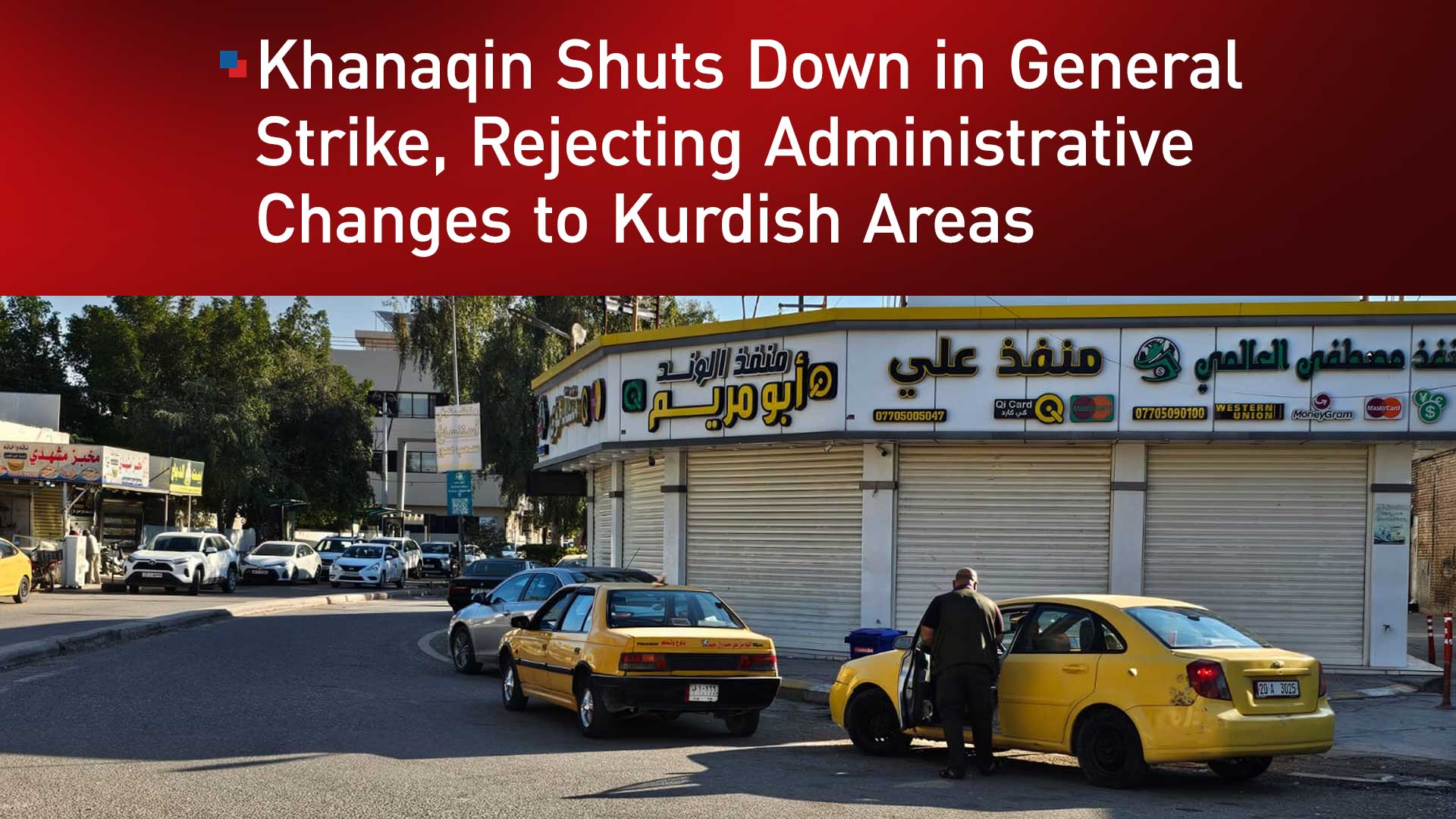
ERBIL (Kurdistan24) — A general strike swept through the disputed town of Khanaqin on Wednesday, with markets shuttered and public institutions closed, as residents protested what they describe as attempts to alter the demographic and administrative structure of Kurdish areas.
Hawre Jaf, Kurdistan24’s correspondent in Khanaqin, reported that residents, political parties, and civil activists have unanimously rejected recent decisions by the Diyala Provincial Council and Iraq’s Ministry of Planning to separate the sub-districts of Jabara, Qaratapa, Gulala, and Saadiya from Khanaqin’s administrative boundaries.
Protesters argue that the measures amount to an effort to weaken Khanaqin’s administrative status and marginalize its Kurdish identity.
Amir Khanqini, a civil activist, told Kurdistan24 that government employees and teachers have boycotted work in response to the decisions.
“We demand the implementation of Article 140, and we will not allow Khanaqin to be sidelined,” he said, referring to the constitutional article designed to resolve the status of disputed territories through normalization, a census, and a referendum.
“Now our city no longer has any sub-districts under it, and there is a risk that it will be reduced from a district to a sub-district,” he added. “As a reaction, a general strike has been declared across schools, government offices, and markets.”
Images from the town showed empty streets and closed shops, underscoring the breadth of participation in the protest.
Another activist, identified as Razhan, said the objective behind the administrative changes is to weaken the Kurdish voice and erode the cultural identity of the region. She warned that if the decisions are not reversed, residents may escalate their actions in the coming days by blocking roads and organizing larger demonstrations.
Khanaqin, located in Diyala province near the Iranian border, is one of several territories disputed between Baghdad and the Kurdistan Regional Government (KRG). The area has long been a flashpoint in disputes over governance, security, and demographic balance.
Following the events of October 16, 2017 — when Iraqi federal forces reasserted control over disputed territories after the Kurdistan Region’s independence referendum — security instability led to the displacement of residents in several Kurdish villages.
Nearly 40 Kurdish villages in the surrounding areas were reportedly emptied amid deteriorating conditions.
In the latest development, the Diyala Provincial Council reclassified Qaratapa from a sub-district to a town and elevated Jabara’s administrative status, steps that residents interpret as part of a broader plan to detach them from Khanaqin.
Critics argue that such administrative restructuring could dilute Khanaqin’s territorial scope and political weight, potentially altering future demographic and electoral calculations in the disputed areas.
Article 140 of the Iraqi Constitution was intended to settle the status of disputed territories through a three-stage process. However, nearly two decades after its adoption, its provisions remain unimplemented, leaving areas such as Khanaqin in prolonged legal and political limbo.
For many residents, the latest decisions are viewed not as routine administrative adjustments but as politically motivated measures taken in the absence of a comprehensive constitutional settlement.
As tensions mount, Khanaqin’s general strike signals growing frustration among its population, who insist that any changes to the area’s administrative boundaries must be addressed within the constitutional framework rather than through unilateral decisions.