JD Vance to Kurdistan24: President Trump ‘Loves the Kurds,’ Reaffirms Strong U.S. Ties
Vice President says the Trump administration maintains “great contacts” and longstanding friendships with the Kurdish people, underscoring strong bilateral relations
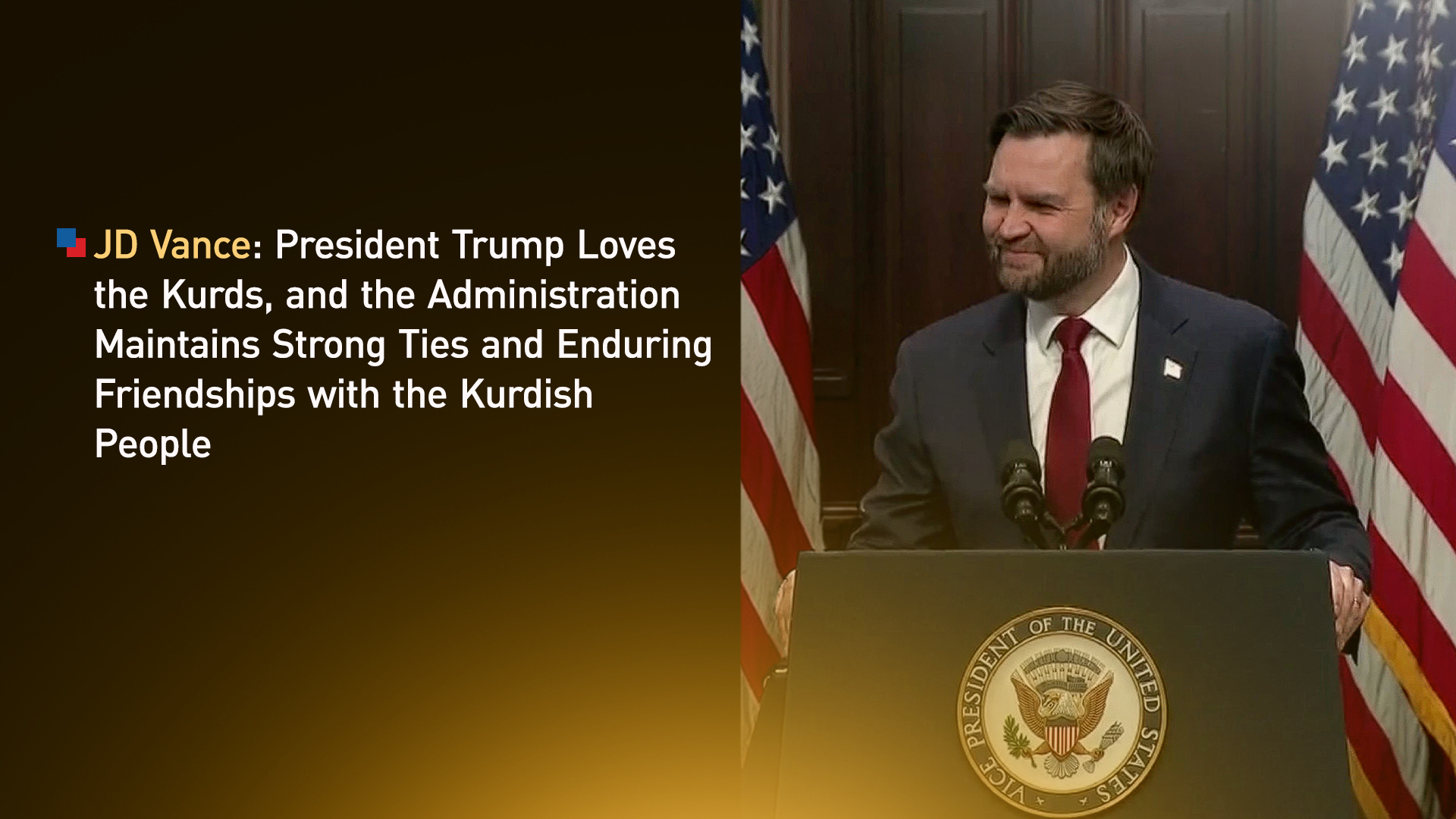
ERBIL (Kurdistan24) — U.S. Vice President JD Vance on Wednesday reaffirmed Washington’s strong relationship with the Kurdish people, underscoring the Trump administration’s commitment to peace, stability, and prosperity for Kurds across the region.
Responding to a question from Kurdistan24 correspondent in Washington, D.C., Rahim Rashidi (Mr. Kurd), Vance said: “We have a great relationship with the Kurds, President Trump loves the Kurds, and the entire Trump administration we have great contacts with the Kurds, great friendships with the Kurdish people in various countries all over the world, and our attitude is we want those people to be able to live in peace and harmony and prosperity with their neighbors.”
Vance’s remarks come amid ongoing regional tensions and diplomatic efforts aimed at preserving stability in Iraq, neighboring Syria, and the entire Middle East.
His comments signal continuity in Washington’s longstanding engagement with Kurdish leadership, particularly in the Kurdistan Region of Iraq, which has been a key U.S. partner in security and counterterrorism efforts.
The relationship between the Kurdish leadership in the Kurdistan Region and the United States dates back decades, solidifying after the 1991 Gulf War and the establishment of a no-fly zone that enabled the formation of the Kurdistan Region’s autonomous administration. Following the 2003 U.S.-led freedom operation in Iraq, ties deepened further, particularly in the security sphere.
The Kurdistan Region became a pivotal ally in the fight against ISIS, with Kurdish Peshmerga forces working closely with U.S. troops and the international coalition.
American military support, training, and advisory missions have remained central to the Region’s security architecture, and U.S. military installations in the Kurdistan Region continue to play a strategic role in counterterrorism operations and regional deterrence.
Beyond security cooperation, Washington has consistently supported a strong and prosperous Kurdistan Region politically and economically. Successive U.S. administrations have emphasized the importance of resolving disputes between Erbil and Baghdad through dialogue, while backing the constitutional status of the Kurdistan Region within federal Iraq.
Economic ties have also expanded significantly. A turning point came with Kurdistan Region Prime Minister Masrour Barzani’s historic visit to the United States in 2025, during which major agreements were signed with leading American energy companies to invest in the Kurdistan Region’s oil and gas sector.
The deals were widely viewed as a vote of confidence in the Region’s energy potential and its investment climate, reinforcing U.S. support for economic diversification and long-term development.
American companies have since increased their footprint in the Region’s energy infrastructure, contributing to production capacity, technological modernization, and broader economic growth. U.S. officials have repeatedly described a stable and economically resilient Kurdistan Region as vital to Iraq’s overall stability.
The strong relationship has been reinforced through regular high-level exchanges. Senior U.S. officials frequently visit Erbil for consultations with Kurdish leaders, highlighting the Region’s strategic importance in Washington’s regional calculations.
Most recently, Tom Barrack, President Trump’s Representative for Syrian Affairs and the U.S. Ambassador to Türkiye, met with President Masoud Barzani in Erbil. During the meeting, Barrack praised President Barzani for his efforts in preventing the expansion of war and violence, particularly his role in de-escalating recent developments in Syria.
Barrack highlighted President Barzani’s contribution to supporting a successful agreement between the Syrian government and the Syrian Democratic Forces (SDF), led by Commander Mazloum Abdi. The discussions centered on maintaining regional stability and advancing a ceasefire framework aimed at preventing renewed conflict in northern Syria.
According to readouts of the meeting, Barrack emphasized that President Barzani’s “wisdom and guidance” should be utilized in addressing Iraq’s broader political and security challenges. He also reaffirmed Washington’s commitment to Iraq’s sovereignty and to fostering a balanced partnership with both Baghdad and the Kurdistan Region.
Such engagements underscore the continued recognition in Washington of the Kurdish leadership’s role as a stabilizing force in a volatile region. As regional dynamics evolve, Vice President Vance’s remarks this week reflect an enduring bipartisan understanding in the United States of the strategic value of close ties with the Kurdish people and their leadership.