Öcalan Calls for Democratic Integration, Legal Reform in His Latest Message
In his message, Öcalan reiterated that the transition to democratic politics had been made and called for legal and institutional steps to consolidate what he described as a move from armed struggle to democratic integration.
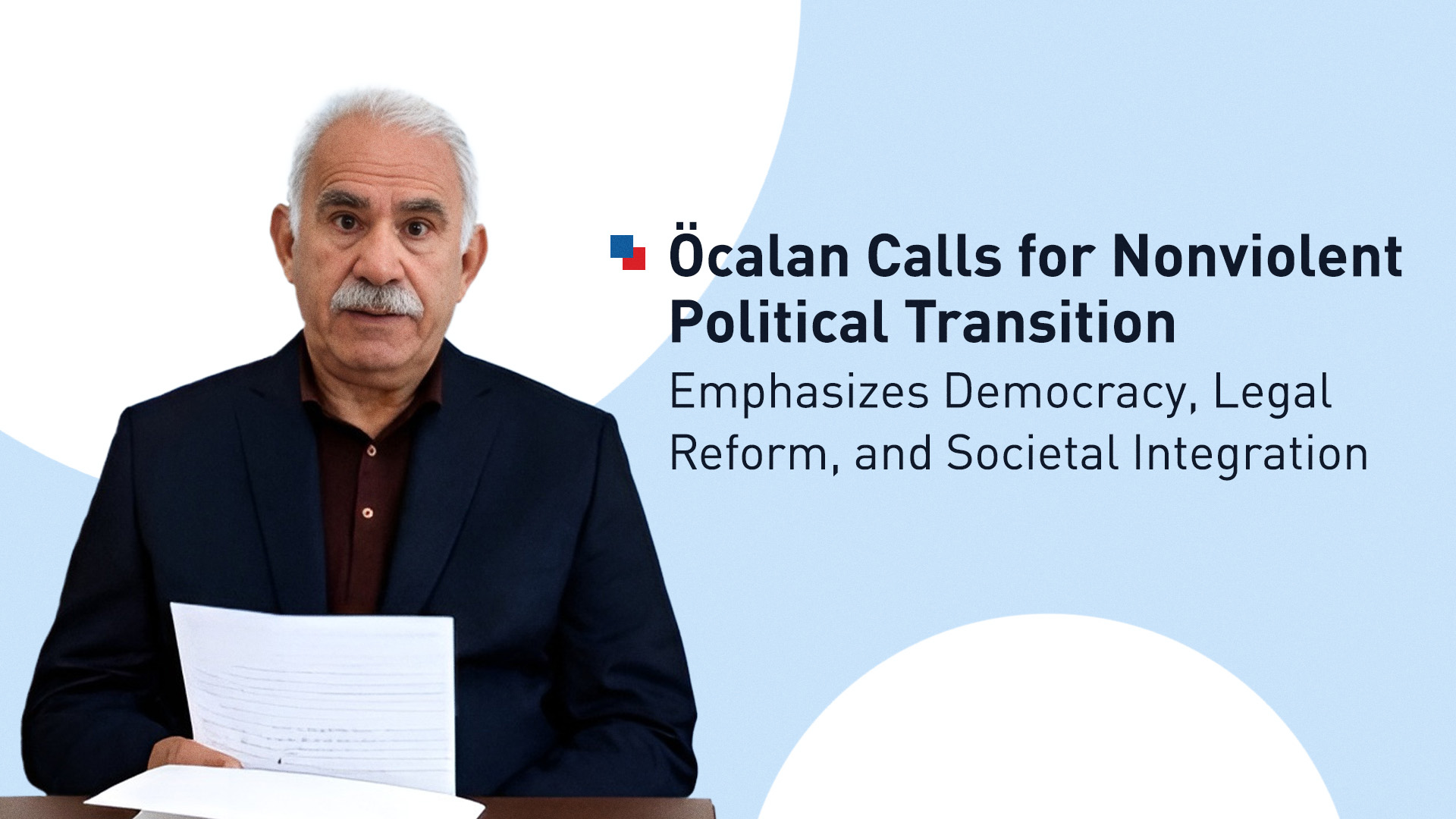
ERBIL (Kurdistan24) - Abdullah Öcalan on Friday issued a message marking the anniversary of his Feb. 27, 2025 “Call for Peace and a Democratic Society,” declaring that the transition from armed struggle to democratic politics has entered a new phase and urging the state to respond with legal and institutional reforms to consolidate the process.
In the message, Öcalan described his 2025 appeal as “a declaration that where democratic politics is established, weapons lose their meaning,” and said it represented an explicit choice in favor of political engagement over violence.
He stated that through “unilateral will and practice,” the movement had moved beyond what he called “the era of negative rebellion” and toward what he characterized as a “positive phase” of democratic construction.
The statement comes one year after Öcalan called on the Kurdistan Workers’ Party (PKK) to dissolve itself and convene a congress, a process that culminated in the organization’s formal dissolution and the end of its armed campaign in May 2025.
A ceasefire had been declared on March 1, 2025, and the PKK’s 12th Congress, held between May 5 and 7, 2025, announced its self-dissolution and the conclusion of armed struggle on May 12, 2025.
In July 2025, as part of what was described as a goodwill gesture within the disarmament process, a group of 30 individuals led by KCK Co-chair Bese Hozat burned their weapons during a ceremony held in front of Jasana Cave in the Dukan district, in Sulaimani. The event was presented as a public step demonstrating the implementation of the congress decisions.
In his latest message, Öcalan said that “the organizational decisions to dissolve and end the strategy of armed struggle were not only a formal and practical rejection of violence, but also signaled a psychological transformation toward a political path.”
He added that the move constituted “a declaration of psychological reconciliation with the Republic.”
He stated that the past process had demonstrated a capacity for negotiation and had paved the way for a transition “from the politics of violence and fragmentation to the politics of democracy and integration.” He emphasized that previous calls, conferences, and congresses were aimed at achieving this objective.
Öcalan also referred to political figures in Türkiye, stating that he considered “the will of Mr. Erdoğan, the call of Mr. Bahçeli, the contribution of Mr. Özel, and the efforts of all other political, social, and civil individuals and institutions who participated positively in the process last year to be very significant.”
He further said, “I particularly remember our comrade Sırrı Süreyya once again with great respect and longing.”
The current peace initiative traces back to Nov. 26, 2024, when Nationalist Movement Party (MHP) leader Devlet Bahçeli launched what was described as a peace initiative.
On Dec. 28, 2024, a delegation from the DEM Party, consisting of Pervin Buldan and Sırrı Süreyya Önder, met with Öcalan at Imrali Prison. Following those meetings, Öcalan issued a message calling on the PKK to dissolve itself and convene a congress.
In that earlier message, he stated: “Strengthening Turkish-Kurdish brotherhood is not only a historical responsibility but a vital and urgent decisive issue for all peoples. To bolster this process, it is essential for all political circles in Türkiye to think beyond narrow, short-term calculations, take initiative, take constructive steps, and participate positively.”
In his anniversary statement, Öcalan reiterated the centrality of relations between Kurds and Turks, writing, “There are no Turks without Kurds, and no Kurds without Turks.”
He described this relationship as possessing “a unique and authentic historical character” and said that foundational documents from the early Republic pointed to unity between the two peoples.
“Our February 27 call is an attempt to revive that spirit of unity and the desire for a Democratic Republic,” he stated, adding that the aim was to “break the mechanism of bloodshed and conflict.” He cautioned that acting according to “short-term and narrow political interests” rather than recognizing the seriousness and risks of the issue would weaken all parties.
Öcalan said the attempt to sustain denial and rebellion amounted to “an attempt to sustain the greatest of irregularities” and declared, “We are removing the obstacles to unity that have been sought to be distorted over the last two hundred years; we are establishing the legal conditions for unity. We want to discuss how we will come together and build a life together.”
He called for a transition “from the negative phase to the positive phase of construction,” stating that the path to a new era and political strategy was opening. “Our aim is to end the era of violent politics and open a process based on a democratic society and the rule of law,” he wrote, inviting “all segments of society to create opportunities in this regard and to take responsibility.”
In outlining the framework of what he described as the “positive phase,” Öcalan said that democratic society, reconciliation, and integration were its foundations. He stated that the phase “excludes methods of forced struggle and violence” and emphasized that the goal was not to seize institutions but to ensure broad participation in social construction.
“The goal of positive construction is not to seize any institution or structure; the goal is to ensure that everyone in society can take responsibility and participate in social construction,” he wrote. He added that oppressed, ethnic, religious, and cultural groups could claim their own creations through “continuous and organized democratic struggle.”
He stressed that “it is very important that the state responds to the democratic transformation,” underscoring the need for institutional engagement in the process.
Öcalan further stated that “democratic integration is at least as important as the beginning of the Republic,” describing it as a call containing significant meaning and potential. He said that at its core lay “the model of a democratic society,” which he presented as an alternative to fragmentation or reverse-assimilationist approaches.
“The transition to democratic integration requires laws of peace,” he wrote, adding that the solution envisioned “the construction of an architecture and a legal framework within the political, social, economic, and cultural spheres.”
He asserted that many current problems and crises stem from “the absence of democratic law” and said that within the framework of democratic politics, he advocated “for a legal solution.” He called for an approach that would create space for democracy and establish strong legal guarantees for that purpose.
Addressing citizenship, Öcalan stated that it “should be built on the basis of a bond with the state, not on belonging to a specific nation [ethnicity].” He advocated for “a free citizenship that prioritizes freedom of religion, ethnicity, and thought,” adding that just as religion and language cannot be imposed, nationality should not be imposed either.
He wrote that the legal relationship of citizenship, “within democratic borders and on the basis of the integrity of the state,” includes the right to freely express and organize one’s religious, ideological, and ethnic identity.
Öcalan said that no system of thought could survive without being built on democracy and that while stagnation and conflict are temporary, democracy would ultimately be permanent. He stated that his call aimed to find solutions to coexistence problems and related crises not only in Türkiye but also in the Middle East.
“We defend the right to exist and the right to free self-expression for all who have been subjected to injustice,” he wrote.
In a section devoted to women, Öcalan described them as “the leading social forces” and stated that no society or state could ignore them and continue its existence. He linked contemporary issues such as domestic violence and femicide to what he described as historical oppression and said that women are “the most liberationist component and the strengthening force of democratic integration.”
He concluded by stating that “the language of this era should not be dominant and authoritarian” and called for giving every “other” the opportunity to express themselves and to be heard. “The realization of all these matters requires a common wisdom that respects one another,” he wrote, ending his message with “Greetings and respect.”
The anniversary message was released amid renewed discussion about the trajectory of the peace process. Mustafa Karasu, a member of the Kurdistan Communities Union (KCK) Council, said in a recent media interview that Türkiye has not taken substantive steps to advance the process one year after Öcalan’s call, despite the PKK’s dissolution and the halt to armed struggle.
Karasu stated that progress requires that Öcalan be allowed to work freely and establish direct contact with the public, political parties, and society. He said that enabling such engagement is essential for the continuation of dialogue.
He also argued that authorities have not taken sufficient legal and political measures to consolidate the process and warned that without clearer legal steps, the initiative could follow the trajectory of earlier efforts that did not reach a conclusive settlement. Karasu called for the implementation of rulings issued by the European Court of Human Rights, an end to the appointment of trustees known as kayyums, and guarantees for political participation by those who have laid down arms.
The anniversary of the Feb. 27, 2025 call has renewed attention to the sequence of developments that followed, including the ceasefire, the PKK’s congress and dissolution, and the symbolic weapons-burning ceremony in July 2025.