Trump Accuses Iran of Using AI to Spread False War Footage
“They showed phony ‘Kamikaze Boats,’ shooting at various Ships at Sea, which looks wonderful, powerful, and vicious, but these Boats don’t exist — It’s all false information to show how ‘tough’ their already defeated Military is,” President Trump wrote.
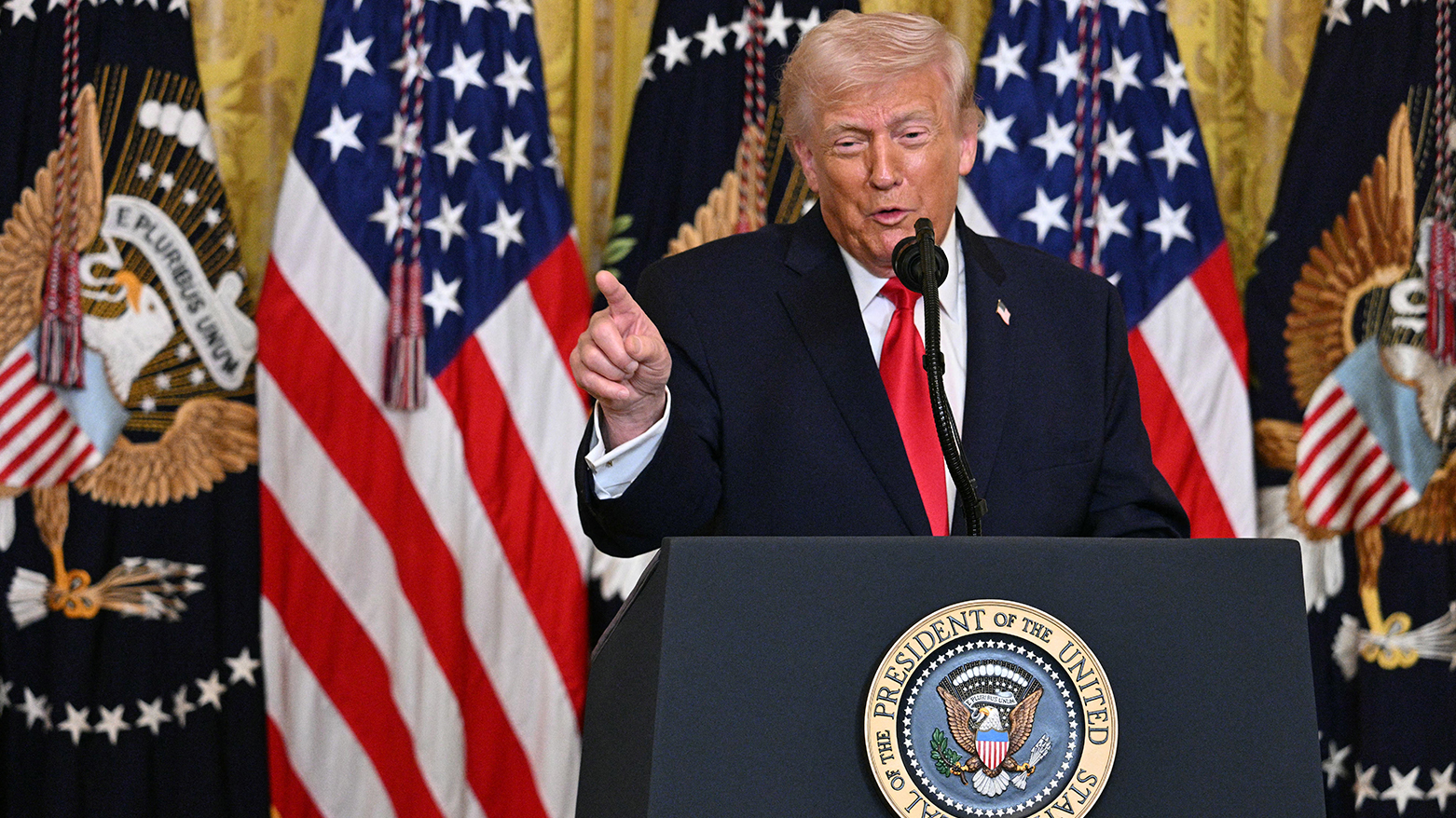
ERBIL (Kurdistan24) - U.S. President Donald Trump said Monday that Iran is using artificial intelligence to spread false images and reports about military engagements in the ongoing conflict with the United States and Israel, accusing Iranian authorities and media outlets of disseminating fabricated information about damage to U.S. military assets.
In a post on his Truth Social platform on March 16, 2026, Trump asserted that Tehran is “a Master of Media Manipulation and Public Relations,” claiming that the Iranian military is “ineffective and weak” but adept at circulating disinformation through international media channels.
In the statement, Trump alleged that Iran has used AI-generated imagery to portray attacks that he said did not occur, including images purportedly showing U.S. naval vessels and refueling aircraft under attack.
“They showed phony ‘Kamikaze Boats,’ shooting at various Ships at Sea, which looks wonderful, powerful, and vicious, but these Boats don’t exist — It’s all false information to show how ‘tough’ their already defeated Military is,” Trump wrote.
The U.S. president also rejected reports that American aircraft had been destroyed or heavily damaged.
“The five U.S. Refueling Planes that were supposedly struck down and badly damaged, according to The Wall Street Journal’s false reporting, and others, are all in service, with the exception of one, which will soon be flying the skies,” he wrote.
Trump further stated that images circulating online depicting fires aboard the aircraft carrier USS Abraham Lincoln (CVN‑72) were fabricated. According to the president, the ship had not been attacked and was not damaged. “Not only was it not burning, it was not even shot at — Iran knows better than to do that!” Trump wrote in the post.
The president also criticized U.S. media outlets that he said had repeated the reports, accusing them of disseminating false information.
He wrote that some organizations should face legal consequences for publishing such claims and praised Brendan Carr, chairman of the Federal Communications Commission, for reviewing broadcast licenses held by certain media companies.
Trump’s comments came as military tensions in the Middle East continued to intensify amid the ongoing war involving the United States, Israel and Iran.
Iranian officials issued separate statements on Monday addressing recent military developments. Iranian Foreign Minister Abbas Araghchi accused Israel of committing environmental damage through airstrikes targeting fuel facilities in Tehran. Writing on the social media platform X, Araghchi said Israeli bombings of fuel depots in the Iranian capital violated international law and posed long-term environmental and health risks.
“Residents face long-term damage to their health and well-being,” Araghchi wrote. He added that contamination of soil and groundwater from the attacks could have generational consequences and said Israel “must be punished for its war crimes.”
Israel's bombings of fuel depots in Tehran violate international law and constitute ecocide.
— Seyed Abbas Araghchi (@araghchi) March 16, 2026
Residents face long-term damage to their health and well-being. Contamination of soil and groundwater could have generational impacts.
Israel must be punished for its war crimes. pic.twitter.com/K9bU57ZBTC
The statement followed Israeli military operations targeting Iranian infrastructure as part of a campaign the Israeli military has described as “Operation Lion’s Roar.”
In a report released Sunday, the Israeli army said it had struck more than 700 missile-related targets in Iran over the course of two weeks of operations. According to the report, approximately 70 percent of Iran’s ballistic missiles and 70 percent of missile launch platforms had been disabled during the strikes.
The Israeli military also said it had destroyed more than 250 drones and significantly degraded Iran’s defensive capabilities. The report stated that 80 percent of Iran’s air defense systems—including radar installations and surface-to-air missile batteries—had been targeted and destroyed.
The Israeli army said the strikes were part of a systematic campaign against Iran’s military infrastructure and that additional targets remained under consideration. “We still have thousands of other targets within Iranian territory, and we update a new bank of targets daily,” the report said.
Meanwhile, Saudi Arabia reported intercepting multiple Iranian drones over its territory. Turki al-Maliki, spokesperson for the Saudi Ministry of Defense, said Monday that Saudi air defenses in the kingdom’s Eastern Region shot down seven explosive-laden drones earlier that morning.
Al-Maliki also said that the previous day Saudi defense systems destroyed 34 drones over the Eastern Region and the capital Riyadh, and intercepted six ballistic missiles near Al-Kharj province.
The Eastern Region, whose administrative center is Dammam along the Gulf coast, is Saudi Arabia’s largest province and a major hub for oil production. According to al-Maliki, Saudi air defense forces have destroyed 147 Iranian drones across various areas of the kingdom over the past five days.
Iranian military officials also issued warnings related to potential attacks on the country’s oil infrastructure. Alireza Tangsiri, commander of Iran’s Islamic Revolutionary Guard Corps Navy, said that any strike on Kharg Island’s oil facilities could have global consequences for energy markets.
Writing on X, Tangsiri warned that an attack on the island would create what he described as “a worse and more terrifying equation” for global energy prices and distribution. Kharg Island is one of Iran’s primary oil export terminals.
His remarks followed U.S. airstrikes earlier this month targeting Iranian military bases on Kharg Island in the Persian Gulf.
In earlier comments, Foreign Minister Araghchi said Iran would respond to any attacks on its energy infrastructure. If Iranian facilities were struck, he said, Iranian forces would target facilities belonging to American companies in the region or installations in which the United States holds shares.
Araghchi also stated that missiles used in the attack on Kharg had been launched from neighboring countries.
The developments have raised concerns about the security of shipping routes in the Persian Gulf, particularly the Strait of Hormuz, a key corridor for global oil transport.
In Tokyo, Japanese Prime Minister Sanae Takaichi said Monday that her government is considering steps to ensure the safety of Japanese-related vessels operating in the Middle East. Speaking during a parliamentary session, Takaichi said Japan is evaluating possible measures within its legal constraints but noted that no request had yet been made by the United States for Japan to deploy naval forces to the region.
The comments followed Trump’s call on social media urging countries including Japan to send warships to the Strait of Hormuz to help secure shipping routes.
Takaichi said she plans to discuss the situation in the Middle East with Trump during summit talks scheduled later this week in Washington.
Japanese Defense Minister Shinjiro Koizumi said the government currently has no plans to send vessels from the Japan Self-Defense Forces to the Middle East.
Japan relies heavily on energy imports from the region. According to government data cited during the parliamentary session, more than 90 percent of Japan’s crude oil imports and about 11 percent of its liquefied natural gas supplies originate from the Middle East.
Koizumi and U.S. Defense Secretary Pete Hegseth discussed the regional situation during a phone call Sunday, according to the Japanese Defense Ministry. The ministry said both sides agreed to maintain close communication regarding developments in the Middle East.
Koizumi told his U.S. counterpart that maintaining peace and stability in the region, including in the Strait of Hormuz, was “extremely important” for Japan and the international community, the ministry said.
Hegseth said the current situation would not require any change to the posture of U.S. forces stationed in Japan and reiterated Washington’s commitment to strengthening deterrence and response capabilities under the U.S.-Japan alliance, according to the ministry.
Separately, Japan announced measures aimed at stabilizing domestic energy supplies as disruptions to oil transportation routes continue.
Chief Cabinet Secretary Minoru Kihara said Monday that the government had begun releasing oil from its strategic reserves to offset expected declines in imports caused by the effective closure of the Strait of Hormuz.
The release marks Japan’s first use of its oil reserves since 2022, when the country participated in a coordinated release organized by the International Energy Agency following Russia’s invasion of Ukraine.
Japan initially plans to release reserves equivalent to 15 days of privately held oil stocks, followed by a month’s worth of government-held reserves, according to officials.
Kihara said the government would take steps to ensure that the oil is distributed smoothly within the market and emphasized that authorities would continue coordinating internationally to maintain stable energy supplies.
The International Energy Agency said Sunday that a coordinated release of oil among its 32 member countries would soon begin. The organization said member states plan to make 400 million barrels of oil available to global markets to address supply disruptions caused by the conflict.
Oil prices have risen amid concerns that the war could continue to affect energy shipments through the Persian Gulf. Benchmark West Texas Intermediate crude briefly exceeded $100 per barrel in New York trading on Sunday, according to market data cited by officials.
Japan has also decided to temporarily reduce the mandatory oil reserve requirement for refiners and trading companies from 70 days to 55 days under its oil stockpiling law, allowing companies to draw down existing stocks for commercial use.
As of the end of 2025, Japan held approximately 470 million barrels of oil in reserves, equivalent to 254 days of domestic consumption, according to government figures. Of that amount, 146 days’ worth were held by the government, 101 days by private companies, and the remainder stored jointly with oil-producing countries.
Prime Minister Takaichi previously announced plans to release about 80 million barrels of oil, equivalent to 45 days of domestic consumption. Officials said it would represent the largest reserve release in Japan’s history.
Energy security concerns have grown as tankers carrying oil and gas from suppliers in the Persian Gulf have been unable to transit the Strait of Hormuz amid the ongoing conflict.
The developments occurred as diplomatic and military tensions continued to escalate across the region, with governments issuing statements and implementing measures in response to the conflict.
Trump’s comments accusing Iran of spreading AI-generated disinformation and denying reports of damage to U.S. military assets came amid these broader developments involving military operations, energy infrastructure concerns, and international responses to the war.
The president’s post on Truth Social marked one of his most detailed public statements addressing claims circulating about the condition of U.S. naval and air assets during the conflict.
Officials across multiple countries continued to issue statements and take policy measures in response to the evolving situation in the Middle East.
Trump reiterated in his statement that the reports and images circulating online about U.S. military losses were false and asserted that the Iranian military was relying on artificial intelligence-generated media to portray battlefield successes.
The remarks came as military operations, regional defense responses, and international energy policy decisions continued to unfold amid the ongoing conflict involving the United States, Israel and Iran.
The U.S. president’s post underscored the information disputes surrounding the conflict while governments across the region and beyond addressed military developments, security concerns and energy market impacts linked to the war.
The statements from Trump and other officials came as governments across the Middle East and Asia continued responding to the evolving conflict and its economic and security implications.
The conflict has triggered military engagements, diplomatic exchanges and energy policy actions across multiple countries, with officials continuing to release statements and operational updates.
Trump reiterated that reports depicting damage to U.S. military equipment were fabricated and attributed them to Iranian disinformation efforts.
The comments were issued as governments across the region reported ongoing military activity and adopted measures aimed at managing security and energy supply concerns arising from the conflict.
The president’s statement formed part of a series of official responses to the unfolding situation in the Middle East.
The developments highlighted the continuing military, diplomatic and economic dimensions of the conflict involving the United States, Israel and Iran.