Trump Announces Productive Conversations with Iran, Postpones Strikes on Power Plants
The announcement by President Trump regarding the postponement of strikes on Iran's energy infrstructure follows productive conversations with Iran over the last two days.
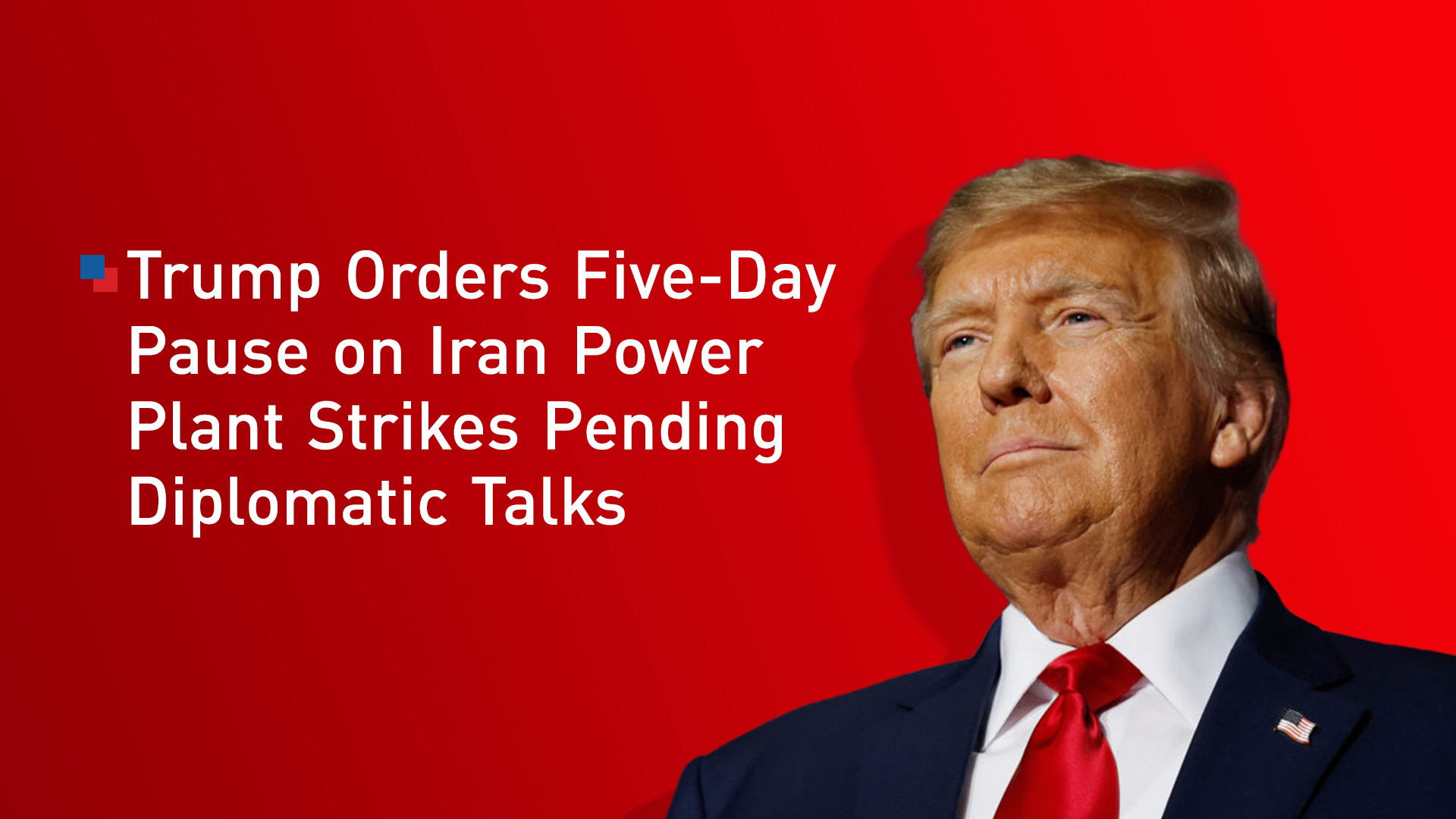
ERBIL (Kurdistan24) - U.S. President Donald Trump announced on Monday on his Truth Social platform that the United States and Iran have had very good and productive conversations regarding a complete and total resolution of hostilities in the Middle East.
In the post, President Trump stated, "I AM PLEASE TO REPORT THAT THE UNITED STATES OF AMERICA, AND THE COUNTRY OF IRAN, HAVE HAD, OVER THE LAST TWO DAYS, VERY GOOD AND PRODUCTIVE CONVERSATIONS REGARDING A COMPLETE AND TOTAL RESOLUTION OF OUR HOSTILITIES IN THE MIDDLE EAST."
The president instructed the Department of War to postpone any and all military strikes against Iranian power plants and energy infrastructure for a five-day period. The decision is subject to the success of the ongoing meetings and discussions that Trump said will continue throughout the week.
He added that "BASED ON THE TENOR AND TONE OF THESE IN DEPTH, DETAILED, AND CONSTRUCTIVE CONVERSATIONS, WITCH WILL CONTINUE THROUGHOUT THE WEEK, I HAVE INSTRUCTED THE DEPARTMENT OF WAR TO POSTPONE ANY AND ALL MILITARY STRIKES AGAINST IRANIAN POWER PLANTS AND ENERGY INFRASTRUCTURE FOR A FIVE DAY PERIOD, SUBJECT TO THE SUCCESS OF THE ONGOING MEETINGS AND DISCUSSIONS."
Trump described the conversations as in-depth, detailed and constructive. He noted that the tenor and tone of the exchanges formed the basis for the temporary postponement of planned strikes.
The announcement was issued directly via the president's Truth Social account. It referenced discussions held over the last two days between the United States and Iran.
The development follows earlier statements by Trump regarding potential military action.
In a previous post cited across multiple reports, Trump had warned that if Iran did not fully open the Strait of Hormuz without threat within 48 hours, the United States would hit and obliterate Iranian power plants starting with the biggest one first.
The Wall Street Journal reported that if such strikes were to occur, they would almost certainly target plants generating electricity from natural gas.
Around 80 percent of power generation in Iran came from natural gas as of 2023, according to the International Energy Agency, amounting to around 303,000 gigawatt-hours.
Total generation jumped by more than 65 percent between 2010 and 2023, the International Energy Agency said. Iran was the second largest electricity producer in the region behind Saudi Arabia in 2023, according to the same data cited by the Wall Street Journal.
One potential target identified in the Wall Street Journal report was the Damavand combined-cycle power plant southeast of Tehran. The facility has a capacity believed to be around 3,000 megawatts and likely accounted for as much as 4 percent of Iran’s total capacity in recent years.
Nuclear power accounts for a tiny fraction of Iran’s overall generation, though its Bushehr nuclear-power plant has already been ensnared in the war.
A drone struck a complex where the nuclear plant is located in recent days. Rafael Grossi, head of the International Atomic Energy Agency, said the nuclear power plant and its reactors were not damaged.
The postponement announcement comes as the conflict involving Iran, the United States and Israel entered its fourth week.
Air defense systems in the United Arab Emirates and Saudi Arabia intercepted Iranian missiles and drones early Sunday, officials said, according to AFP.
The United Arab Emirates Ministry of Defense stated that its air defenses were currently responding to incoming missile and drone threats from Iran. The sounds heard were the result of air defense systems intercepting missiles and drones, the ministry said.
Saudi Arabia’s defense ministry reported that air defense systems tracked three ballistic missiles launched toward Riyadh.
One missile was intercepted while two others fell in an uninhabited area, AP reported. Six drones targeting the kingdom’s eastern region were downed with no immediate casualties or damage confirmed, according to the same report.
Iranian missile strikes hit southern Israel late Saturday, causing injuries and significant structural damage, AFP and AP reported.
Missiles struck the cities of Arad and Dimona in Israel’s southern Negev region. A missile strike in Arad injured nearly 70 people and damaged at least 10 apartment buildings, AP said. Ten individuals were in serious condition.
AFP reported that 84 wounded people were transported to hospitals, citing Israel’s Magen David Adom emergency service. Emergency responders continued to search damaged buildings.
In Dimona, a separate missile strike wounded approximately 30 people, AP and AFP reported.
The missile landed several kilometers from Israel’s main nuclear research center, causing extensive damage to nearby residential buildings.
Israeli military spokesperson Brig. Gen. Effie Defrin said air defense systems operated but did not intercept at least one incoming missile. Air defense systems operated but did not intercept the missile; we will investigate the incident, he said.
Iranian officials stated the strikes were in response to earlier attacks on Iranian territory, including a reported strike on the nuclear enrichment facility at Natanz. The facility did not experience radiation leakage, according to Iranian authorities and the International Atomic Energy Agency, which confirmed no abnormal radiation levels were detected.
The death toll since the start of the conflict has exceeded 1,500 in Iran, more than 1,000 in Lebanon, 15 in Israel and 13 U.S. military personnel, AP reported. Millions of people have been displaced, particularly in Iran and Lebanon.
The conflict has extended into maritime zones. A projectile struck near a bulk carrier approximately 15 nautical miles north of Sharjah in the UAE, the United Kingdom Maritime Trade Operations center reported to AP.
The explosion caused concern but no injuries among the crew. The UAE joined 21 other countries in agreeing to contribute to efforts to secure the Strait of Hormuz, AFP reported. The group condemned attacks on commercial vessels and energy infrastructure and described the situation as a de facto closure of the strait by Iranian forces.
Iran has denied restricting maritime traffic while accusing Gulf states of facilitating U.S. military operations. Gulf governments have rejected these accusations, stating they would not allow their airspace or territory to be used to launch attacks against Iran.
The United States responded with military and economic measures. Trump warned that Iran must reopen the Strait of Hormuz within 48 hours or face further military action. Potential targets could include natural gas-powered electricity plants, the Wall Street Journal reported.
The Pentagon deployed three additional warships and approximately 2,500 Marines to the Middle East, marking the second such deployment within a week, AP reported. The U.S. administration temporarily lifted sanctions on certain Iranian oil shipments already at sea. Treasury Secretary Scott Bessent said the move would allow approximately 140 million barrels of oil to enter global markets.
Treasury Secretary Scott Bessent said the United States may need to escalate military operations against Iran to wind down the conflict.
"They’re not mutually exclusive. Sometimes you have to escalate to de-escalate. This is the only language the Iranians understand," Bessent said on NBC’s Meet the Press.
He defended the temporary lifting of sanctions on Iranian oil already loaded onto ships. "That Iranian oil was always going to be sold to the Chinese at a discount. So which is better? Oil prices spiking to $150 and Iran getting 70 percent, or prices below $100," Bessent added.
Oil prices surged early Monday. West Texas Intermediate for May delivery rose 1.8 percent to just over $100 per barrel before easing slightly. Brent crude reached $113.44 per barrel before retreating to around $111, according to market reports. The surge marked a dramatic increase from February 27 levels.
Iran vowed to irreversibly destroy key infrastructure across the Middle East if threats to target Iranian power plants were carried out.
"If the United States’ threats regarding Iran’s power plants are carried out... the Strait of Hormuz will be completely closed, and it will not be reopened until our destroyed power plants are rebuilt," the operational command Khatam al-Anbiya said in a statement carried by Iranian state television.
The military added that it would target Israeli energy facilities, ICT infrastructure and power plants in regional countries hosting U.S. bases.
Iran’s Foreign Ministry stated that the Strait of Hormuz remains open.
"Ships hesitate because insurers fear the war of choice you initiated—not Iran," Foreign Minister Abbas Araghchi said on X. No insurer—and no Iranian—will be swayed by more threats. Try respect, he added.
The Iranian Foreign Ministry on Monday reaffirmed that the Strait of Hormuz remains open to international shipping despite wartime restrictions. Navigation in the Strait of Hormuz is ongoing, taking into account the necessary measures and considerations arising from the state of war, the ministry said in a statement.
Israeli Chief of Staff Lt. Gen. Eyal Zamir described the conflict as reaching a midpoint. "We are at the midway point, but the direction is clear," he said, according to AP.
The conflict has also affected civilian infrastructure. A hospital and a tourist site in Iran’s Khuzestan province were damaged, resulting in at least one fatality, AP reported. In the occupied West Bank, missile fragments caused casualties and property damage. Four people were killed and nine injured, Palestinian authorities said.
This article was updated on Monday, March 23, 2026, at 02:52pm.