Trump Confirms Discussions Says Dealing With 'A Top Person,” Not Iran's Supreme Leader
When questioned about the identity of the Iranian official in these discussions, the U.S. President responded, "A top person. Don't forget. We've wiped out the leadership phase one, phase two, and largely phase three. But we're dealing with a man who I believe is the most respected and the leader."
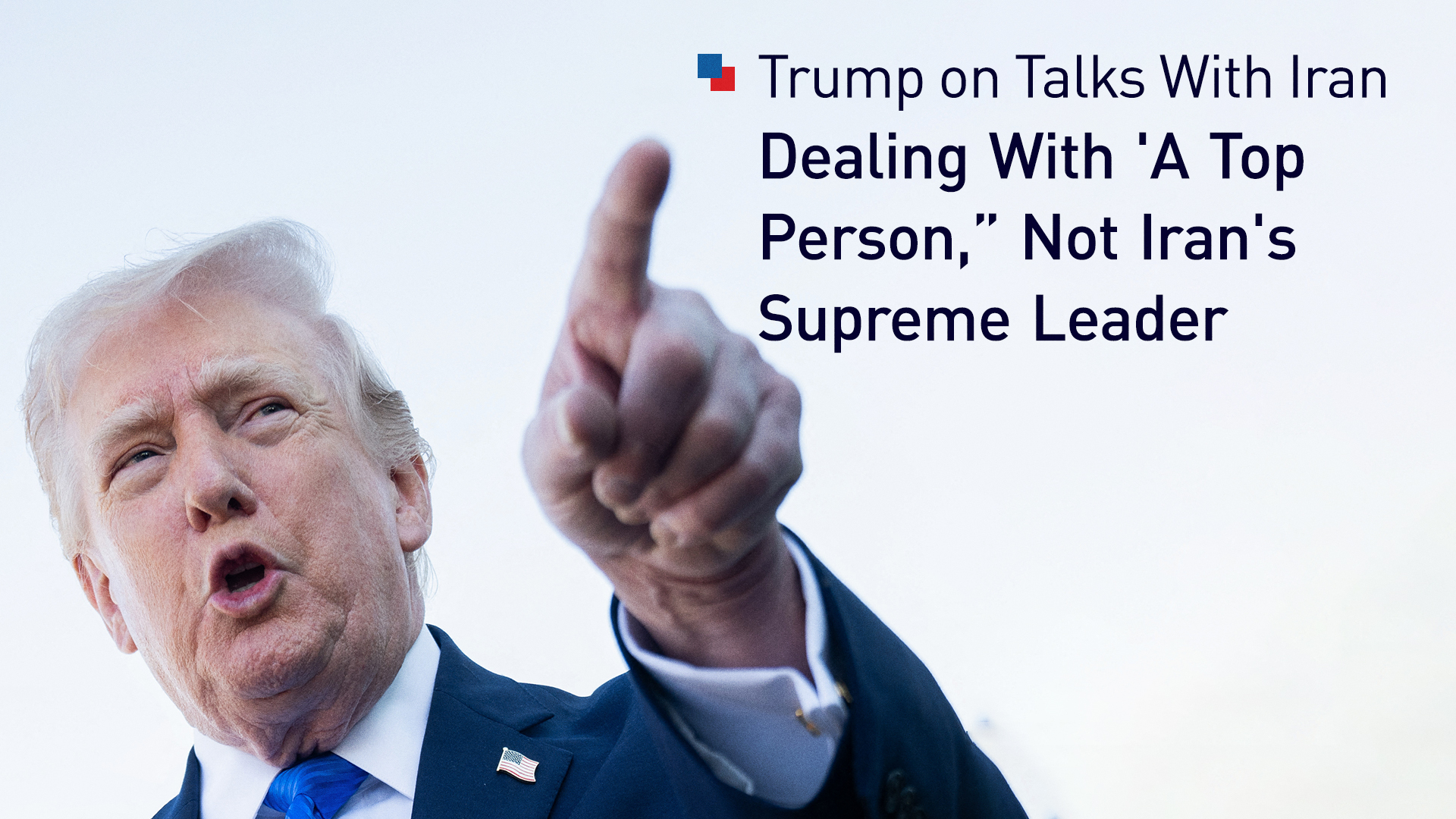
ERBIL (Kurdistan24) - U.S. President Donald Trump made the comments while speaking to reporters before boarding Air Force One on Monday, stating that discussions with an unidentified Iranian official are ongoing and that a five-day delay on military strikes against Iran remains contingent on reaching a settlement.
The U.S. President confirmed that initial communications occurred on Sunday and extended into Sunday evening. He indicated a mutual interest in reaching an agreement between the two nations.
"So, the discussions took place yesterday. They went into yesterday evening. They want very much to make a deal. We'd like to make a deal, too," the U.S. President told reporters.
According to the U.S. President, the two sides are expected to communicate again by telephone. He noted logistical difficulties regarding in-person meetings, stating, "We're going to get together today by probably phone, because it's very hard to find a country. It's very hard for them to get out, I guess. But we'll, at some point very soon, meet."
The U.S. President framed the current diplomatic window as a structured pause in military operations. "We're doing a five-day period. We'll see how that goes. And if it goes well, we're going to end up with settling this. Otherwise, we'll just keep bombing our little hearts," he stated.
When questioned about the identity of the Iranian official in these discussions, the U.S. President declined to name the individual but characterized him as a senior figure. He responded, "A top person. Don't forget. We've wiped out the leadership phase one, phase two, and largely phase three. But we're dealing with a man who I believe is the most respected and the leader."
The U.S. President also addressed the current state of the Iranian leadership structure, noting significant attrition among top officials. "You know, it's a little tough. They've wiped out — they've wiped out everybody," he said.
When reporters specifically asked if he was speaking with the Supreme Leader, the U.S. President clarified that he was not. He also addressed the status of the Supreme Leader's son. "No, not the Supreme Leader. We are — He's not much of a — Well, nobody's ever — nobody heard of the second Supreme Leader, the son," he remarked.
Regarding the nature of the communications and the status of the son, the U.S. President stated, "Are these direct calls? Nobody — we have not heard from the son. Every once in a while, you'll see a statement made, but we haven't. We don't know if he's living."
However, he expressed confidence in the authority of the individuals currently engaging with the United States. "But the people that seem to be running it — and they seem that based on, really, facts, because things they've said have taken place," the U.S. President said.
President Trump also explained that "There are many points of agreement with Iran right now like 15 points. They’re not going to have a nuclear weapon—that’s number one. That’s number one, two, and three. They will never have a nuclear weapon—they’ve agreed to that."
Reagrding the state of Strait of Hormuz, the U.S. President proposed a joint control of the waterway, saying, "It will be jointly controlled ... and maybe [controlled by] me... me and the Ayatollah, whoever the Ayatollah is, whoever the next Ayatollah is. And look there will also be a very serious from of regime change. In all fairness, everbody has been killed from the regime."
These remarks from Washington contrast directly with statements issued by Iranian officials. According to a Monday report by the Tasnim News Agency, a senior Iranian security official explicitly denied that any negotiations are occurring between Tehran and Washington.
The Iranian official stated that "no negotiations with Trump are taking place." According to this official, the U.S. decision to postpone strikes on Iranian infrastructure was not the result of diplomatic progress, but rather a consequence of "Iran's military threats" establishing credible deterrence.
The Iranian official acknowledged that communications had occurred but characterized them differently than the U.S. administration. "From the beginning of the war until today, messages have been sent to Tehran by various mediators, to which the clear response has been that we will continue our defense until the necessary level of deterrence is achieved," the official noted.
The official further emphasized that "no negotiations have been or are currently in progress," directly contradicting the U.S. President's account of the interactions.
According to the Iranian official, economic pressures also influenced the U.S. decision to delay military action. "Pressure from financial markets and the threat to bonds within the United States and the West has increased, and this was another significant factor behind this retreat," the official stated.
The official also indicated that the current maritime and economic disruptions would persist. "With this method of psychological warfare, neither will the situation in the Strait of Hormuz return to its pre-war state, nor will calm return to the energy markets," the Iranian representative added.
The conflicting narratives emerge during the fourth week of the ongoing conflict involving the U.S., Israel, and Iran. Previously, the U.S. President had utilized his Truth Social platform to announce that the Department of War was instructed to postpone planned strikes against Iranian power plants and energy infrastructure for a five-day period, citing "in depth, detailed, and constructive conversations."
Prior to this postponement, the U.S. had issued an ultimatum demanding the full reopening of the Strait of Hormuz within 48 hours, threatening to "hit and obliterate" Iranian power generation facilities if the demand was not met.
The diplomatic developments coincide with sustained military actions across the region. Recent operations have included Iranian missile and drone activity directed at the United Arab Emirates and Saudi Arabia, as well as missile strikes on southern Israel that resulted in structural damage and casualties in Arad and Dimona.
The U.S. has also increased its regional military presence, recently deploying three warships and approximately 2,500 Marines to the area.
The U.S. President confirmed ongoing discussions with an unnamed senior Iranian official, stating that a five-day pause in military strikes depends on reaching a settlement.
This article was updated on Monday, March 23, 2026, at 05:49pm.