The Long Walk to Safety: March 31 and Kurdistan’s Defining Exodus
Today in History: March 31, 1991 – Faced with a Ba’athist counter-offensive, one million Kurds fled their homes, trekking to the mountains and borders of Iran and Türkiye, sparking a historic humanitarian crisis that reshaped Kurdistan’s future.
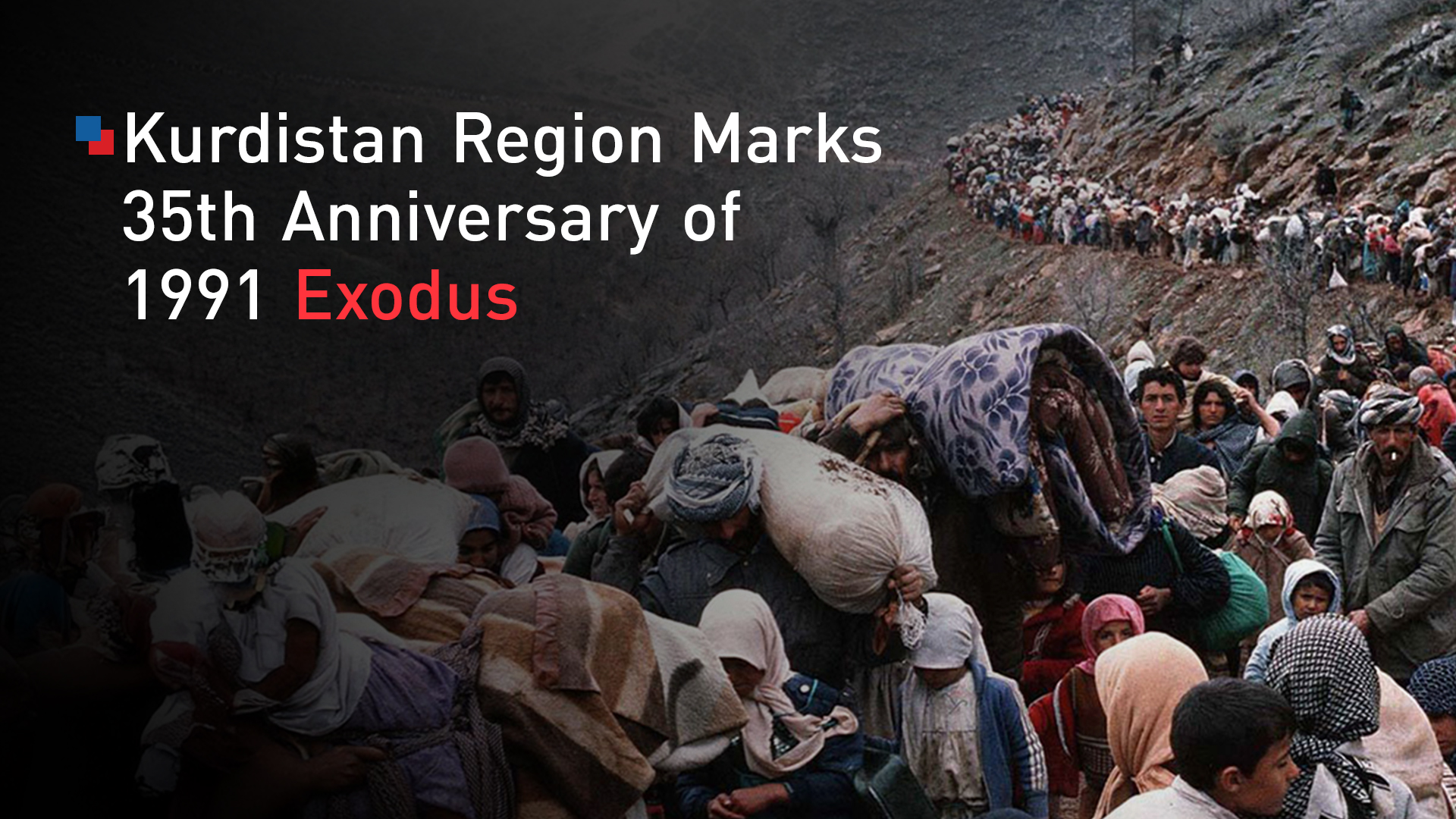
ERBIL (Kurdistan24) - Tuesday, March 31, marks the 35th anniversary of a mass migration involving approximately one million residents of the Kurdistan Region, an unprecedented demographic exodus triggered when the military forces of the fallen Ba'ath regime launched a massive, coordinated counter-offensive designed to reoccupy previously liberated regional territories, according to official commemorative statements released to mark the observance.
The documented accounts detailing the chronology of the 1991 Million-Person Exodus indicate that the widespread civilian displacement occurred in direct response to severe shifts in the regional military balance.
Following the initial and widespread success of the regional movement recognized as the 1991 Spring Uprising—a massive civil mobilization that successfully resulted in the rapid liberation of almost all districts and geographic areas across the Kurdistan Region—the central government in Baghdad fundamentally altered its military posture, the reports noted.
Officials stated that the Ba'ath regime systematically gathered and deployed heavily armed military formations with the explicit operational objective of retaking total administrative and physical control over the newly liberated zones.
This aggressive military mobilization escalated precisely ten days after local populations had successfully secured the liberation of the strategic city of Kirkuk during the early, highly active phases of the public uprising.
According to the chronological timeline provided in the commemorative release, the central government formally initiated its comprehensive counter-offensive on March 31, 1991.
The direct, rapid advancement of the Ba'athist armed forces into the liberated administrative areas presented the local civilian population with an immediate and severe existential choice.
Faced with the rapidly approaching military units and the prospect of remaining under what the institutional documentation describes as renewed systemic oppression, the overwhelming majority of the population residing within the borders of the Kurdistan Region resolved to abandon their ancestral lands and residential properties.
The subsequent mass migration fundamentally encompassed all geographic sectors of the Kurdistan Region.
Fleeing the imminent arrival of the central government's advancing military forces, hundreds of thousands of citizens—ultimately culminating in an estimated one million individuals—migrated outward in a sudden, massive wave of civilian displacement.
The official statements characterize this historical event not merely as a chaotic flight from regional conflict, but as a deliberate, collective rejection of political subjugation by the regional populace.
The logistics of this vast demographic movement were severely constrained by the sudden nature of the central military offensive.
According to the records, the displaced populations directed their movement primarily toward the mountainous international borders of the neighboring nations of Iran and Türkiye. The vast majority of these fleeing citizens were forced to undertake the grueling, dangerous journey entirely on foot, organizing into massive, vulnerable groups to traverse the difficult geographic terrain.
Concurrently, other segments of the retreating civilian population utilized civilian automobiles and various alternative means of mechanical transport to accelerate their arrival at the perceived safety of the Iranian and Turkish border perimeters.
The sudden mobilization of a million-person exodus migrating toward the international borders of Iran and Türkiye rapidly generated a profound diplomatic resonance at the highest global and international levels. The international community, confronted with the escalating scale of the humanitarian displacement, mobilized to formulate a coordinated structural response to the events unfolding across northern Iraq.
The official reports emphasize that global international powers were in fundamental agreement regarding the severity of the crisis, collectively viewing the coordinated military operations directed against the Kurdish people—which the documents specifically classify as a genocide—as a profound disgrace to humanity and a severe institutional failure of the international community during the 20th century.
Within this framework of urgent global diplomatic engagement, the national government of France emerged as a highly influential institutional actor in advocating for immediate international intervention.
French diplomatic personnel and senior political figures initiated a sustained, high-level lobbying effort directed specifically at the United Nations Security Council. The anniversary accounts distinctly highlight the primary, instrumental role played by Danielle Mitterrand, the wife of the French President at the time, François Mitterrand.
According to the stated historical records, she functioned as one of the key central figures in ensuring that the French state formally elevated the escalating Kurdish humanitarian issue before the United Nations Security Council, effectively catalyzing the diplomatic momentum required for a binding intervention.
This sustained international diplomatic pressure, heavily championed by the French structural lobbying efforts, ultimately yielded a historic and binding international security mandate. On April 5, 1991, the United Nations Security Council formally and officially adopted Resolution 688.
This critical international directive was explicitly designed and implemented to directly address the catastrophic humanitarian conditions and to mandate the immediate establishment of a formal Safe Haven for the internally displaced Kurdish populations.
The strategic drafting and territorial implementation of the security parameters associated with Resolution 688 involved direct, high-level coordination with senior executive officials from the United States government. The historical records specifically identify James Baker, who was serving at the time in his capacity as a senior advisor to United States President George H.W. Bush Sr., as a significant diplomatic architect in the subsequent geopolitical security arrangements.
The accounts state that Baker played a highly significant and central role in the complex negotiations that led to both the passing of Resolution 688 and the specific geographic definition of the 36th parallel as an internationally protected boundary. The successful implementation of this coordinated international decision succeeded directly in halting the ongoing acts of genocide directed against the civilian population by the central regime.
In order to enforce the strict parameters of the newly adopted United Nations resolution and to physically safeguard the legally defined Safe Haven situated geographically above the 36th parallel, an international military presence was rapidly organized and systematically deployed.
The global powers authorized the stationing of a substantial contingent of Coalition armed forces in the immediate region to ensure the physical protection of the displaced population attempting to seek refuge from the Ba'athist military elements.
According to the established international operational framework, these specialized Coalition military units were permanently stationed at the Incirlik Air Base, a strategic military installation located within the sovereign borders of Türkiye.
This specific international military deployment, which became formally recognized under the operational designation of Operation Provide Comfort, was also frequently referred to within the region as the "Hammer Force."
The physical presence of these heavily armed Coalition forces operating directly out of Türkiye provided the necessary and robust security umbrella required to definitively deter any further territorial advancements by the central regime's military elements.
With the official diplomatic demarcation of the 36th parallel and the active military enforcement of the No-Fly Zone by the Coalition forces stationed in Türkiye, the immediate security environment within the northern territories began to stabilize significantly.
The formal establishment of this internationally protected geographic territory directly prompted the displaced citizens to cautiously initiate their mass return journeys. The populations who had previously sought refuge at the mountainous borders of Iran and Türkiye began moving back toward their original birthplaces and residential homes in large numbers.
However, the published historical accounts specify that the mass return of the civilian population was not exclusively driven by the issuance of the United Nations resolutions or the immediate physical presence of international military forces.
The organized demographic return was heavily supplemented and facilitated by the direct, active encouragement and political mobilization efforts organized by the political coalition known as the Kurdistan Front.
Furthermore, the structural stabilization of the region was substantially reinforced through direct political engagement between regional Kurdish representatives and the central Iraqi government. The formal leadership of the Kurdish movement initiated a series of direct, high-level negotiations, an initiative which notably included a highly significant diplomatic visit by the Kurdish leadership directly to Baghdad.
The documents indicate that these formal talks with the central authorities were absolutely instrumental in creating a necessary, foundational degree of trust among the returning civilian population. The negotiations provided vital political reassurances to the public that the regime of Saddam Hussein would not be in a strategic or operational position to repeat such extensive, devastating military crimes against the local populations in the future.
The secure, stabilized environment facilitated by the combined deployment of the international armed forces and the newly established domestic political frameworks fundamentally paved the way for the creation of formal democratic governance institutions within the protected region.
Operating under the strict security umbrella provided by the Coalition forces sent to protect the people during their organized return, regional authorities were able to systematically organize comprehensive democratic electoral processes. According to the historical timeline provided by officials, this complex institutional process culminated when the region successfully held the formal Kurdistan Region parliamentary elections on May 19, 1992.
Following the successful conclusion of the parliamentary elections, the newly elected regional representatives moved swiftly to establish a formal administrative and executive structure designed to govern the internationally protected territories. This institutional and political development reached its final foundational conclusion with the formal and official establishment of the Kurdistan Regional Government on July 4, 1992.
The geographic and administrative legacy of the international interventions of 1991 remains a permanently defining feature of the current regional political structure today.
The official documents confirm that the internationally recognized 36th parallel and the associated No-Fly Zone initially established by the United Nations Security Council directly defined the exact territorial borders that are presently governed under the official civilian authority of the Kurdistan Regional Government.