The Day Baghdad Wrote Exile Into Law: Feyli Kurds and the Mechanics of Dispossession
On April 4, 1980, Saddam’s regime deported and dispossessed the Feyli Kurds, killing thousands and confiscating wealth. Recognized as genocide in 2010, their exile and erasure left lasting scars on Iraqi society and ethnic and religious components' rights.
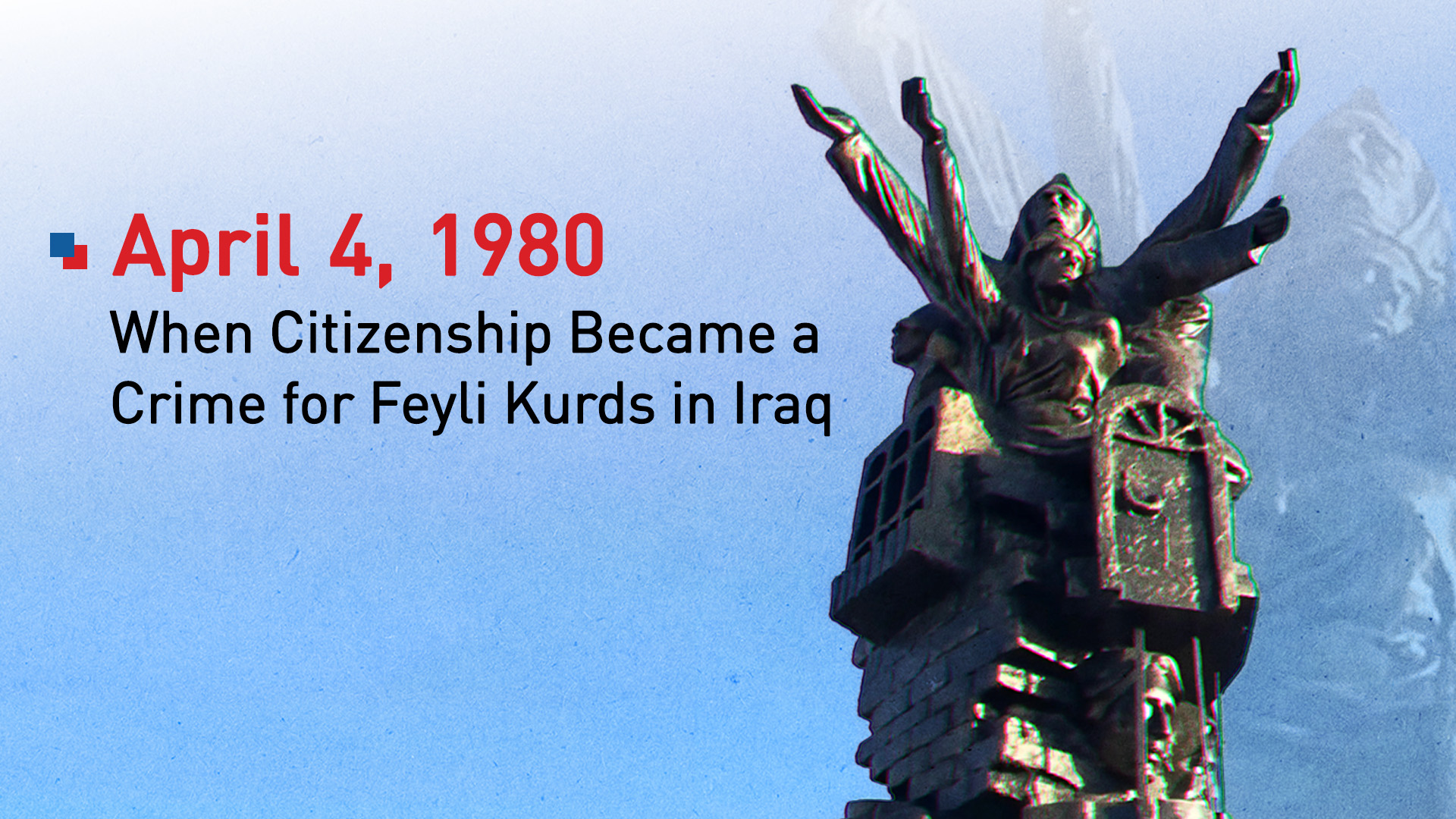
ERBIL (Kurdistan24) - To walk through the labyrinthine alleys of Baghdad’s Shorja market in the mid-twentieth century was to navigate the commercial beating heart of Mesopotamia. Here, amid the heavy scent of cardamom, the vibrant displays of imported textiles, and the rhythmic clatter of coppersmiths, a distinct and flourishing community held sway. The Feyli Kurds, a demographic component whose ancestral roots lay in the rugged foothills of the Zagros Mountains straddling the Iran-Iraq border, had migrated to the Iraqi capital over successive generations.
By the nineteen-seventies, they had transformed themselves into the city’s indispensable merchant class. They controlled vital supply chains, managed lucrative import-export enterprises, and established a socioeconomic prominence that belied their relatively modest numbers. Yet, it was precisely this prominence, intertwined with the immutable facts of their ethnic and sectarian identity, that would soon precipitate their near-total erasure from the Iraqi landscape.
Forty-six years ago today, on April 4, 1980, the Iraqi state, then firmly in the grip of the Baath Party and newly under the absolute grip of Saddam Hussein, initiated a campaign of deportation, dispossession, and enforced disappearance against the Feyli Kurds that remains one of the most chillingly bureaucratized atrocities of the modern Middle East.
Over the ensuing months and years, an estimated three hundred thousand to five hundred thousand Feyli Kurds were stripped of their citizenship, herded onto military transport vehicles, and driven across heavily mined borders into neighboring Iran. Simultaneously, the state apparatus systematically detained tens of thousands of young Feyli men, the vast majority of whom were swallowed by the regime’s subterranean prison system, never to be seen again.
Viewed through the retrospective lens of history, the events of April 1980 represent far more than a localized project of demographic engineering. They constituted the crucible in which the Baathist regime forged the administrative and legal mechanisms of ethnic cleansing.
The systematic persecution of the Feyli Kurds established a devastating blueprint—a dark procedural rehearsal—for the state-sponsored genocidal campaigns that would follow, including the mass disappearances of the Barzani clan in 1983 and the catastrophic Anfal campaign of 1988. To understand the origins of the Iraqi state’s weaponization of citizenship, one must examine the meticulous, paranoid logic that led to the dismantling of the Feyli community.
The vulnerability of the Feyli Kurds was embedded in the complex intersection of their identity. As ethnic Kurds, they were linked by blood and culture to the restive northern populations that had long resisted the centralizing dictates of Baghdad. Prominent Feylis were known to be active in opposition movements, including the Kurdistan Democratic Party and the Iraqi Communist Party.
At the same time, as adherents predominantly to Shiite Islam, the Feylis shared a sectarian bond with the majority population of southern Iraq. In the eyes of the Baathist intelligence apparatus, which was overwhelmingly dominated by a Sunni Arab elite reliant on tribal and regional loyalties, the Feylis represented a potent, multifaceted threat. They were a people whose wealth afforded them influence, whose ethnicity tied them to Kurdish struggle in the north, and whose religion linked them to the profound unrest brewing across the eastern border.
The geopolitical tectonic plates of the region had shifted violently the previous year.
The 1979 Islamic Revolution in Iran, which culminated in the establishment of a Shiite theocracy under Ayatollah Ruhollah Khomeini, deeply unsettled the psuedo-secular, nationalist, proto-fascist Ba’athist government.
Saddam Hussein viewed the reverberations of the Iranian revolution as an existential threat to his rule. He began to perceive Iraq’s Shiite populations, and the Feyli Kurds in particular, as a potential fifth column—an internal adversary that might harbor sympathies for the new regime in Tehran.
The immediate catalyst for the regime’s fury occurred on April 1, 1980.
During a public gathering at Al-Mustansiriya University in Baghdad, assailants threw a grenade at Tariq Aziz, the Iraqi Deputy Prime Minister and a close confidant of Saddam Hussein. Aziz survived, but the regime moved swiftly to assign blame, attributing the assassination attempt to the Islamic Dawa Party, an Iran-backed Shiite political organization.
The state’s retaliation was not merely swift; it was categorically expansive. Within seventy-two hours, the Mukhabarat, Iraq’s feared internal security service, initiated mass roundups of Feyli Kurds across Baghdad and the eastern provinces of Diyala, Wasit, and Maysan. The state opted for collective punishment, visiting the sins of a perceived political enemy upon an entire demographic category.
To execute this mass expulsion with a veneer of administrative legitimacy, the regime did not have to invent a new legal framework; it simply weaponized a preexisting one.
The architecture of Feyli exclusion traced its origins back to the foundational days of the modern Iraqi state, specifically the Iraqi Nationality Law of 1924, drafted during the era of the British Mandate. The 1924 legislation categorized residents into two distinct classes based on their registry in the 1920 census: those holding Ottoman citizenship and those holding Persian citizenship. Because the Ottoman Empire had historically subjected its citizens to gruelling military conscription, many Feyli Kurds living in the porous borderlands during the late nineteenth and early twentieth centuries had registered as Persian subjects to protect their sons from the draft.
Consequently, despite having inhabited the Mesopotamian plains and the Zagros foothills for centuries, generations of Feyli Kurds inherited a precarious, second-class legal status. They were officially designated as "citizens of Iranian origin" or holders of taba’iyya (subjecthood).
Following the Baath Party’s seizure of power in 1968, the state had periodically exploited this legal loophole, engaging in intermittent deportations in 1970 and 1974 during moments of political friction. But the campaign launched on April 4, 1980, was unprecedented in its absolute totality.
The Revolutionary Command Council (RCC), the supreme executive body of the Baathist state, retroactively codified the expulsions in May 1980 by issuing Resolution 666. This decree authorized the Ministry of Interior to unilaterally revoke the Iraqi nationality of any person of "foreign origin" deemed to be "disloyal to the homeland, the people, and the supreme national and social objectives of the Revolution."
The language of the resolution was deliberately vague, providing the security services with an infinitely elastic mandate to arrest, strip, and exile.
The mechanics of the deportation were characterized by a chilling, industrialized brutality.
According to extensive archival records, scholarly analyses, and testimonies gathered by organizations such as the Kurdistan Memory Programme, state security forces launched highly coordinated raids on Feyli neighborhoods.
Armed officers descended upon homes in the dead of night, raided bustling merchant stalls in the Shorja market, and pulled students directly from their university classrooms. Families were frequently given only minutes to gather whatever belongings they could carry in their arms.
At localized detention centers and border checkpoints, the bureaucratic apparatus of erasure went to work. Authorities systematically confiscated identity documents, passports, birth certificates, and property deeds. Stripped of all legal identification, the deportees were transformed instantly into stateless phantoms.
They were then loaded onto flatbed military trucks, transported to the Iranian border, and forced to cross into neighboring territory at gunpoint. The terrain they were forced to navigate was unforgiving.
Testimonies collected by human rights agencies detail harrowing forced marches through rugged, heavily militarized, and densely mined mountain passes. Elderly individuals, pregnant women, and young children, deprived of food, water, and shelter, frequently succumbed to exposure, exhaustion, or the sudden, catastrophic detonation of landmines during the crossing.
Yet, expulsion was only one facet of the Baathist strategy; the campaign was equally a project of monumental state-sponsored theft. Parallel to the physical removal of the Feyli people, the Revolutionary Command Council issued supplementary decrees mandating the immediate seizure of all movable and immovable assets belonging to the deportees.
The scope of the confiscation was staggering. It encompassed prime residential real estate in Baghdad, vast commercial holdings, factory infrastructure, retail inventory, and the contents of countless bank accounts. The Ministry of Finance and various state-run real estate entities were tasked with overseeing the liquidation and redistribution of these assets.
Scholars of Middle Eastern economic history note that this massive, forced transfer of wealth served a dual purpose for the regime. It effectively neutralized a prominent, independent segment of the Iraqi merchant class, eliminating a center of economic power that existed outside the state’s direct control.
Simultaneously, it provided the regime with an immense reservoir of stolen wealth with which to purchase the loyalty of its domestic base. Confiscated Feyli properties were routinely awarded to Baath Party officials, military officers, and regime loyalists at drastically reduced prices, or simply gifted outright as patronage ahead of the looming Iran-Iraq War.
The regime’s effort to obliterate the Feyli presence extended deep into the most intimate spheres of private life. In an astonishing intrusion into the sanctity of the family, the RCC issued Resolution 474 in 1981, which offered a financial bounty of four thousand Iraqi dinars to any Iraqi man who divorced his wife if she was classified as being of "Iranian origin."
The state effectively incentivized the tearing apart of marriages and the fracturing of mixed-heritage families, weaponizing the law to enforce an ethnic and sectarian purity.
As devastating as the deportations and the economic ruin were, the most profound trauma inflicted upon the Feyli Kurds on April 4, 1980, and the days that followed, was the targeted, systematic separation of families.
While women, young children, and the elderly were expelled across the border, the state deliberately held back the young men. An estimated ten thousand to twenty thousand Feyli males—typically ranging in age from eighteen to thirty, though older men and teenagers were also taken—were detained by security forces.
As the transport trucks departed for the Iranian frontier, the air was filled with the agonizing cries of mothers and wives watching their sons and husbands being led away by armed guards.
These men were absorbed into the black hole of the Baathist carceral state.
Archival evidence indicates that they were transferred to notorious holding facilities, including the subterranean cells of the Directorate of General Security in Baghdad, the sprawling Abu Ghraib prison, and the desolate Nugra Salman fortress, a remote detention center located in the unforgiving southern desert.
The ultimate fate of these men remains one of the darkest, most agonizing chapters of modern Iraqi history. For decades, their families living in exile clung to the desperate hope that the men were being held in secret labor camps, or perhaps conscripted as prisoners of war. However, following the U.S.-led liberation of Iraq in 2003 and the subsequent collapse of the Baathist regime, the unearthing of mass graves and the recovery of internal intelligence documents provided a grim and horrifying clarity.
Forensic investigators, human rights advocates, and international scholars have concluded that the vast majority of the detained Feyli men were subjected to mass, extrajudicial executions. Furthermore, chilling testimonies and tribunal records have cited evidence indicating that some Feyli detainees were utilized as human test subjects in the development of chemical and biological weapons by the Iraqi military-industrial complex during the grueling eight-year war with Iran.
For the survivors who managed to reach Iran, the trauma of expulsion was immediately compounded by the outbreak of the Iran-Iraq War in September 1980.
The deported Feylis arrived as stateless refugees in a country that was rapidly mobilizing for a massive, existential conflict with the very nation that had just expelled them. They were funneled into desolate refugee camps, such as those located in Jahrom and Azna, where they lived in precarious, impoverished conditions.
Their legal and social status in Iran was profoundly ambiguous.
As stateless persons, they lacked formal legal protections, the right to secure legal employment, and freedom of movement. While the Iranian government accommodated them as refugees, authorities often viewed them with suspicion.
Despite their Shiite faith, their Iraqi origins and distinct cultural identity left them marginalized within their host country. This state of legal and social limbo persisted for decades, producing a generation of Feyli Kurds who were born, raised, and educated in the shadow of exile, lacking recognized citizenship in the nation of their ancestry or the nation of their refuge.
The fall of Saddam Hussein in 2003 opened narrow, fraught avenues for legal redress and historical reckoning, though the process has proven agonizingly complex.
In 2006, the newly formed Iraqi parliament passed a revised nationality law specifically designed to restore citizenship to those who had been stripped of it under the draconian mandates of Resolution 666. Yet, the bureaucratic reality of proving identity and ownership after nearly three decades of intentional state erasure was a labyrinthine nightmare.
Original civil registry records had been destroyed, altered, or lost. The properties that the Feylis had once owned in Baghdad and the eastern provinces had long since been occupied, legally transferred, or redeveloped by others. For many returning Feylis, the physical, economic, and social landscape of their former lives had been irrevocably obliterated.
A significant milestone in the pursuit of transitional justice was reached on November 29, 2010.
Following extensive hearings and the presentation of survivor testimonies and archival evidence, the Iraqi High Criminal Court formally recognized the deportation, dispossession, and mass killing of the Feyli Kurds as an act of genocide and crimes against humanity.
This landmark judicial ruling, which was subsequently endorsed by the Iraqi Parliament in 2011, offered a profound measure of historical validation to a community that had suffered in silence for decades. The tribunal convicted several high-ranking former Baathist officials for their roles in orchestrating the 1980 campaign, including Tariq Aziz and Saadoun Shakir, cementing the legal record of the state's culpability.
Nevertheless, human rights advocates and Feyli political representatives consistently emphasize that legal recognition, while vital, cannot undo the structural violence inflicted upon the community. The material and social damages unleashed on April 4, 1980, have yet to be fully repaired.
Decades of systemic marginalization, combined with the permanent loss of their traditional commercial and cultural hubs, have left the Feyli community struggling to reclaim its pre-1980 standing within the mosaic of Iraqi society.
The systematic persecution of the Feyli Kurds stands today as a somber historical testament to the extreme vulnerabilities of ethnic or religious component populations operating under totalitarian regimes. It was not a chaotic byproduct of wartime paranoia, but a cold, calculated, state-sponsored effort to erase an entire demographic from the national fabric.
Crucially, the bureaucratic methodologies refined during the Feyli deportations—the use of executive resolutions to manufacture legal cover, the mobilization of multiple state ministries to execute mass asset confiscation, and the systematic separation and extermination of military-aged males—served as the procedural foundation for the genocidal campaigns that would ravage Iraq later in the decade.
The legacy of April 1980 continues to resonate through contemporary Iraq, casting a long, unyielding shadow over the enduring complexities of transitional justice, the deep intergenerational scars of statelessness, and the devastating permanence of bureaucratized terror.