The Sanctuaries of Spring: Ecology and Memory in the Mountains of Kurdistan
Spring awakens the Zagros: in Barzan and Sherwan, Kurdish communities revive ancient forests, protect wildlife, and honor a century-old legacy of ecological stewardship—a landscape of resilience where history, culture, and nature intertwine.
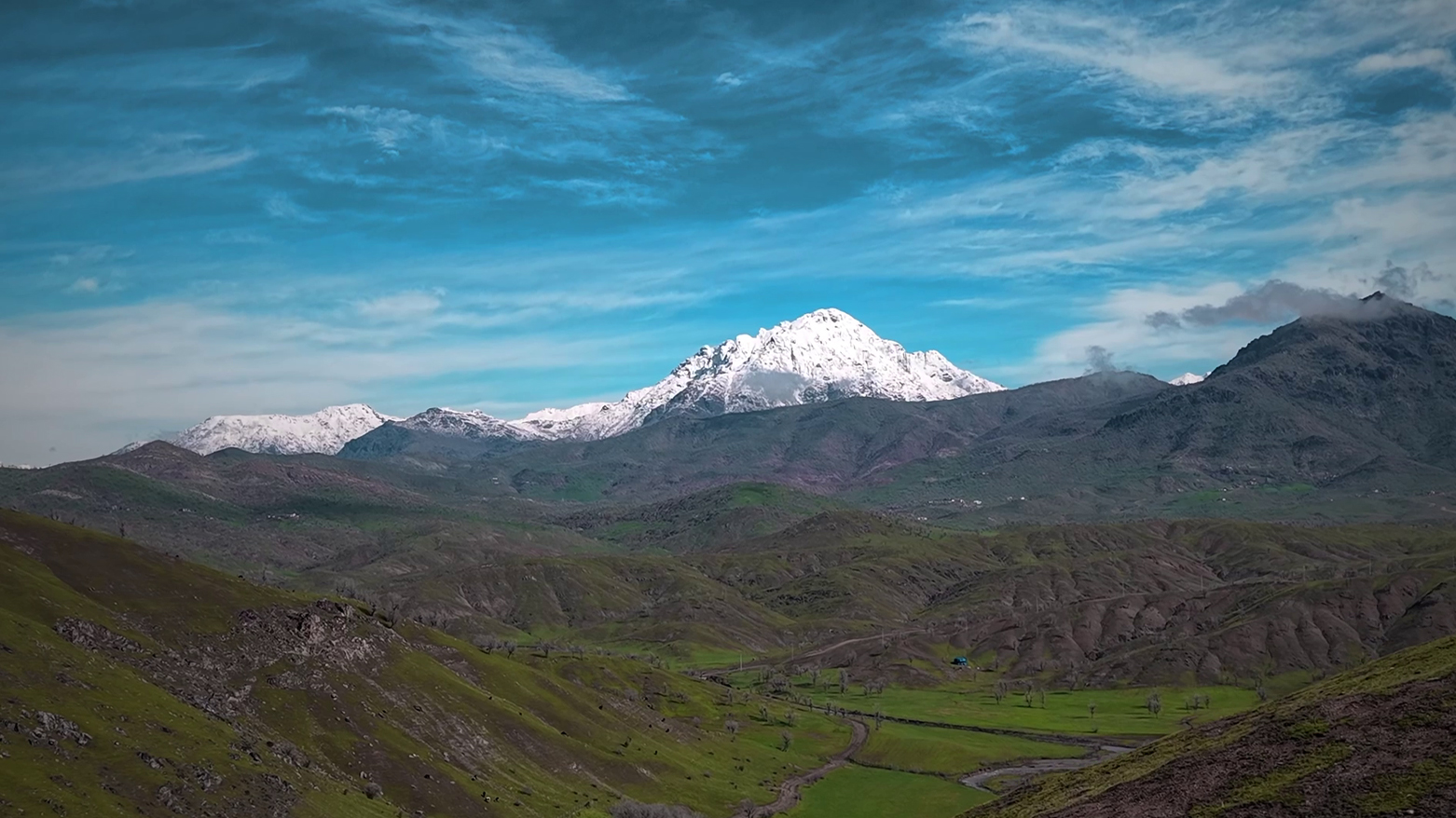
ERBIL (Kurdistan24) - To witness the arrival of spring in the Zagros Mountains is to understand the mechanics of resurrection. For much of the winter, the precipitous peaks that define the Kurdistan Region are locked in a forbidding monochrome, buried under heavy snows that sever remote villages from the valleys below. But as March approaches, the atmospheric theater shifts. The snowpack begins to fracture and weep, sending a chaotic symphony of meltwater down limestone ravines. By the time the vernal equinox arrives—heralded across the region as Newroz, the Kurdish New Year—the landscape has undergone a violent, verdant transformation.
Nowhere is this seasonal alchemy more profound than in the rugged, intertwined territories of Barzan and Sherwan, situated in the northernmost reaches of the Erbil Governorate. Here, the Greater Zab River, swollen with icy runoff, carves a serpentine path through deep gorges, its roar echoing against canyon walls.
Above the riverbanks, the mountainous terrain of Sherwan rises in formidable, terraced slopes. The aridity that characterizes much of the broader Middle East is entirely absent here. Instead, the air is thick with the loamy scent of damp earth and the fragrant bloom of wild almond and hawthorn trees.
The hillsides become a fleeting, vivid tapestry.
Groves of ancient Brant’s oak (Quercus brantii) push forth tender, lime-green shoots. Beneath the canopy, the forest floor erupts with flora endemic to the Zagros: wild rhubarb (Rêwas), native orchids, and the strikingly melancholic Fritillaria imperialis—the inverted tulip, known locally as the "gulşilêr," whose bell-like crimson flowers hang heavily toward the soil.
For the local Kurdish communities, this explosion of life is not merely a seasonal shift; it is a vital economic and cultural awakening. Families venture into the high pastures of Sherwan to forage for wild spring greens like kenger (gundelia) and sirish (wild garlic), continuing a subsistence choreography that has sustained their ancestors for millennia.
Yet, to observe the natural abundance of the Barzan and Sherwan regions is to confront a striking ecological anomaly. Across much of Iraq, the environment is in a state of cascading crisis.
The United Nations consistently ranks Iraq among the countries most vulnerable to the impacts of climate change, plagued by desertification, vanishing marshlands, and severe drought. Even within the more temperate Kurdistan Region, unregulated development, deforestation for winter firewood, and overhunting have left deep scars on the landscape.
Barzan, however, remains a sanctuary.
On a given spring morning in the Sherwan heights, one might spot a herd of Bezoar ibex confidently navigating a sheer cliff face, unbothered by the proximity of human settlements. Brown bears forage in the dense thickets, and camera traps have occasionally confirmed the presence of the elusive, critically endangered leopard.
The rivers remain rich with endemic trout. The forests are dense and un-pillaged.
This flourishing biodiversity is not an accident of geography, nor is it the result of modern, state-imposed conservation programs. Rather, it is the legacy of an indigenous environmental philosophy implemented nearly a century ago by Sheikh Ahmed Barzani.
Born in 1896, Sheikh Ahmed was the spiritual and tribal leader of the Barzan region, and the older brother of Mullah Mustafa Barzani, the foundational figure of the modern Kurdish national movement.
In the annals of Middle Eastern history, Sheikh Ahmed is primarily remembered as a leader of early rebellions against the British mandate and the Iraqi monarchy. However, among environmental historians and Kurdish scholars, he is recognized as an improbably prescient pioneer of ecological conservation.
In the 1920s and 1930s, decades before environmentalism coalesced into a global movement, Sheikh Ahmed issued a series of binding tribal decrees aimed at preserving the natural world of the Barzan and Sherwan territories.
His edicts were specific, uncompromising, and revolutionary for their time. He strictly forbade the cutting of living trees, particularly the slow-growing oaks that anchor the mountain soil. Dead wood could be harvested for fuel, but the living forest was to be left untouched.
His mandates extended to wildlife with equal rigor. Hunting was tightly regulated to maintain ecological equilibrium. It was strictly prohibited to kill pregnant animals, to hunt during breeding seasons, or to ambush animals at drinking springs—an act he viewed as a profound violation of natural fairness.
Furthermore, Sheikh Ahmed banned the use of dynamite and poison for fishing in the Greater Zab and its tributaries, destructive practices that were devastatingly common in the region at the time.
The origins of Sheikh Ahmed’s environmentalism were deeply rooted in his adherence to the Naqshbandi order of Sufi Islam, which emphasizes a profound asceticism and an intimate, respectful connection to the divine creation. For Sheikh Ahmed, the mountains were not a resource to be ruthlessly exploited, but a sacred trust. To desecrate the environment was to commit a moral offense against the Creator.
This spiritual stewardship was married to a pragmatic understanding of the harsh Zagros environment: the Kurds, whose famous proverb asserts they have "no friends but the mountains," relied on the integrity of these ecosystems for their very survival. Destroying the forests and depleting the wildlife would ultimately destroy the people.
Today, nearly a century after those edicts were handed down, the ethos of Sheikh Ahmed permeates the cultural consciousness of Barzan and Sherwan, and the wider Kurdistan.
The decrees transitioned from tribal mandates to a deeply ingrained social contract. In these communities, environmental protection relies less on the formal policing of the Kurdistan Regional Government and more on a fierce, localized self-regulation. To cut a green tree or poach an ibex in Barzan is not merely illegal; it is a profound social taboo, a betrayal of local identity and ancestral memory.
This cultural devotion to the land is inextricably linked to the region’s traumatic history. The Barzan area was the epicenter of the Ba’athist regime’s genocidal campaigns in the 1980s.
During the Anfal campaign, and the specific 1983 roundups of the Barzani tribes, thousands of men and boys were disappeared and murdered. Villages in Sherwan and Barzan were systematically dynamited, and forests were intentionally burned or chemically defoliated by the Iraqi military to deny Kurdish Peshmerga fighters cover.
Because the destruction of the environment was a central tactic of the genocide against the Kurds, the restoration and protection of that environment has become an act of profound resistance. When surviving families returned to the ruined valleys of Barzan in the 1990s, after the establishment of the autonomous Kurdish enclave, they did not just rebuild their homes; they consciously allowed the land to heal.
The strict enforcement of Sheikh Ahmed’s environmental laws was resurrected alongside the villages. Replanting oak saplings and protecting returning wildlife became synonymous with the survival of the Kurdish identity.
As spring deepens into April, the full weight of this history and resilience is palpable across the Sherwan ridges. The snowline retreats further up the jagged peaks of the Zagros, revealing high alpine meadows that soon flood with nomadic shepherds moving their flocks to summer pastures.
The cyclical rhythm of this migration is deeply harmonious with the limits of the land. The shepherds, inheritors of a century-old ecological mandate, tread lightly, leaving the wild habitats undisturbed.
In the tradition of examining how geography shapes human destiny, the story of the Barzan and Sherwan mountains offers a profound counter-narrative to the prevailing environmental despair of the twenty-first century.
It demonstrates that effective ecological stewardship does not always require the bureaucratic apparatus of a modern state, nor does it have to be imported from Western conservationists. Sometimes, the most resilient environmentalism is born from the synthesis of indigenous spirituality, traumatic historical memory, and a community’s profound, existential love for its home.
As the sun sets over the Greater Zab valley, turning the limestone cliffs of Sherwan a bruised, incandescent purple, the evening air cools quickly.
The calls of partridges echo from the brush, and the silhouette of an ibex stands momentarily frozen on a distant ridge. It is a landscape that has endured war, displacement, and the slow violence of a changing climate.
Yet, in the vibrant, thrumming vitality of the Kurdish spring, the mountains remain unbowed—a living monument to a people who chose to protect the land that has, for centuries, protected them.