PM Barzani Extends Easter Greetings, Reaffirms Commitment to Coexistence
Masrour Barzani extended Easter greetings to Christian communities in Kurdistan, Iraq, and worldwide, reaffirming the Kurdistan Regional Government’s commitment to coexistence, peace, and the protection of all communities.
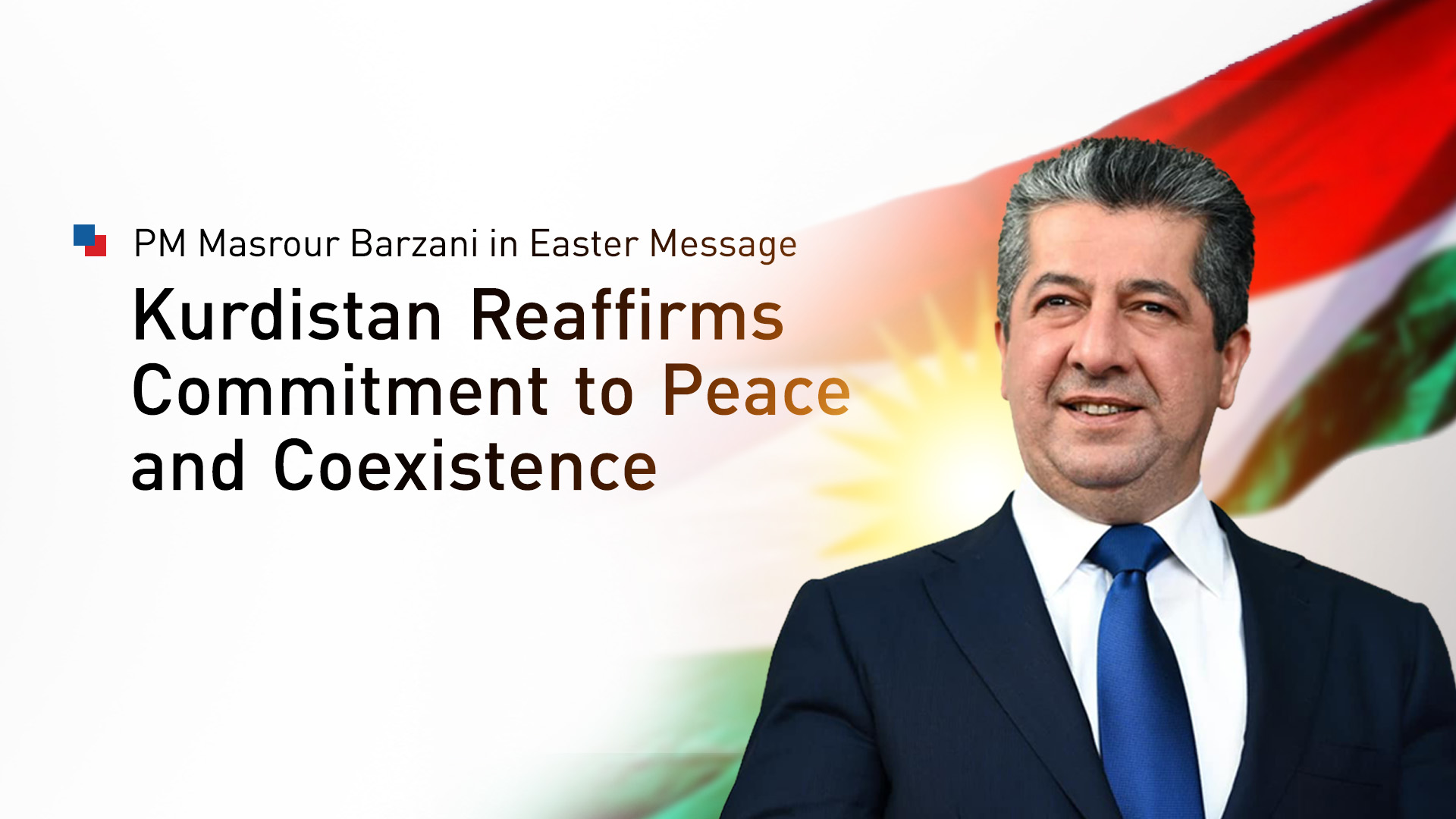
ERBIL (Kurdistan24) - Kurdistan Region Prime Minister Masrour Barzani on X, on Sunday, extended Easter greetings to Christian communities in the Kurdistan Region, Iraq, and worldwide, reaffirming the Kurdistan Regional Government’s stated commitment to coexistence, peace, and the protection of all communities, according to a statement posted on the platform.
“Happy Easter to our Christian brothers and sisters in Kurdistan, Iraq, and around the world,” Barzani said in the message. “On this blessed occasion, we reaffirm our commitment to Kurdistan’s historic culture of coexistence and to peace and the protection of all our communities.”
Happy Easter to our Christian brothers and sisters in Kurdistan, Iraq, and around the world.
— Masrour Barzani (@masrourbarzani) April 5, 2026
On this blessed occasion, we reaffirm our commitment to Kurdistan’s historic culture of coexistence and to peace and the protection of all our communities. pic.twitter.com/I5jshSvrKE
The statement comes as official measures have long been taken by the Kurdistan Regional Government (KRG) to mark Easter, including the designation of April 5–7, 2026, as public holidays for Christians across government institutions, according to KRG announcements.
The decision enables Christian citizens to observe the religious holiday, widely regarded as the most significant feast in the Christian calendar, without administrative or workplace constraints.
Officials have described such measures as part of a broader institutional framework aimed at promoting religious tolerance and inclusion. The Kurdistan Region formally recognizes multiple religious and ethnic communities, including Assyrian, Chaldean, and Armenian Christians, within its administrative and legal systems.
The KRG’s approach to coexistence is codified in several legal instruments, most notably Law No. 5 of 2015 on the Protection of the Rights of Communities. The legislation establishes guarantees for the preservation of cultural and religious identity, prohibits discrimination, and affirms equal political participation for recognized groups, according to official documentation.
Dindar Zebari, the KRG Coordinator of International Recommendations, has previously stated that the law operates alongside other frameworks, including the Declaration on the Rights of Nations, Religions and Religious Sects and the Law on Official Languages, to reinforce protections for minority communities.
These provisions, officials say, promote “the spirit of respect, tolerance and coexistence among the citizens of KRI,” as outlined in government human rights planning materials.
Institutional mechanisms also support the implementation of these policies.
The Ministry of Endowment and Religious Affairs, through its Directorate of Religious Affairs and Coexistence, oversees initiatives aimed at fostering interfaith dialogue and supporting religious education. These include programs for Syriac-language instruction, reflecting the linguistic and cultural heritage of Christian communities in the Region.
Senior Kurdish officials have consistently emphasized the centrality of diversity within the Region’s governance model. At the 2025 National Prayer Breakfast, President Masoud Barzani, Kurdistan Region President Nechirvan Barzani, and Prime Minister Masrour Barzani each delivered remarks underscoring this theme.
President Masoud Barzani, in his remarks, emphasized that this marked the first time such a gathering had been organized in Kurdistan, designed to introduce the world to the Region’s longstanding tradition of tolerance, freedom of belief, and interfaith acceptance. These values, he noted, are not recent developments but are deeply rooted in Kurdistan’s heritage.
“The culture of peaceful coexistence and mutual respect is something we are proud of and determined to preserve,” he said.
Speaking to a diverse audience of guests from across the globe and within the country, PM Masrour Barzani thanked participants for making the inaugural event a success, describing it as an occasion that surpassed all expectations.
“I can tell you, it’s not only been successful—it has exceeded my expectations,” PM Barzani said. At the heart of PM Barzani’s message at the event was a celebration of Kurdistan’s cultural and religious diversity. “We belong to different religions, we belong to different faiths, but differences in our religions do not divide us—they unite us in the search for divinity,” he said. “This is what makes us Kurdistanis, and we are proud of our diversity.”
Kurdistan Region President Nechirvan Barzani, during his address at the same event, described religious and cultural plurality as “a source of our strength, stability, and pride,” while highlighting the Region’s response to the displacement crisis during the ISIS conflict. According to his remarks, mosques and schools were opened to Christian and Yezidi displaced persons in 2014, and the Region hosted more than two million displaced individuals.
Public observance of Easter in the Kurdistan Region typically includes large gatherings across churches in Erbil, Duhok, and Sulaimani, where thousands of worshippers participate in religious services. These events take place under the protection of regional security forces, including the Peshmerga, according to reports, and often feature visits by government officials expressing solidarity with Christian communities.
The KRG has also introduced structural provisions aimed at ensuring minority representation within political institutions. These include reserved quota seats for ethnic and religious communities in the Kurdistan Parliament, as well as designated government positions such as a Minister for Communities. Officials say these measures are intended to institutionalize inclusion within the Region’s governance framework.
The Region formally recognizes multiple faiths, including Christianity, Yezidism, and Zoroastrianism, among others. Authorities have stated that this recognition is reflected not only in legal protections but also in public policy decisions, such as the acknowledgment of religious holidays and support for community institutions.
Prime Minister Barzani’s Easter message aligns with similar statements issued in previous years by Kurdish leadership, in which religious occasions have been used to reiterate commitments to coexistence and unity. Officials have described these recurring messages as part of an ongoing effort to reinforce the Region’s identity as a pluralistic society.
While observers have noted challenges in the implementation of some policies, official statements and administrative practices indicate a continued emphasis on coexistence as a guiding principle of governance in the Kurdistan Region.
PM Barzani’s message on Sunday reiterated that position, linking the observance of Easter to broader commitments outlined by the KRG in its legal and institutional frameworks.
This article was updated pn Sunday, Apr. 5, 2026, at 09:39am.