Trump and Pope Leo XIV Clash Over Iran War and Moral Authority
An American pope confronts an American president: Donald Trump and Pope Leo XIV clash over Iran, exposing a rare split between moral doctrine and transactional power as a fragile ceasefire underscores their global influence.
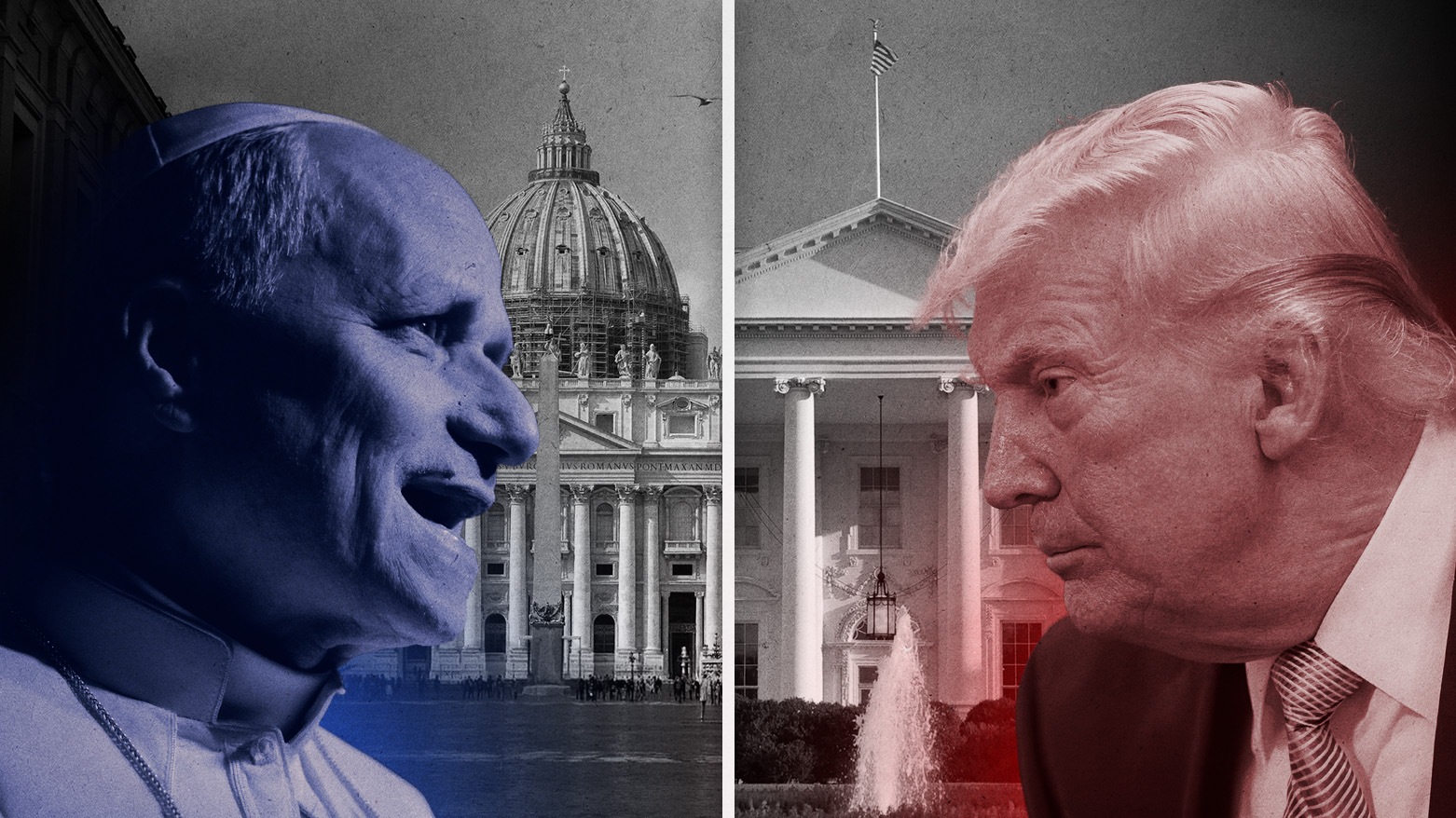
ERBIL (Kurdistan24) - A brief exchange of papal words in St. Peter’s Square on a spring evening in Rome has come to sit uneasily alongside the machinery of war still unfolding across the Middle East. Hours before a fragile cease-fire announcement in the Iran conflict, Pope Leo XIV described U.S. threats against Iran as “truly unacceptable,” an unusually direct moral censure aimed at the American president at a moment of acute geopolitical tension.
The comment, delivered to reporters during an unscheduled encounter in Vatican City, followed President Donald Trump’s warning that Iranian infrastructure—including power plants and bridges—could be targeted if Tehran failed to comply with U.S. demands over maritime passage in the Strait of Hormuz. The pontiff’s intervention, according to reporting by The New York Times, framed the issue not only in political terms but as a violation of “international law” and a “moral question concerning the good of the people as a whole.”
Within hours, Trump announced a two-week cease-fire agreement, coupled with a declaration that his administration was advancing toward what he described as a “definitive agreement concerning long-term peace with Iran,” according to official statements cited by U.S. outlets.
The convergence of these events has sharpened a rare dynamic in contemporary international politics: two Americans, occupying vastly different institutions of global authority, shaping—through language, doctrine, and influence—the moral and strategic framing of an escalating war.
A transatlantic moral challenge from the Vatican
The confrontation between the White House and the Vatican has not emerged abruptly. It has been building since the election of Leo XIV last year, the first American-born pontiff in the Catholic Church’s two-millennia history.
As The Wall Street Journal has reported, Pope Leo XIV has sought to reassert the Vatican’s traditional role as a defender of the post-World War II international order, warning that global politics was increasingly defined by the normalization of force.
“War is back in vogue,” the pope told ambassadors earlier this year, according to the Journal. The statement, delivered in a marble hall above St. Peter’s Basilica, reflected a broader Vatican concern that the erosion of legal and diplomatic constraints on state violence was accelerating amid conflicts in Ukraine, the Middle East, and beyond.
Pope Leo XIV’s critique has extended beyond abstract principles.
According to Vatican officials cited in multiple reports, he has explicitly opposed framing the Iran war in religious terms and has rejected efforts by parts of the Trump administration to cast military action as divinely sanctioned.
War Secretary Pete Hegseth’s public calls for prayer “in the name of Jesus Christ” for battlefield success were later criticized by the pope, who said such invocations distort the Christian tradition by aligning it with violence.
Escalation, rhetoric, and contested legitimacy
The latest exchange occurred against a backdrop of intensifying rhetoric surrounding the Iran conflict.
Trump, in social media posts cited by The New Yorker, warned that “a whole civilization will die tonight,” language that drew condemnation from lawmakers and international observers even as it was later followed by a cease-fire announcement.
In the same reporting, analysts described a widening gap between diplomatic processes and the language of coercion being deployed alongside them. The administration’s approach, according to The New Yorker, has been characterized by critics as “transactional,” prioritizing immediate strategic leverage over long-term diplomatic architecture.
Pope Leo’s response has consistently emphasized restraint and negotiation.
In his Tuesday remarks, he urged a return to dialogue, telling reporters: “Come back to the table. Let’s talk. Let’s look for solutions in a peaceful way,” according to The New York Times.
Historical context and institutional divergence
The Vatican’s position reflects longstanding doctrinal continuity rather than a departure into political partisanship.
Catholic scholars cited in reporting by the Associated Press emphasized that papal opposition to war is rooted in centuries of theological and legal tradition, including the Church’s engagement with the development of international humanitarian norms and the Geneva Conventions.
Yet the specificity of Pope Leo XIV’s criticisms—particularly his willingness to reference contemporary U.S. policy decisions—marks a notable departure from the more generalized critiques of his predecessors.
Analysts cited by AP described the tone as unusually direct for a pontiff addressing a sitting American president.
The divergence between the two figures is also institutional.
Trump’s approach to foreign policy, as described in The New Yorker’s analysis of his administration, has emphasized rapid escalation, coercive signaling, and the use of overwhelming force to reshape adversaries’ behavior.
The pope’s framework, by contrast, is rooted in what Vatican officials describe as a defense of international legal norms and the moral limits of state power.
A fractured American global influence
The confrontation has also underscored a broader fragmentation in American global influence, with competing sources of authority emerging from within the United States itself.
Leo XIV’s position as a U.S.-born pontiff has complicated the traditional assumption that Vatican diplomacy functions as an external moral counterweight to Washington.
As The Wall Street Journal noted, Pope Leo XIV’s cultural and linguistic familiarity with American society has made his interventions unusually legible within U.S. political discourse, reducing the interpretive distance that often softens papal criticism when it originates abroad.
At the same time, the domestic resonance of his statements has sharpened political divisions.
Catholic leaders in the United States, according to AP reporting, have expressed both alignment with the pope’s humanitarian framing of immigration and concern among conservative factions over perceived encroachment on national sovereignty debates.
Geopolitical implications and uncertain trajectory
The immediate impact of the papal intervention on the cease-fire remains difficult to isolate. Trump’s announcement followed shortly after Pope Leo XIV’s remarks, but officials have not attributed causality to Vatican pressure.
Still, analysts quoted in The New Yorker and AP reporting suggest that the convergence of diplomatic pressure, military escalation, and public moral criticism has created a more volatile decision-making environment.
Iran, meanwhile, continues to frame the conflict in existential terms, with state-linked narratives emphasizing resistance and historical memory of the Iran-Iraq War as a foundation for long-term endurance. Western analysts caution that these narratives, combined with asymmetric military capabilities, could prolong instability even under formal cease-fire conditions.
Closing uncertainty
For now, the cease-fire halts active escalation without resolving the underlying disputes that led to it. The Vatican has called for sustained negotiations, while the White House has signaled continued engagement through conditional diplomacy.
What remains unresolved is not only the trajectory of the Iran conflict, but the broader question raised by the rare public exchange between the White House and the Vatican: how moral authority, military power, and international law interact when they are articulated simultaneously from two of the most globally visible American voices.
Whether that tension produces restraint or further fragmentation will depend less on rhetoric than on whether the fragile pause in hostilities develops into a durable diplomatic framework—or collapses under the pressures that preceded it.